A fully automatic screen printing machine uses the selective permeability of the screen stencil. Image areas of the mesh allow ink to pass through. Non-image areas are blocked. A squeegee presses the ink and moves it across the screen. This transfers the pattern onto the substrate.
Core components
A fully automatic screen printing machine has five components.
Screen stencil
The mesh surface has open holes only in the image area, allowing ink to pass through. The non-image area is sealed.
Squeegee
The squeegee presses the ink and controls its flow direction.
Printing table
A support platform that holds the substrate, such as a cosmetic bottle.
Ink
Selected according to the substrate material.
Substrate
The surface on which the pattern is printed.
Ink transfer mechanism
Ink filling
Ink is placed at one end of the screen stencil.
Squeegee pressure
The squeegee contacts the ink area of the screen under pressure and moves toward the other end.
Selective penetration
As the squeegee moves, ink passes only through the open mesh in the image area. The sealed non-image area blocks it.
Contact control
The squeegee maintains line contact with the screen and substrate. This ensures precise ink transfer to the target position.
Effect of tension and rebound force
Screen tension
The tension of the screen produces a rebound force. This creates a moving line contact between the screen and the substrate.
Separation state
In non-contact areas, the screen separates from the substrate. This prevents ink from spreading beyond the image area.
Snap-off movement
The rebound force allows the ink to separate quickly from the screen. This ensures sharp print edges.
Single printing cycle
Squeegee movement
The squeegee completes ink pressing and pattern transfer.
Screen lifting
After the squeegee lifts, the screen stencil separates from the substrate.
Ink recovery
The squeegee gently scrapes the remaining ink back to the starting position.
Cycle completion
The substrate is discharged or enters the next printing stage.
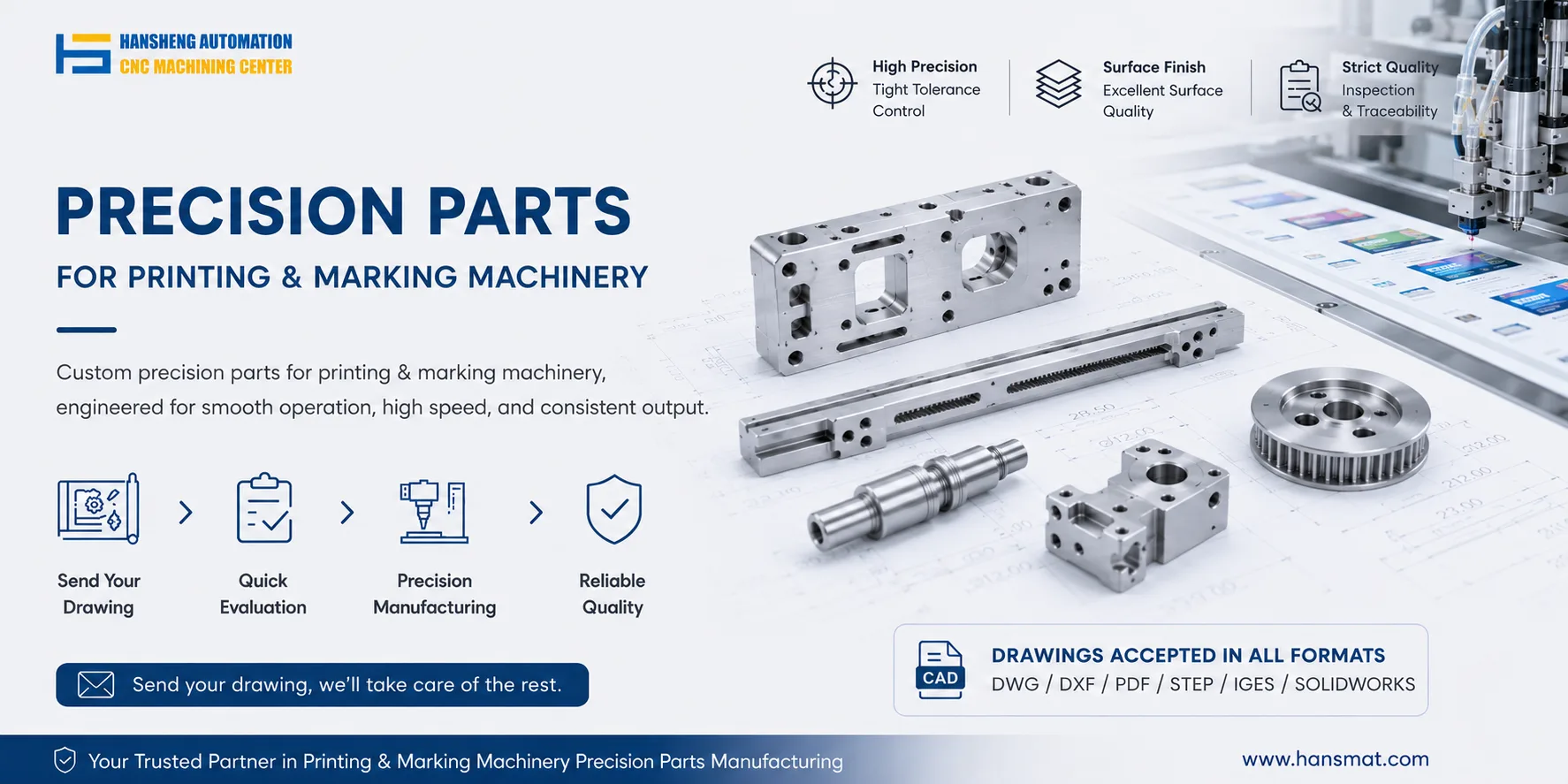
This process enables high-precision pattern reproduction. It is used in cosmetic packaging, electronic component marking, and other applications. For replacement or optimization of non-standard squeegees, screen frames, or tension adjustment blocks in these machines, Hansheng Automation provides custom machining based on customer drawings or sample parts.