Wafer handling robots adopt a five-axis design rather than a six-axis design mainly because five axes fully meet the specific requirements of wafer transfer while achieving a better balance in cost, complexity, reliability, and cleanliness.
1. Matching Operational Requirements
The core motions in wafer handling are horizontal movement along the X/Y axes, vertical movement along the Z axis, rotation around the θ axis, and slight tilt adjustment. A five-axis design already covers all these movements and can accurately perform standard tasks such as picking and placing wafers from vacuum chambers and transferring them between equipment. Adding a sixth axis, usually a redundant wrist rotation, does not improve operational capability but instead creates unnecessary burden.
2. Cost and Complexity Control
Each additional motion axis requires extra core components such as servo motors, reducers, and encoders, as well as more complex control algorithms and wiring. This directly increases manufacturing cost and also makes system debugging and maintenance more difficult and time-consuming. A five-axis design maximizes cost efficiency while still meeting functional requirements.
3. Space and Interference Avoidance
Equipment layouts in wafer fabs are extremely compact, and the robots usually move along fixed tracks. The more flexible wrist movement of a six-axis robot actually increases the risk of collision and interference with surrounding precision equipment in tight spaces. The motion path of a five-axis robot is easier to predict and control, providing better production safety.
4. Cleanliness Assurance
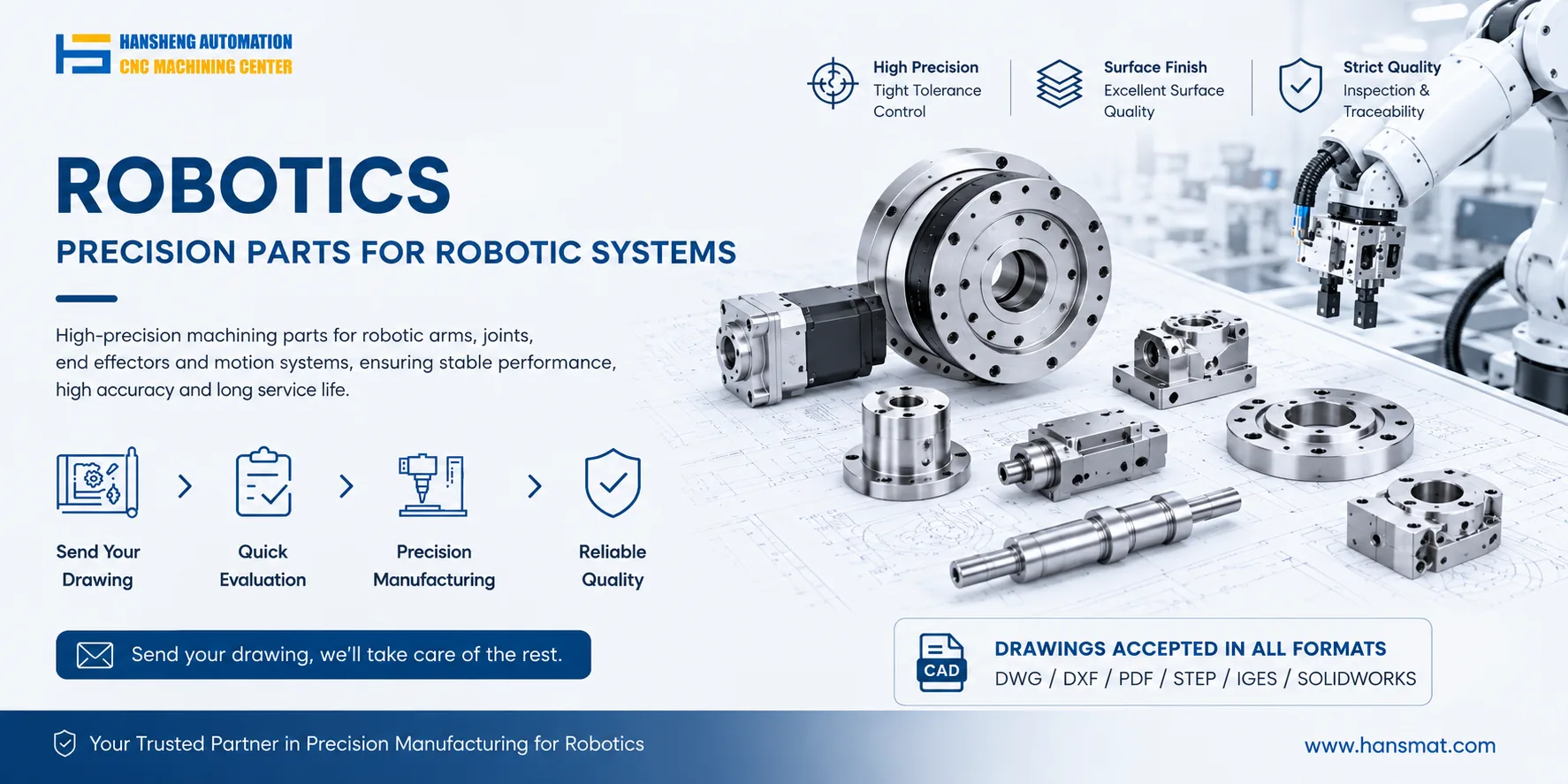
Semiconductor fabs have extremely strict cleanliness requirements, such as ISO Class 4 or higher. Every motion joint is a potential source of particle contamination. A simpler five-axis structure means fewer mechanical connections and moving parts, fundamentally reducing particles generated by friction and lubrication, which helps maintain an ultra-clean environment. For cleanroom-critical mechanical parts that require high dimensional accuracy and low particle generation, Hansheng Automation provides custom machining services based on customer drawings, supporting prototype development and small-batch production.
5. Reliability and Stability
Generally, the simpler the structure, the lower the failure rate. Because of its simpler mechanical structure and control logic, a five-axis robot can provide higher reliability and a longer mean time between failures in semiconductor production lines that run 24 hours continuously, ensuring production continuity.