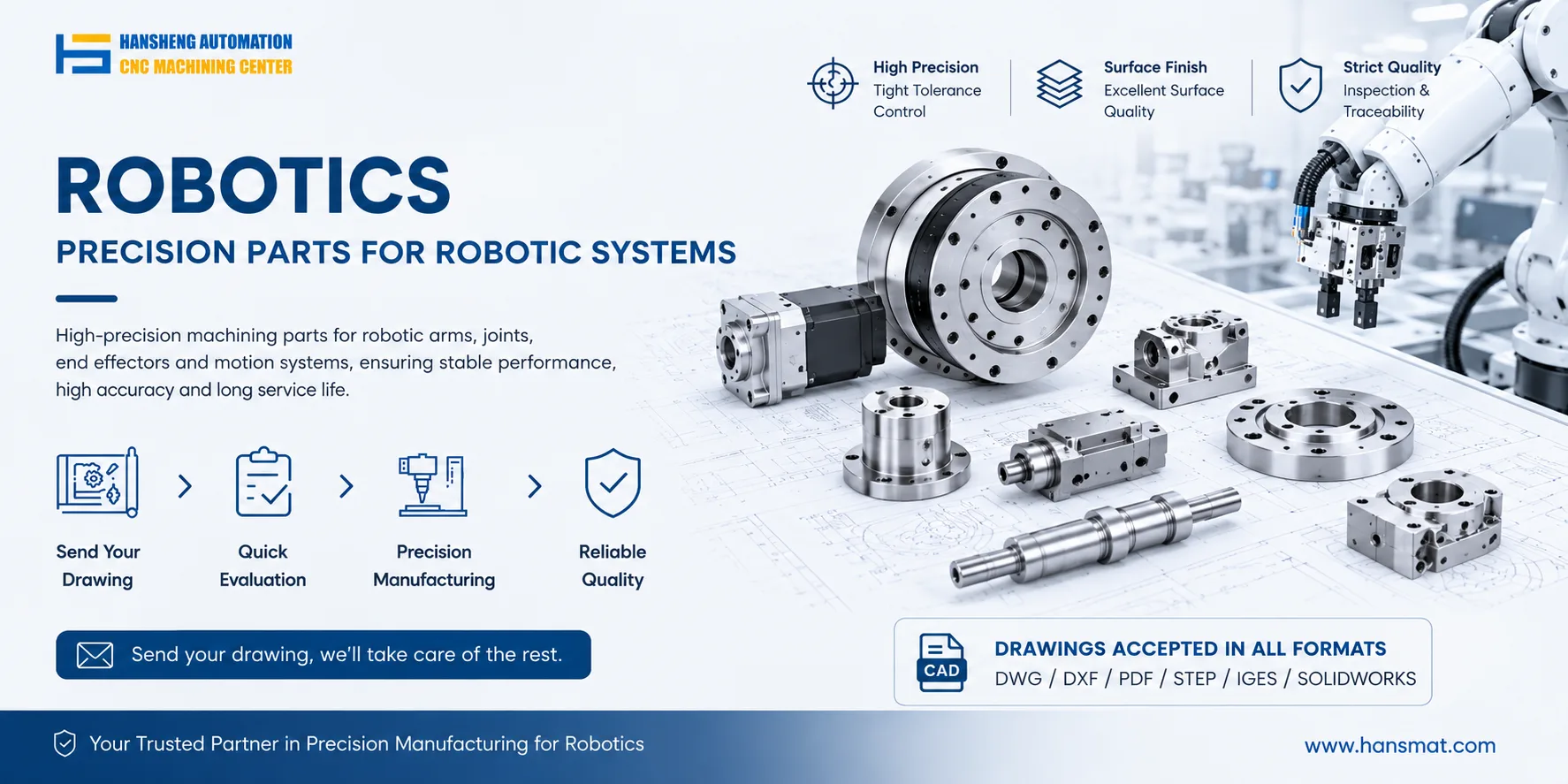
Industrial robots are applicable to a wide range of manufacturing scenarios. Based on their primary operational functions, these applications can be grouped into five mainstream categories. Each category imposes different requirements on robot precision, payload, speed, and environmental adaptability, which must be considered during selection.
1. Welding Operations
This includes both arc welding and spot welding. Robots precisely control welding current, voltage, travel speed, and oscillation parameters, ensuring consistent seam quality and stability, significantly improving productivity and reducing defect rates. Typical applications are found in automotive body welding, construction machinery structural parts, and hardware fabrication. For non‑standard weld seams or special workpieces, we can supply custom‑designed welding torch holders and collision‑sensor interfaces based on drawings, enhancing process compatibility.
2. Material Handling and Palletizing
Robots perform fast and accurate transfer, stacking, and depalletizing of heavy or bulk materials, replacing manual labor in high‑intensity repetitive handling. Common in logistics warehouse palletizing, PCB loading/unloading in electronics manufacturing, and finished‑product stacking in food and beverage industries, with payload capacities ranging from a few kilograms to several hundred kilograms.
3. Precision Assembly
Leveraging high repeat positioning accuracy (up to ±0.02 mm) and force feedback, robots can precisely assemble small components such as gears, bearings, and connectors, improving assembly consistency and cycle time. Widely used in consumer electronics (smartphones, watches), automotive parts (engine assemblies), and precision instruments (sensors, optical modules). For precision assembly tasks, we can design and manufacture high‑rigidity grippers, vacuum suction cups, and locating trays to ensure micron‑level part grasping and alignment accuracy.
4. Surface Spraying
Robots apply paints or powders uniformly and stably, avoiding uneven thickness, sags, or missed areas common in manual spraying, while also reducing operator exposure to hazardous solvents and dust. Major applications include automotive body painting, furniture surface coating, and anti‑corrosion treatment of hardware parts, often requiring explosion‑proof design and corrosion‑resistant protection.
5. Grinding and Polishing
Robots perform standardized grinding, deburring, and polishing on metal (e.g., aluminum, stainless steel) or plastic surfaces, achieving consistent surface roughness and improving product appearance and subsequent plating/paint adhesion. This application is concentrated in surface finishing of hardware products, sanitary fittings, phone frames, and plastic housings.
These five categories represent the most mature application areas for industrial robots today. In practice, they can be extended to inspection, cutting, injection‑molding pick‑and‑place, and more. Proper selection of robot type and supporting tooling can significantly enhance production line flexibility and overall operational efficiency.