Pulping machines fall into three main groups by scale: home, commercial, and industrial. Within those groups, four working principles dominate: blade cutting, hammer impact, abrasive disc grinding, and screw extrusion.
Home Pulping Machines
Blade-Type Blenders
Blade-type blenders use sharp blades spinning at high speed to cut ingredients. Speed usually ranges from 10,000 to 30,000 rpm, with power from 300 to 1,500 W. They suit smoothies, milkshakes, sauces, and baby food. Prices range from about RMB 200 to 800.
High-Speed Blenders
High-speed blenders run at up to 48,000 rpm and use blunt blades to break ingredients by impact rather than slicing. Power ranges from 1,200 to 2,200 W. They break cell walls to release nutrients and can handle hard ingredients such as ice cubes and whole fish. Prices range from RMB 800 to 3,000.
Commercial Pulping Machines
High-Speed Centrifugal Type
This type uses a stainless steel filter screen to separate juice from pulp. Juice yield is 70 to 85 percent, with throughput of 50 to 200 kg per hour. It suits juice shops processing high-water fruits such as apples and oranges.
Slow Screw Press Type
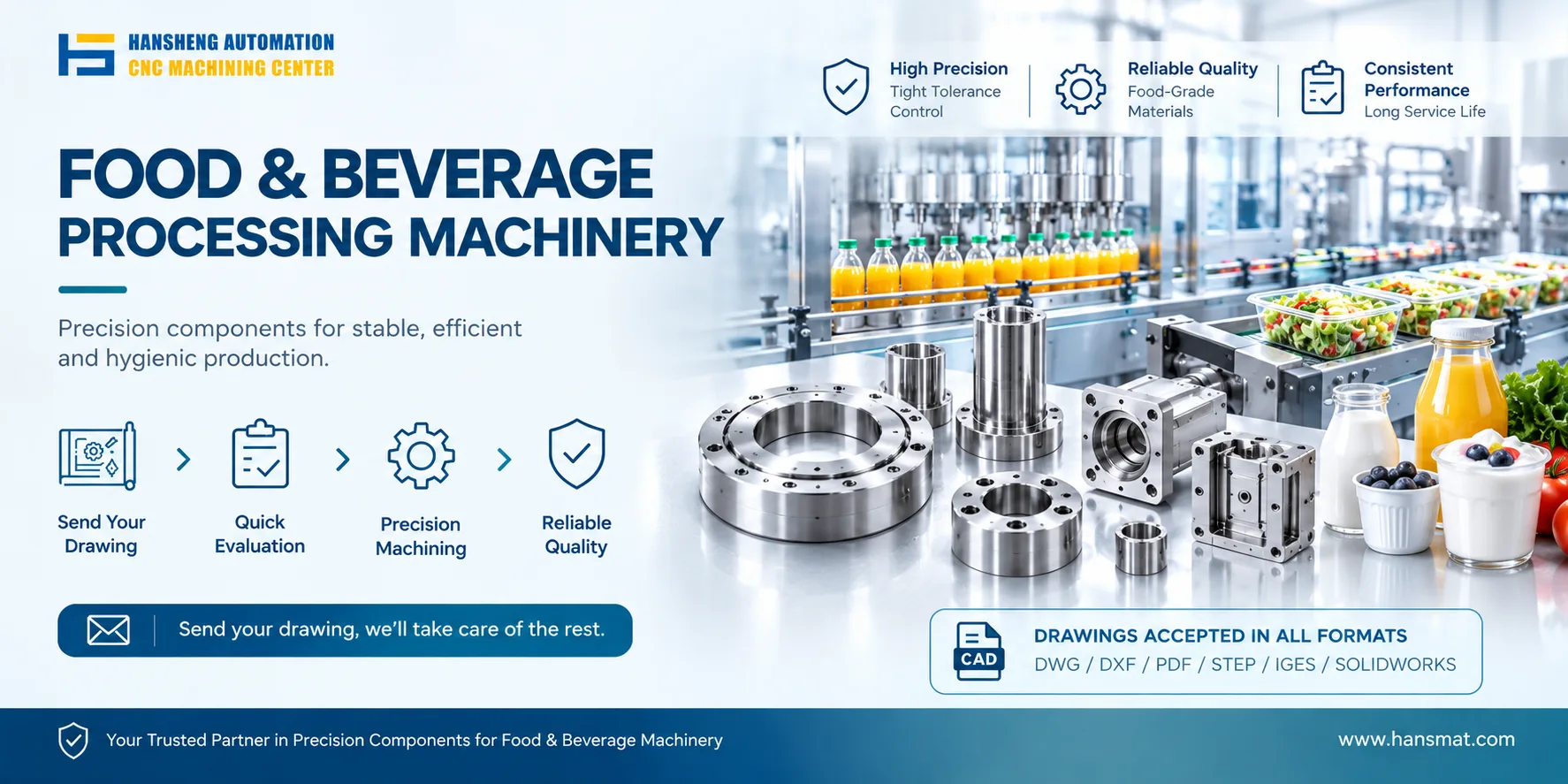
A screw turns at low speed, around 80 rpm, to press and grind material. Juice yield is 85 to 95 percent, and more nutrients are retained. It suits fibrous ingredients such as ginger and celery. Prices range from RMB 3,000 to 8,000. Hansheng Automation can machine replacement screws, filter screens, and wear parts for these machines to customer drawings.
Industrial Pulping Machines
Hammer Mills
Hammer mills use high-speed hammers to strike material. Throughput ranges from 500 to 2,000 kg per hour, with motor power from 7.5 to 45 kW. They are used for pre-crushing in fruit and vegetable processing lines.
Ball Mill Pulpers
Ball mill pulpers use stainless steel balls as grinding media. Fineness can reach 200 to 300 mesh. They are used for tomato paste, jam, and similar paste products.
Inline Emulsifiers
Inline emulsifiers use a stator and rotor structure to generate high-frequency shear. They handle viscosity up to 10,000 cP and are used for homogenizing dairy products and condiments.
Specialized Equipment
Soy Milk Grinders
Soy milk grinders use an abrasive disc to grind at low temperature. The okara separation rate exceeds 90 percent, and protein extraction is about 15 percent higher than conventional equipment.
Ultrafine Grinders for Traditional Chinese Medicine
These units use low-temperature air flow grinding. Particle size can reach below 10 microns, with a cell wall breaking rate of 95 percent or higher. They are used in Chinese medicine preparation.
Laboratory Homogenizers
Laboratory homogenizers offer digital speed control from 500 to 30,000 rpm. They are used for biological sample preparation, with speed accuracy of ±1 rpm.
How to Choose the Right Type
Match the machine to the material and the required output. High-water fruits work well with centrifugal types. Fibrous ingredients need a screw press or a hammer mill. Paste products need a ball mill or emulsifier. For hard or heat-sensitive materials, low-temperature grinding preserves quality better than high-speed cutting. When replacement screws, blades, screens, or grinding discs are needed, we can machine them to drawing.
Our precision custom machining capability is not limited to pulping machines. Hansheng Automation also produces parts for filling machinery, food processing equipment, and printing machinery, along with precision components for yachts and RC cars. From single parts to small batch runs, we machine to customer drawings and deliver parts for assembly.