Robot arms typically use stepper motors, servo motors, and brushless DC motors. Each type has different characteristics and is selected according to precision, load, speed, and efficiency requirements.
1. Stepper Motors
A stepper motor is an open-loop control motor that converts electrical pulse signals into angular or linear displacement. It can precisely control rotation angle and step count, and provides relatively high torque at low speeds. Stepper motors are suitable for small robot arms that do not require extremely high precision and operate under light loads, such as educational robots and small desktop robotic arms.
2. Servo Motors
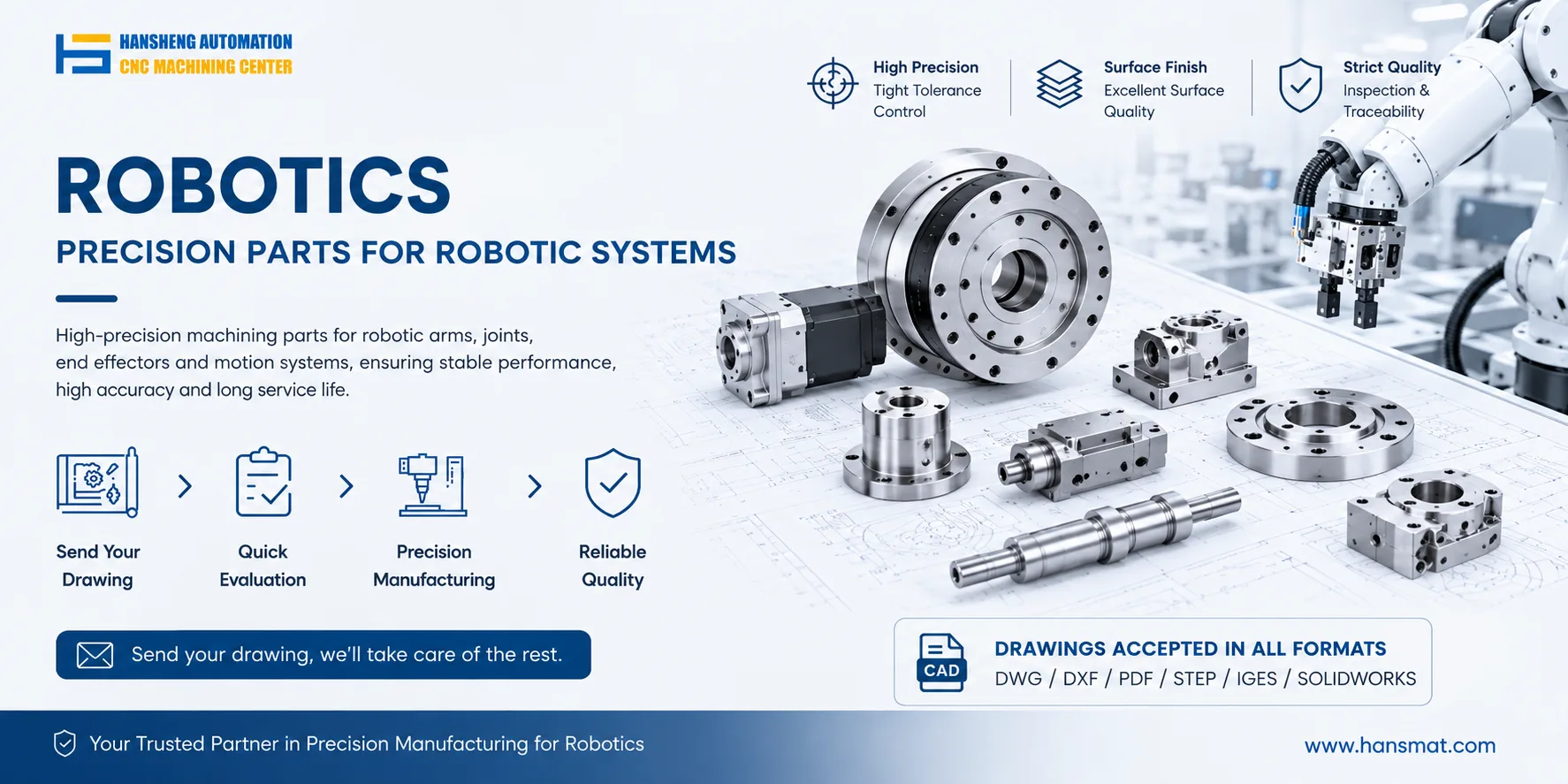
Servo motors can precisely control speed, position, and torque. They offer fast response, high accuracy, and strong overload capacity, making them widely used in industrial robot arms. They meet the motion control requirements of high-precision and high-speed applications, such as robotic arms on automotive manufacturing and electronics production lines. For non-standard motor mounting flanges, adapter plates, or other mechanical parts used in these servo-driven robot arms, Hansheng Automation provides custom machining services based on customer drawings, supporting both prototype development and small-batch production.
3. Brushless DC Motors
Brushless DC motors overcome the inherent disadvantages of brushed DC motors by replacing the mechanical commutator with an electronic commutator. They are characterized by high efficiency, long service life, and good speed regulation. They are commonly used in robot arms that require good endurance and efficiency, such as collaborative robot arms.