The essential difference between industrial robots and robotic arms lies in functional complexity and intelligence. A robotic arm mainly performs tasks according to fixed programs, while an industrial robot has learning capability and intelligent operation ability. In terms of application, robotic arms are mostly serial structures, whereas industrial robots are divided into serial and parallel structures with complementary uses. In terms of definition, Western countries once distinguished them by the number of axes, and Japan also used axis count to define robots. Today, the international concept has largely converged.
Essential Difference
A robotic arm follows fixed or pre-set programs, imitating human arm movements along defined trajectories to transport materials, handle parts, or operate tools for designated tasks. For example, on an automobile production line, a robotic arm moves components from one position to another along a set path and performs simple assembly work.
An industrial robot, by contrast, can adapt to changes through sensing and programming, and is capable of more complex and intelligent operations.
Difference in Application Scope
Robotic arms are widely used in industry. Their main technologies are drive and control, and they generally adopt a serial structure. A serial robotic arm is formed by connecting multiple joints in sequence, and each joint has an independent drive unit. This structure gives the arm a large working space and good flexibility. For example, in electronic product assembly, a serial robotic arm can flexibly pick and place tiny electronic components.
Industrial robots include both parallel and serial types.
Parallel robots are mostly used in applications that require high rigidity, high precision, and high speed but do not require a large workspace. Typical uses include sorting, handling, motion simulation, parallel machine tools, metal cutting, robot joints, and spacecraft interfaces. In logistics warehousing centers, parallel robots can sort goods quickly and accurately, improving efficiency.
Serial robots complement parallel robots in application. They have a large working space and can avoid coupling effects between drive axes. However, each axis must be controlled independently, and encoders and sensors are needed to improve motion accuracy. In large-scale mechanical manufacturing, serial robots can perform welding and painting over a wide range.
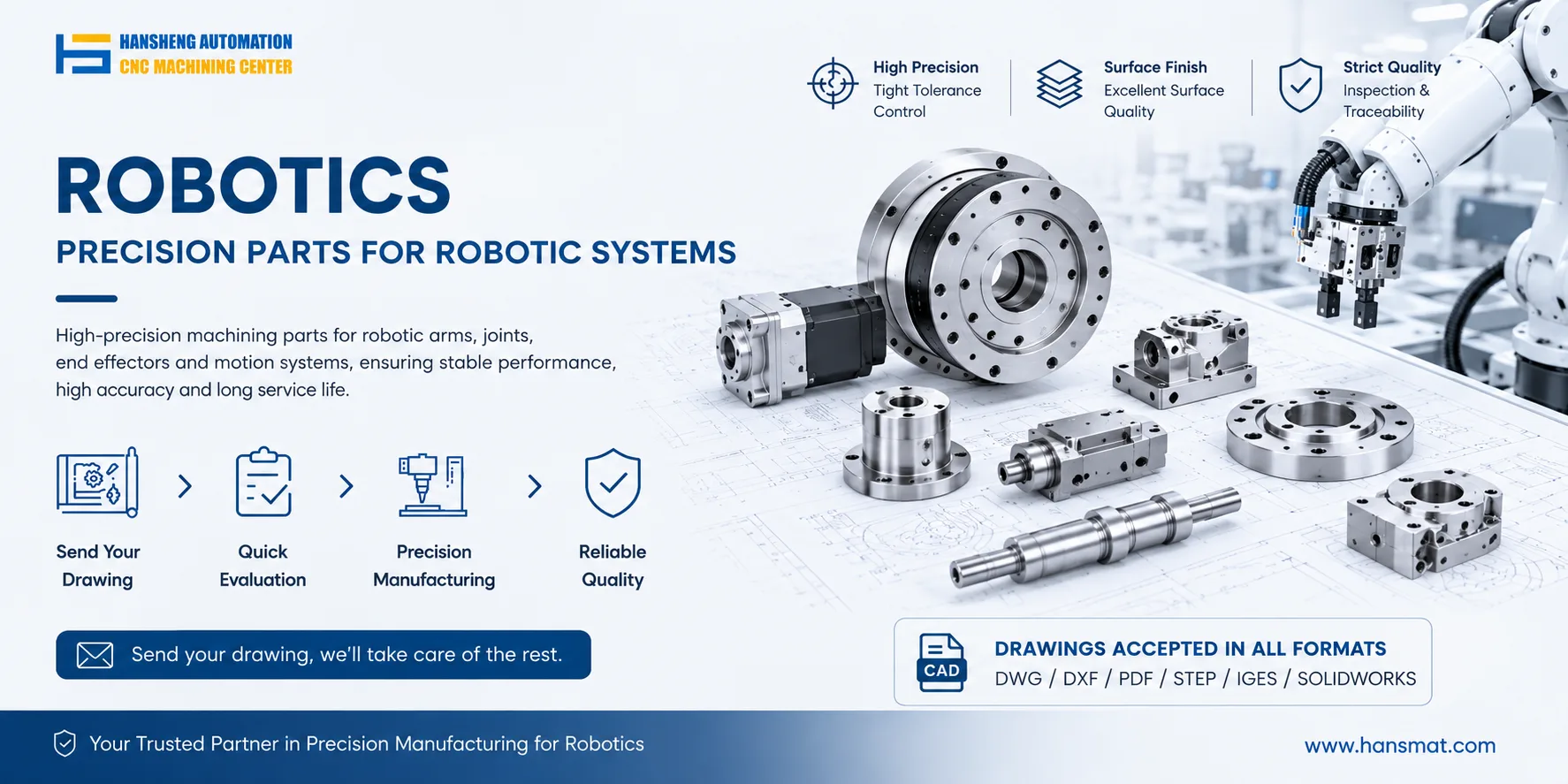
For non-standard joints, end effectors, or structural parts used in either serial or parallel configurations, Hansheng Automation provides custom machining services based on customer drawings, supporting prototype development and small-batch production.
Difference in Definition
Western countries generally believe that a robot should be controlled by a computer and become a multi-functional automatic machine through programming. Under this view, mechanical arms with six or more axes can be called robots, while those with five axes or fewer are only robotic arms. This definition emphasizes versatility and complexity, because six or more axes provide greater freedom of motion and allow more complex tasks.
Japan once defined robots as advanced automatic machines and included robotic arms in the robot category, even treating three-axis arms as robots. This reflected a broader understanding of robots in the early stage of Japanese robot technology development.
At present, the international concept of robots has largely converged. A robot is generally understood as an automated machine that uses its own power and control capability to perform various functions. This unified definition supports the global exchange and development of robot technology.