Production of bamboo express packaging bags usually covers three stages: material preparation, forming, and post-processing. By process route, it can be divided into bamboo fiber woven type and bamboo film calendering type. Equipment selection depends on production scale, bag load capacity, degradation requirements, and surface printing requirements.
Material preparation equipment
General pretreatment equipment includes log cutting machines, bamboo peeling machines, and crushers or chippers. A log cutting machine cuts raw bamboo into standard sections of 0.8 to 1.5 meters. The cutting length can be adjusted to the raw material size. A bamboo peeling machine removes the green and yellow layers to reduce the effect of impurities on later product performance. A crusher or chipper processes bamboo sections into 2 to 5 cm bamboo chips or shavings for later purification or grinding.
The bamboo fiber woven route also uses cooking tanks, bleaching pools, and pulping machines. A cooking tank is a pressure vessel. Certified operators must control temperature and pressure to purify bamboo chips into spinnable bamboo fiber. Spinning machines work with winders to turn the fiber into 20 to 40 count cheese yarn for weaving. The bamboo film calendering route uses a bamboo powder mill to grind bamboo chips to 80 to 120 mesh, plus a dryer to remove moisture before extrusion.
Forming equipment
The bamboo fiber woven route uses rapier looms or high-speed water jet looms to weave cheese yarn into bag fabric. Width and warp and weft density can be customized for different load requirements. Bag sewing machines stitch the sides and bottom of the fabric into a bag shape. Portable bag sewing machines suit small batches. Industrial automatic bag sewing machines suit large batches.
The bamboo film calendering route uses a twin-screw extruder to mix and melt dried bamboo powder with degradable resins such as PLA and PBAT in a set ratio. This makes the material uniform. High-temperature parts need guard rails. A three-roll calender presses the melt into bamboo-based film from 0.08 to 0.15 mm thick. Roll temperature is adjustable. A fully automatic bag making machine completes film slitting, heat sealing, punching, and rewinding, producing finished bags in express delivery sizes.
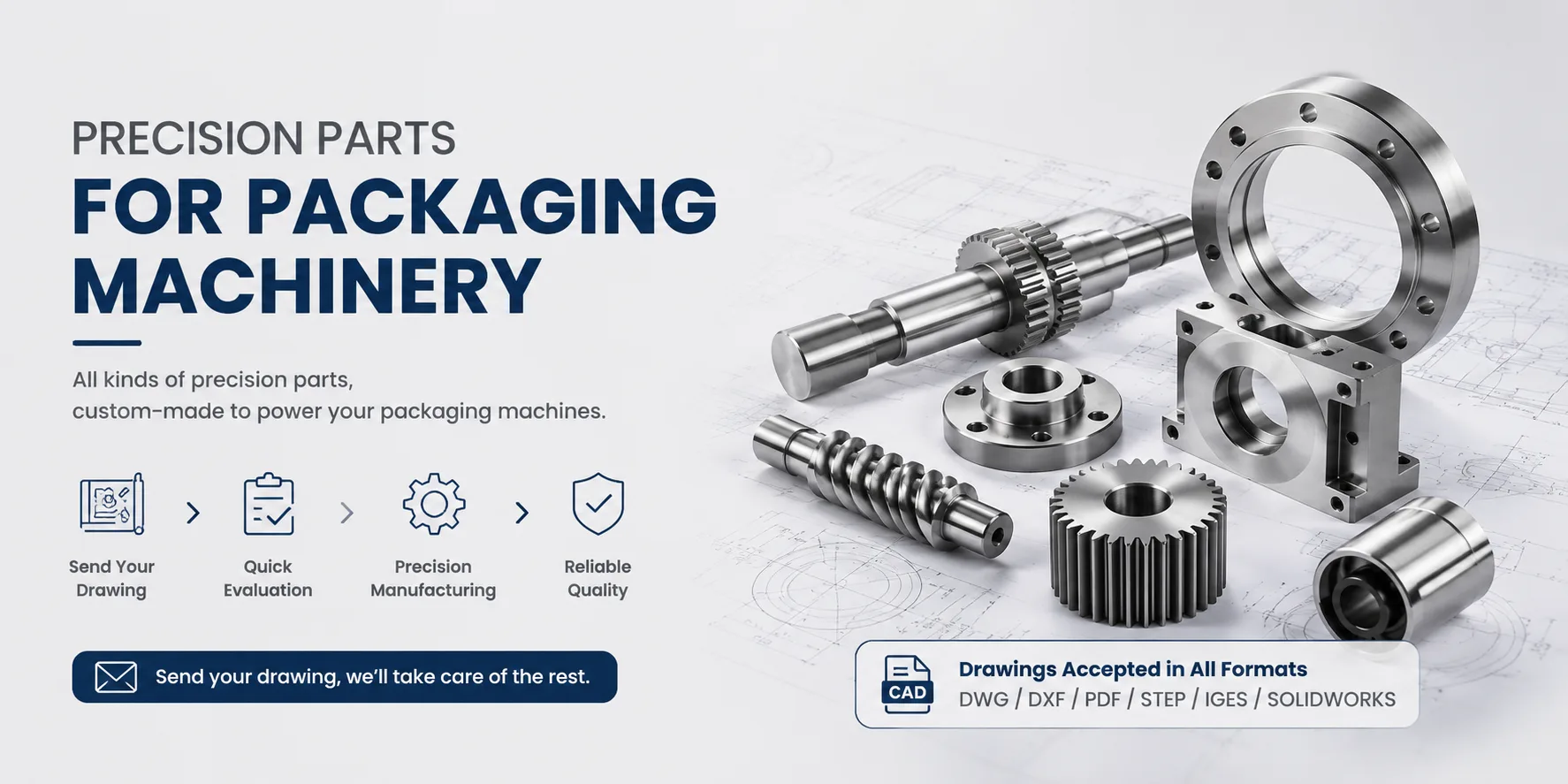
Parts in this equipment, such as blades, screens, rollers, heat sealing jaws, cutting knives, punching pins, dies, and fixtures, often need to be custom made to drawings. Hansheng Automation can precision-machine these non-standard parts in single pieces or small batches according to customer design drawings. We can use stainless steel, aluminum alloy, carbon steel, or engineering plastics, control tolerances to drawing requirements, and provide surface treatments such as anodizing, blackening, nickel plating, or powder coating.
Post-processing and supporting equipment
Flexographic printing machines print the express label area, brand marks, and other content. They can handle roll stock or sheet stock, and printing accuracy can be adjusted as needed. Tensile testing machines check transverse and longitudinal tensile strength and load capacity to confirm that bags meet industry strength requirements for express packaging. Dust collection equipment is used in material preparation and grinding to reduce dust pollution and occupational health risks. Automatic packing machines arrange finished bags into standard quantities for storage and transport.
Our custom precision machining capability is not limited to equipment for making bamboo express packaging bags. In addition to printing machinery parts, food machinery parts, and medical device parts, we can machine yacht precision parts, RC car precision parts, tobacco packaging machinery parts, and filling machinery parts according to drawings. After customers provide drawings, Hansheng Automation can support prototyping and batch production for non-standard parts.