The core difference is how they work. A high-shear emulsifier uses strong shear force to mix and emulsify immiscible liquids. A homogenizer uses high-pressure impact to break down and evenly disperse particles in liquid-solid or liquid-liquid mixtures. Their working principles and applications are fundamentally different.
Working principle
High-shear emulsifier: The key parts are the stator and rotor. The rotor spins at high speed and creates strong shear force. Material is drawn into the shear zone and torn, broken, and mixed in the narrow gap between stator and rotor, which produces emulsification. Working pressure is normally atmospheric.
Homogenizer: The key parts are the high-pressure pump and homogenizing valve. Material passes through an adjustable narrow gap under high pressure, usually 10 to 150 MPa. Cavitation, impact, and shear break down particles and disperse them evenly.
Structure and appearance
High-shear emulsifier: Most units are mounted on an open tank top or installed inline in a pipe. The structure is relatively simple. The high-speed rotor and stator head can be seen directly.
Homogenizer: It is a closed high-pressure piping system. The homogenizing valve sits inside a heavy housing. The internal action cannot be seen from outside. The overall structure is more complex and robust.
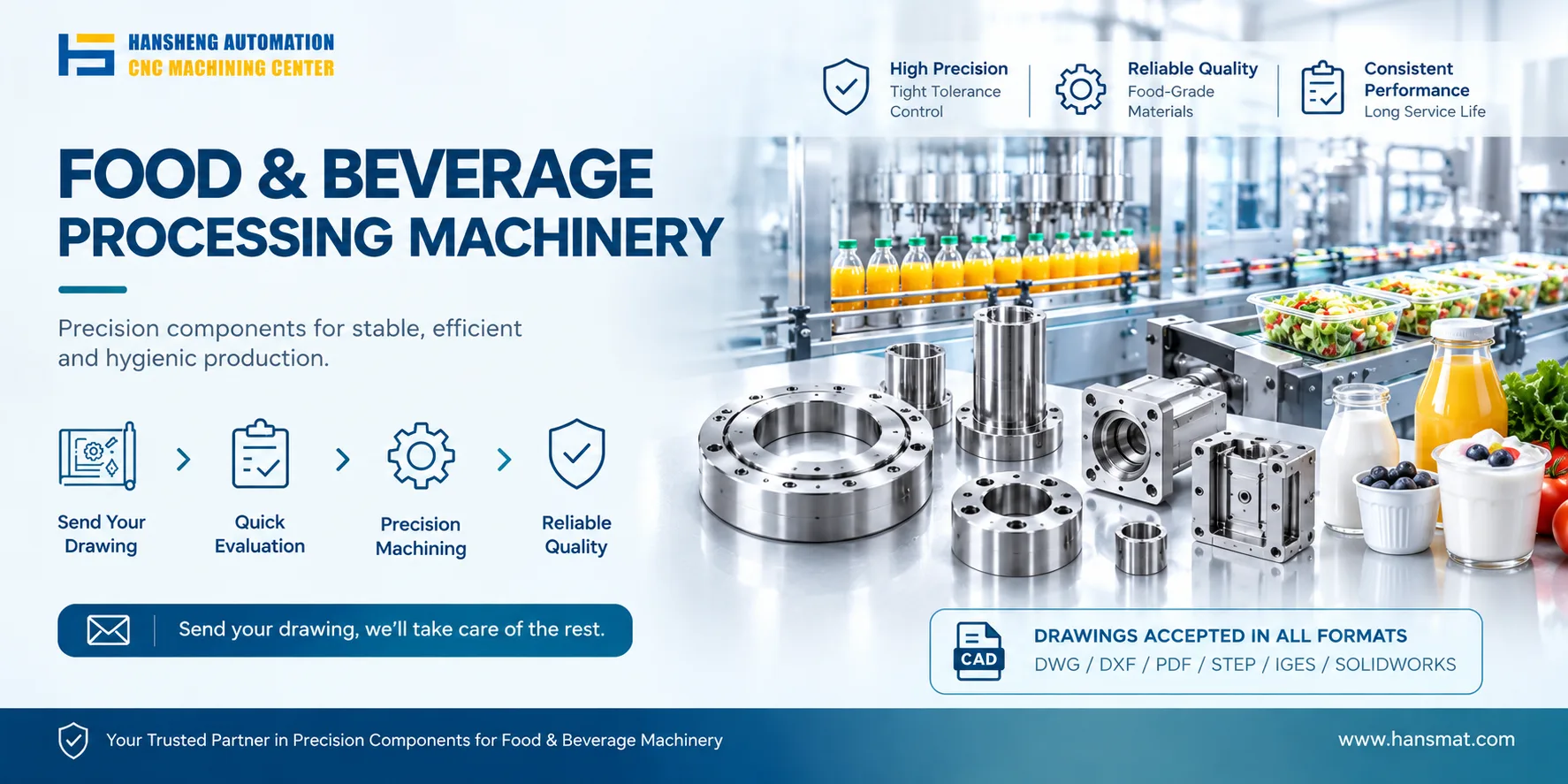
Hansheng Automation can machine custom rotor-stator assemblies, homogenizing valves, valve seats, and wear parts from customer drawings, in single pieces or small batches.
Processing results and finished product
High-shear emulsifier: It handles low to medium viscosity materials well. It disperses one liquid into another immiscible liquid to form an emulsion, such as mayonnaise or cream. Droplet size distribution is relatively wide, usually in the micron range from 1 to 50 μm.
Homogenizer: The processed material has very high uniformity. It can break particles such as fruit pulp, fat globules, and drug particles down to submicron or nanometer size, from 0.1 to 2 μm. The finished product is more stable and less likely to separate or settle.
Main applications
High-shear emulsifier: Widely used in cosmetics such as face creams and lotions, food such as sauces and beverages, and chemicals such as lubricants and coatings. It mainly mixes, emulsifies, and homogenizes medium-viscosity fluids.
Homogenizer: A key unit in dairy products such as milk and yogurt, fruit juice, biopharmaceuticals such as cell disruption and liposome preparation, and chemical nano materials. It mainly provides ultra-fine grinding, nano dispersion, and improved product stability.
Key parameters and selection
High-shear emulsifier: Selection mainly depends on motor power from 1 to 200 kW, speed from 1000 to 15000 rpm, throughput in liters per hour, and stator-rotor structure.
Homogenizer: Core selection parameters are working pressure in MPa or bar and flow rate in liters per hour. Lab units can reach above 2000 bar. Industrial units usually run from 200 to 800 bar.
For custom rotors, stators, and valve components, Hansheng Automation can review drawings and produce parts to match the required profile and tolerance.
Selection advice
If the goal is to quickly mix immiscible liquids such as oil and water into a stable emulsion, choose a high-shear emulsifier.
If the goal is to break solid particles such as fruit pulp or catalyst, or droplets such as fat globules, into very fine size and obtain a highly uniform, stable suspension or nano dispersion, choose a homogenizer.
In many processes, the two are used together. A high-shear emulsifier performs initial pre-mixing, and a homogenizer performs fine homogenization.
Beyond emulsifiers and homogenizers, our precision component customization serves more than one industry. We machine filling machinery parts, tobacco packaging machinery parts, medical device components, yacht precision components, RC car precision components, printing machinery parts, and food machinery parts. Hansheng Automation works from customer drawings and delivers one-off or batch parts to the required material, tolerance, and surface finish. Our scope is precision components, not complete machines.