A fiber laser marking machine uses ytterbium-doped double-clad fiber as the laser medium, which produces a beam output close to the diffraction limit. The equipment is built around a fiber laser. A computer controls high-speed galvanometer deflection to change the optical path of the laser beam, enabling automatic marking. Laser marking is a non-contact, force-free processing method that has almost no negative impact on product quality. The finished marking also gives a stronger sense of texture.
Advantages of Fiber Laser Marking Machines
- No consumables are required, so processing cost is low after initial investment.
- Maintenance frequency is low, which helps reduce service costs.
- Marking speed is fast, with almost no damage to the product.
- The marking range is wide and suitable for many materials, including metals and alloys, rare metals and alloys, metal oxides, specially surface-treated materials, crystal, and plastics.
- Marking can be performed on flat surfaces as well as uneven surfaces.
- Marking is fine enough that even small characters and logos on small products remain clearly visible.
- The system can mark tens of thousands of times per second or more, making it suitable for large-scale production.
- It can be used on production lines because the laser is computer-controlled, providing predictable ranges and accurate speed.
- Layout can be freely arranged on the computer without making templates, which reduces processing cost.
- The machine is compact and occupies little space.
- It has a long service life and is not easily damaged.
Common power options for fiber laser marking machines are 10 W, 20 W, and 30 W. Higher power generally means faster engraving speed and better quality. However, the selection should not be based on power alone; the specific material to be marked must also be considered to achieve the best result and cost-effectiveness.
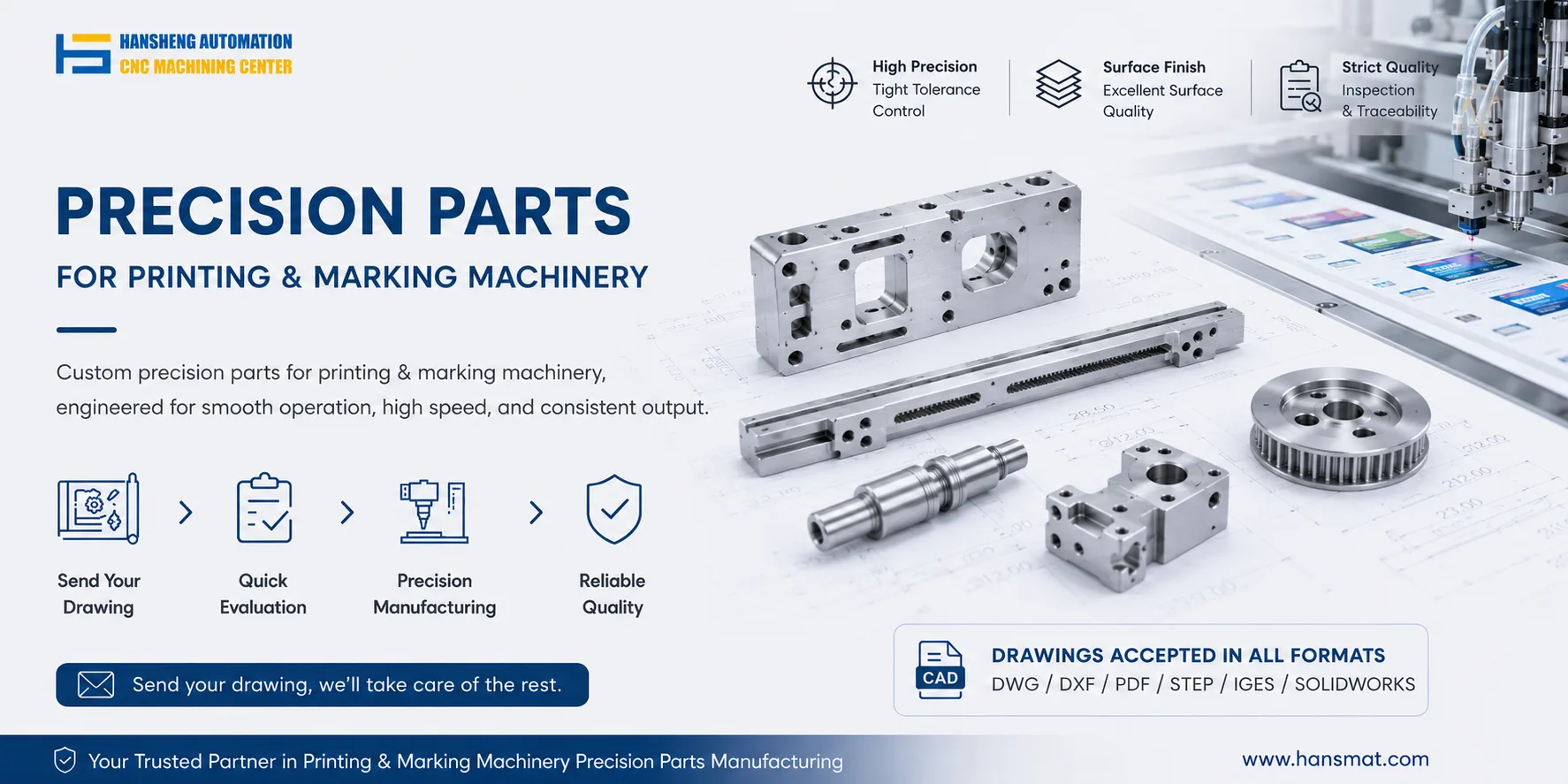
For precision non-standard components used in fiber laser marking systems, such as optical mounting brackets and galvanometer seats, Hansheng Automation provides custom machining based on customer drawings or samples, including single-piece and small-batch orders.