


In high-speed cigarette production, where packaging lines exceed 800 packs per minute, the structural integrity of a casting is defined by the balance between mass and precision. An oversized frame adds unnecessary inertia, while a casting that is too light fails to dampen the high-frequency vibrations that lead to misalignment in cam indexers and gearboxes.
At hansheng, we understand that tobacco machinery castings range from lightweight, intricate precision components to heavy-duty structural frames up to 3,800mm in length. Achieving a specified tolerance of ±0.03mm in sand or gravity casting is not just a metric; it is a requirement for minimizing secondary machining and ensuring long-term uptime.
This article analyzes the typical weight ranges for tobacco machinery components and explains how precision casting processes-from Lost Foam to Gravity Casting-impact the performance of your high-speed production lines.
Why Weight Matters in Tobacco Machine Castings
In tobacco processing and packaging equipment, cigarette machinery castings must endure continuous 24/7 operation at speeds of 300–1,000 packs per minute. Weight directly influences:
Vibration damping
Heavier cast parts for tobacco machinery (often ductile or gray iron) absorb shocks better, reducing alignment errors.
01
Installation and handling
Overly heavy components increase crane time and safety risks; too light ones may lack rigidity.
02
Energy efficiency
We propose industry-leading solutions to ensure production safety by calculating each parameter of the system,reasonably selecting distribution protection devices,and adopting a microcomputer protection system for comprehensive monitoring and control.
03
Cost and logistics
Weight impacts shipping, machining, and overall project budgets.
04
Typical Weight Ranges for Tobacco Machinery Castings
Tobacco machinery castings are categorized by their functional role in the production line, which dictates the optimal casting method and material selection.
Intricate Precision Components
(0.05 kg – 50 kg)
Key Parts: Cam followers, sensor housings, and high-speed gripper arms.
Materials & Process: Primarily Aluminum alloys or Stainless Steel, often utilizing Gravity Casting or Investment Casting to ensure zero-porosity.
Dynamic Sub-assemblies
(50 kg – 500 kg)
Key Parts: Gearbox housings, conveyor drive brackets, and intermediate support plates.
Materials & Process: Ductile Iron (e.g., QT500-7) or Gray Iron via Sand Casting.
Monolithic Frames and Heavy-Duty Bases (500 kg – 2,000+ kg)
Key Parts: Main machine beds, heavy-duty structural columns, and integrated processing platforms.
Materials & Process: High-grade Gray Iron or custom alloys using Lost Foam Casting or Large-scale Sand Casting.
Factors Influencing the Weight Range of Cast Parts for Tobacco Machinery
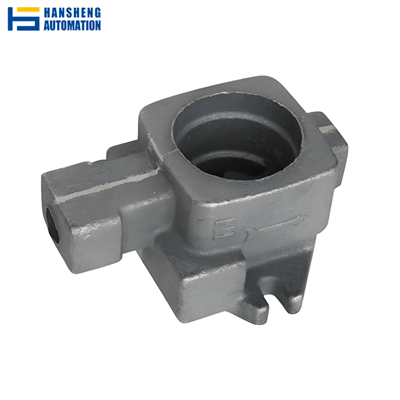
Material Density vs. Dynamic Damping
The choice between Ductile Iron (QT series) and Gray Iron is often dictated by the vibration profile of the machine. While Gray Iron offers superior damping for heavy bases, Ductile Iron's higher strength-to-weight ratio allows for thinner-walled structural components without sacrificing rigidity. For high-speed reciprocating parts, Aluminum Gravity Casting is preferred, reducing mass by up to 60% compared to ferrous alternatives to minimize motor load and heat generation.
Geometric Optimization via Lost Foam Casting
The weight of complex tobacco machine parts-such as those with internal cooling or dust extraction channels-is best controlled through Lost Foam Casting. This process allows for intricate geometries and near-net shapes that are impossible with traditional sand casting.


Wall Thickness and Structural Integrity
Maintaining a specified tolerance of ±0.03mm starts with controlled wall thickness. We utilize rib reinforcements rather than bulk mass to ensure rigidity. Uniform wall thickness is critical to prevent "hot spots" during cooling, which can cause internal stresses that lead to microscopic warping.
The "Casting-to-Machining" Synergy
A casting's weight is only "optimal" if it supports high-precision finishing. Because our CNC facilities achieve ±0.005mm accuracy, we design our castings with minimal but strategically placed datum points.

Why Hansheng Excels in Metal Casting Services and Precision Casting for Tobacco Applications
Hansheng Automation stands out as a one-stop partner for tobacco machine castings. With capabilities spanning 0.05 kg to over 2,000 kg (and single castings up to several tons), they deliver Precision Casting and full CNC integration for tolerances as tight as ±0.03 mm.
Scale: Single castings up to 3,800mm; weights from 50g to 2 tons.
Accuracy: Casting tolerance of ±0.03mm; CNC machining up to ±0.002mm.
Elite Equipment: Post-casting precision is guaranteed by Kashifuji KPS30 skiving machines and Seibu Wire EDM.
Vertical Expertise: We manufacture the core components (Cam Indexers, Harmonic Drives) that sit inside the castings, ensuring perfect system harmony.
FAQ
Q: What is the general weight range for tobacco machine castings?
A: Typical tobacco machine castings range from 0.05 kg for precision fittings to over 2,000 kg for large structural frames, with most cigarette machinery castings falling between 50 kg and 1,000 kg.
Q: Are lighter cast parts for tobacco machinery always better?
A: No-lighter Precision Casting components suit fast-moving parts, but heavier cast parts for tobacco machinery provide essential vibration damping in frames and bases.
Q: How does weight affect the performance of cigarette machinery castings?
A: Optimal weight ensures stability, reduces resonance, and extends service life, directly cutting downtime in high-speed tobacco lines.
Q: Can Hansheng produce custom weights outside standard ranges?
A: Yes-Hansheng's Metal Casting Services support fully customized tobacco machine castings from micro to multi-ton scales with full machining.
Q: What materials are used for different weight ranges?
A: Lightweight (under 50 kg) often uses aluminum; medium-to-heavy (50–2,000 kg) relies on ductile or gray iron for strength and damping.
Q: How quickly can I get precision-weighted castings?
A: With simulation-driven processes, lead times for Precision Casting typically range from 4–8 weeks, depending on volume and complexity.