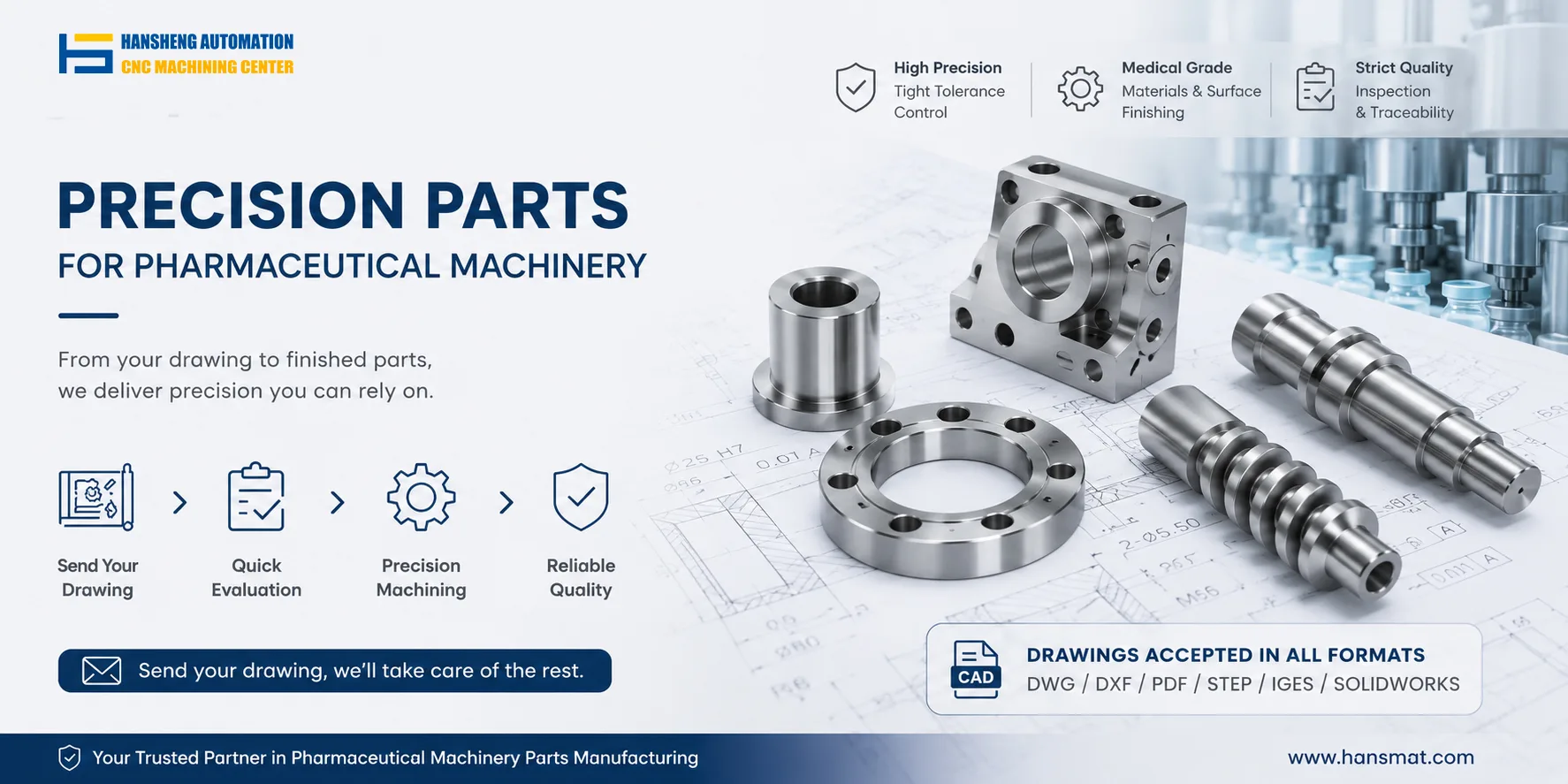
Whether it involves high-efficiency wet mixing and drying systems handling liquid raw materials or dry granulation equipment for solid powder blending, the stable operation of these core processes heavily relies on the support of high-precision underlying mechanical components. Hansheng Automation supports the exact manufacturing of various non-standard components according to customer prints. Leveraging advanced CNC machining technology, we can custom-machine high-strength mixing impellers, precision spray components, and highly sealed drive shafts for these different types of granulation systems. By strictly controlling geometric tolerances at the micron level, we guarantee efficient equipment operation under various complex conditions right from the hardware source.
From a process perspective, wet and dry granulation represent two distinctly different production technologies. The core advantage of the wet process (often manifested in industries like dairy as a combination of wet mixing and spray drying) is that the system can thoroughly and uniformly fuse various raw materials and trace nutrients in a liquid environment, such as fresh milk. Subsequently, the equipment efficiently converts the liquid mixture into a high-quality powder product through processes like high-temperature spray drying. This method maximizes the uniform distribution of nutritional formulas. However, the prerequisite for adopting the wet process is that the production facility must be located close to the raw material source, such as a dairy farm. For instance, some milk powder brands that rely on foreign raw milk but manufacture domestically usually have to opt for dry granulation equipment due to long-distance international transportation constraints.
In contrast, dry granulators operate by mechanically and physically blending various solid powder raw materials directly. This process is completely unconstrained by the physical distance to the material source, offering a relatively simple operational workflow and significantly lowering production and logistics costs. Nevertheless, the dry process has clear limitations: pure solid-state physical blending struggles to achieve the absolute uniform distribution of trace nutrients that liquid-state fusion can guarantee.
In summary, both dry and wet granulation technologies have well-defined application scenarios, advantages, and disadvantages. Manufacturers must comprehensively evaluate and select the most suitable granulation equipment based on the distance of the raw material supply chain, product formula uniformity requirements, and overall cost control targets. Meanwhile, as equipment manufacturing technology continues to evolve, the industry is actively exploring new granulation processes that combine the strengths of both dry and wet methods. We will continue to utilize our professional build-to-print customization capabilities to provide high-standard precision machining services for food and pharmaceutical machinery clients, fully supporting the implementation and equipment upgrades of various innovative granulation technologies.