The standard operation of a wet granulator encompasses three core stages: production preparation, equipment operation, and post-production maintenance. The fundamental purpose of this process is to efficiently convert loose powder materials into dense, uniform solid granules by precisely spraying liquid binders combined with mechanical shear forces.
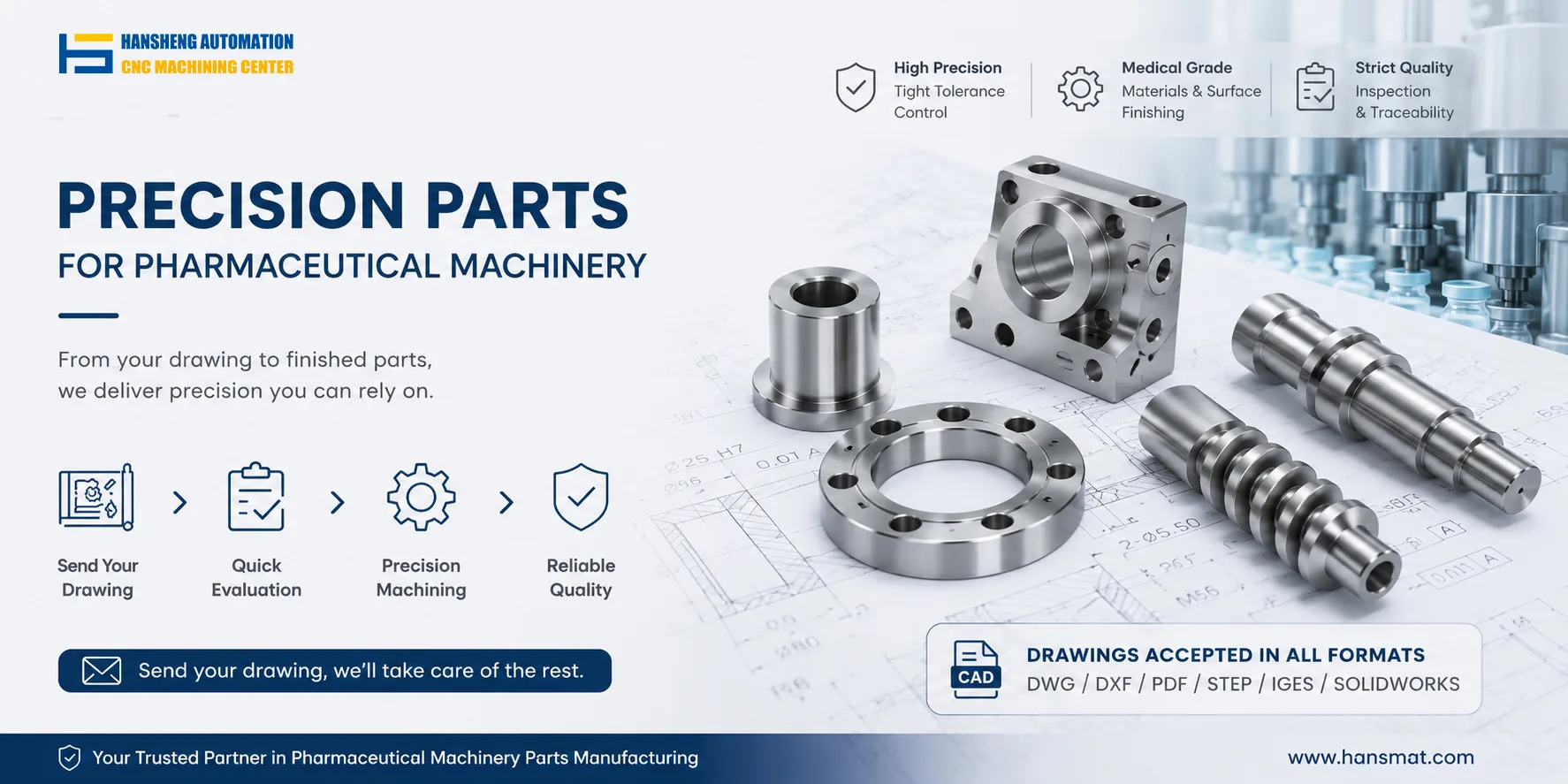
The first stage is high-standard pre-operation preparation. Before production, operators must comprehensively inspect and verify the cleanliness and air-tightness of the granulation bowl, main mixing impeller, high-speed chopper, and all interfaces. For the customization and upgrade of such core running components, we can perform single-piece or low-volume precision machining based on customer-provided design drawings. Hansheng Automation deeply understands the rigorous requirements that the wet granulation process places on underlying hardware geometries and dynamic fit tolerances. Therefore, utilizing premium special wear-resistant stainless steel, we precisely manufacture various non-standard main impellers, chopper blade sets, and high-sealing drive shafts for you. This ensures, from a mechanical hardware level, that the equipment's set process parameters (such as main impeller speeds of 200-600 rpm and ultimate chopper speeds of 1000-3000 rpm) are executed flawlessly. Once the equipment's hardware is confirmed to be in perfect condition, operators can weigh the raw materials and binders (such as HPMC solution, typically 15%-30% of the total material weight) according to the process formulation.
The second stage is the rigorous operational workflow. Equipment operation must proceed strictly according to the process sequence. First, the powder raw materials are loaded, and the bottom main impeller is started for 2 to 5 minutes of dry mixing. Subsequently, the system injects the binder at a steady rate through a liquid spray device (a "slow then fast" liquid addition principle is recommended). At this point, both the mixing impeller and the side-mounted chopper run simultaneously at high speeds, and intense mechanical shear forces cause the materials to rapidly agglomerate. Operators must closely observe the plastic state of the material. Once it reaches the ideal critical point of "forming a ball when squeezed and breaking apart when touched," the discharge valve must be opened immediately to transfer the qualified wet granules to a fluid bed or oven for the subsequent drying process.
The third stage involves critical process control points and safety regulations. Accurate determination of the granulation endpoint directly dictates final product quality; target granule size distribution is typically controlled between 0.5 and 2 mm, alongside good bulk density requirements. During granulation, material temperature must be monitored in real-time (generally not exceeding 40°C) to prevent the heat accumulated from high-frequency physical friction from causing heat-sensitive binders to fail. Furthermore, production safety cannot be overlooked: opening the top cover while the equipment is running at high speed is strictly prohibited, and the main power supply must be completely disconnected before any cleaning operations.
The final stage is strict daily maintenance and cleaning. To address cross-contamination risks in the pharmaceutical industry, all parts in contact with materials must be thoroughly cleaned after each production run. Concurrently, the lubrication status of heavy-duty drive components and the measurement accuracy of instruments must be included in regular inspection plans. If organic solvents are used in granulation, the equipment's explosion-proof system must remain absolutely reliable. In this aspect, the pharmaceutical-grade mirror polishing (Ra ≤ 0.4μm) that Hansheng Automation provides for its custom machined parts effectively prevents material adhesion at the physical surface level. This significantly shortens your equipment's daily cleaning cycles, ensuring the entire production workflow perfectly aligns with stringent GMP quality management regulations.