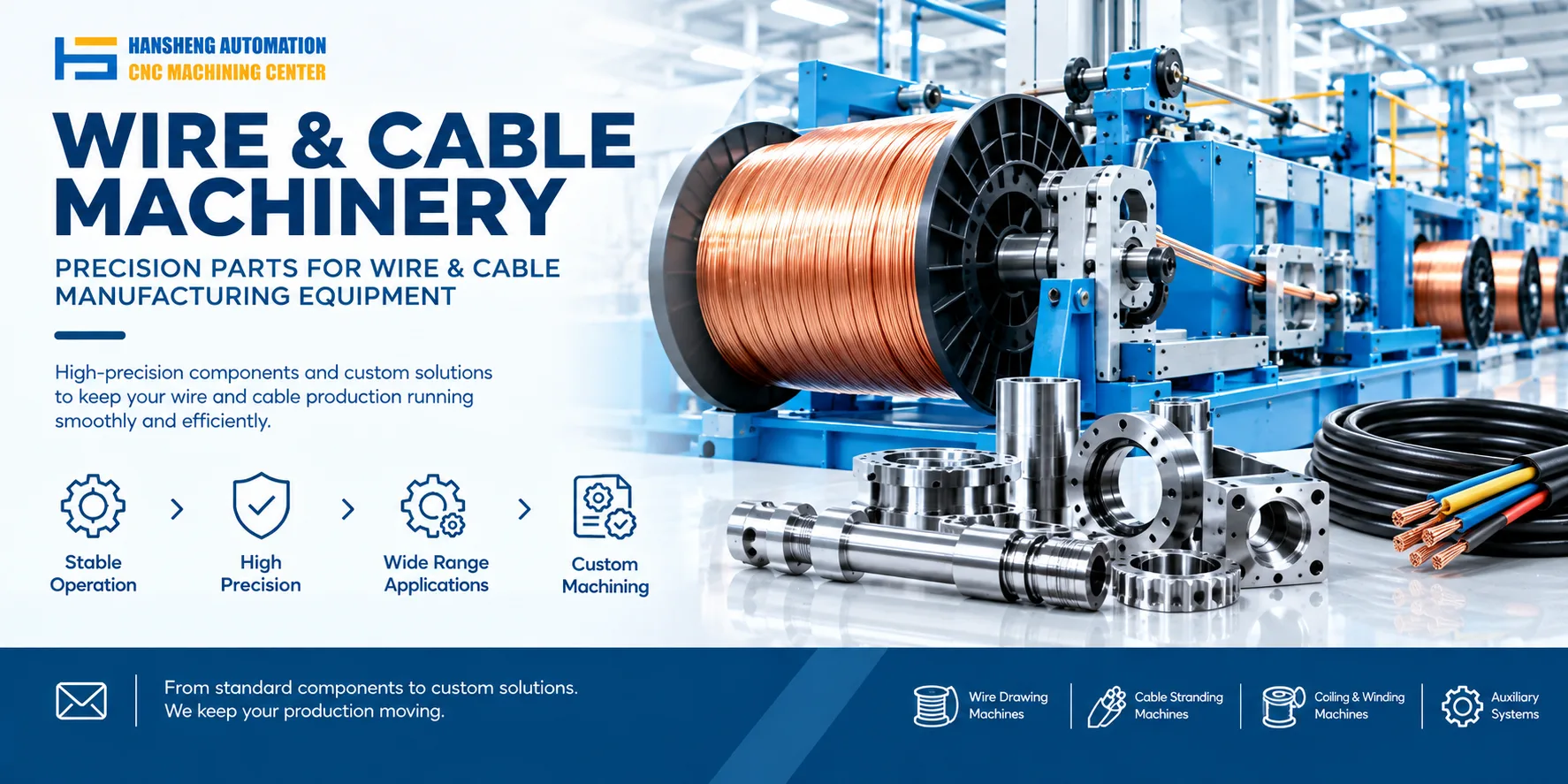
Reciprocating extruders and twin-rotor continuous mixers are both used for compounding and extrusion of plastics or rubber. They differ in mixing principle, screw structure, production line setup, and application. Hansheng Automation can machine mixing pins, barrel liners, screws, rotors, gears, and bearing housings from customer drawings, in single pieces or small batches.
1. How a reciprocating plastic extruder works
The screw rotates one turn and reciprocates once at the same time.
Material is sheared between mixing pins and irregular trapezoidal mixing flights.
The reverse movement of the material adds useful axial mixing to radial mixing.
The melt is continuously sheared, turned over, meshed, and stretched.
Three or four rows of mixing pins are arranged regularly on the barrel liner.
This structure ensures both dispersive mixing and distributive mixing.
The special screw structure makes uncontrolled pressure and temperature fluctuations less likely.
Melt splitting frequency, secondary orientation, and recombination are important mixing features of reciprocating machines.
2. Features of a twin-rotor continuous mixer
High automation level and high production efficiency.
Continuous production, stable formula, and excellent product quality.
Clean and tidy workshop environment for masterbatch production.
Strong self-cleaning on the barrel and screw. When changing compounds, cleaning the barrel and screw is easy, which suits mixing of multiple compound types.
Continuous internal mixers produce no dust. Pressurized chamber internal mixers generate dust, which is harmful to operators.
Plant layout: continuous internal mixing and pelletizing lines take up little space and have low floor height requirements.
Automation: automated machine combinations reduce manual operation and raise production efficiency.
Quality: continuous internal mixing lines run continuously, so output quality is stable.
During mixing, continuous internal mixing lines show no obvious current peaks. Current is stable and smooth, and motor energy saving is clear.
Good mixing and compounding effect, with better dispersion.
3. Main differences
Mixing principle: A reciprocating extruder uses screw rotation plus reciprocation. It shears material through pins and trapezoidal flights, and uses reverse movement to improve axial mixing. A twin-rotor continuous mixer uses two rotors for continuous mixing. It focuses on self-cleaning, continuous production, and stable formula.
Production organization: A reciprocating extruder suits extrusion and compounding that require dispersive mixing, distributive mixing, and stable pressure and temperature. A twin-rotor continuous mixer suits masterbatch, multiple compound types, and continuous pelletizing, with a higher automation level.
Cleaning and maintenance: A twin-rotor continuous mixer has strong self-cleaning on the barrel and screw, so cleaning during material changes is easy. A reciprocating extruder has a special structure and advantages in controlling pressure and temperature fluctuations.
Operation: A twin-rotor continuous mixing line has stable current and no obvious current peaks, which helps save energy. A reciprocating extruder controls pressure and temperature fluctuations through its special screw structure.
Beyond reciprocating extruders and twin-rotor continuous mixers, our precision custom machining capability is not limited to one industry. Hansheng Automation can machine non-standard metal parts for medical devices, food machinery, and printing equipment from customer drawings. We also machine yacht components, RC car components, and specialized parts for tobacco packaging and filling machinery. We focus on build-to-print custom machining and produce single pieces or small batches according to customer drawings. We do not sell complete machines.