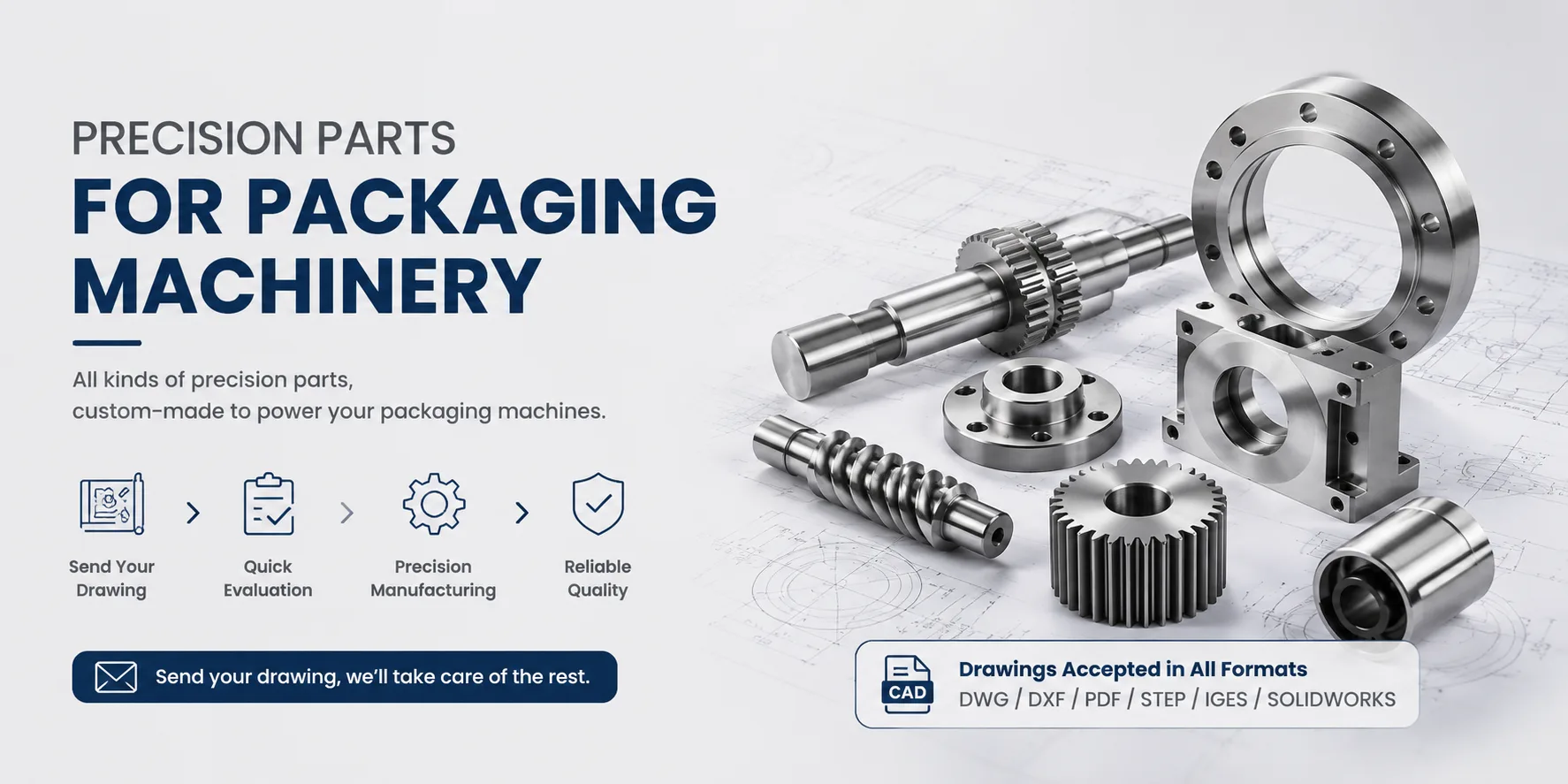
A sealing machine is used to close packaging containers after product filling, preserving quality and preventing loss. Because packaging containers are made from a wide range of materials-such as paper, plastics, glass, ceramics, metal, and composites-and differ greatly in shape and physical properties, the sealing methods and mechanisms also vary. Hansheng Automation provides custom precision machining of key sealing machine components based on customer drawings, including single-piece and small-batch non-standard parts.
Sealing devices are generally classified by the mechanical properties of the packaging material into flexible container sealing devices and rigid container sealing machines.
1. Flexible container sealing devices
Flexible containers are bag-type containers made from flexible materials such as paper, plastic film, or composite film. Their sealing is often integrated with bag making and filling into a combined machine, and standalone use is less common. Different materials require different sealing devices.
Paper bag sealing devices: For paper materials, adhesive is typically applied to the sealing area, followed by mechanical pressure to complete the seal. Key components such as glue rollers, pressure rollers, and scraper plates need consistent surface finish and dimensional accuracy to ensure uniform adhesive application and bonding.
Plastic film bag and composite film bag sealing devices: Many plastics have good heat-sealing properties. Bags made from such materials are sealed by applying heat and mechanical pressure at the sealing area to fuse the material. Critical parts include heat-sealing jaws, heating bars, silicone backing plates, and cooling plates, whose flatness, tooth profile, and surface coating directly affect seal strength and resistance to film sticking.
2. Rigid container sealing machines
Rigid containers retain their shape after forming, and sealing is usually achieved with different types of caps or closures. Common types include:
Screw capping machines: The cap is pre-formed with internal threads, either single-start or multi-start. The machine rotates the cap to press it tightly onto the container mouth. Screw capping heads, jaws, and threaded mandrels must meet precise thread tolerances and surface roughness to maintain stable torque and prevent cross-threading.
Roll-on capping machines: The cap is usually made of aluminum and has no pre-formed threads. Rollers press the aluminum cap to form threads matching the bottle neck profile. When opened, the cap breaks along a pre-scored skirt and cannot be restored, hence the term "tamper-evident cap." Roll-on capping wheels, pressure heads, and support shafts require high hardness and precise grinding to produce clear, consistent thread impressions.
Edge rolling sealing machines: A cylindrical metal cap is placed over the bottle mouth, and rollers press the bottom edge inward to grip the flange of the bottle mouth. This method is often used for wide-mouth jars. Roller profiles and clamping fixtures must be matched to the bottle mouth diameter and cap thickness to achieve uniform curling without sharp edges.
Crown capping machines: Specifically used for crown caps on beer, carbonated beverages, and similar drinks. The crown cap is placed on the bottle mouth, and the capping die presses downward, causing the corrugated skirt of the cap to contract inward and lock onto the neck flange. Capping dies, corrugated shrinking sleeves, and bottle positioning parts require careful dimensioning to reduce bottle breakage and cap deformation at high speed.
Plug sealing machines: The closure is made of elastic materials such as rubber, plastic, or cork. Sealing is achieved by the elastic deformation of the plug when pressed vertically into the bottle mouth. Plug pressing rods, guide sleeves, and combination pressing heads must be machined to match the bottle bore and plug interference, ensuring even insertion force and correct alignment.
Seaming machines: Primarily used for metal food cans. Rollers curl, hook, and press the periphery of the can end and body flange together to form a tight seal. First-operation and second-operation seaming rolls, chucks, and base plates require precise roll profiles and controlled hardness to deliver reliable hermetic sealing and pressure resistance.
From flexible bag heat sealing to rigid cap sealing, sealing quality depends on high-precision, wear-resistant components. Hansheng Automation can manufacture key parts such as heat-sealing jaws, pressure rollers, screw capping heads, roll-on capping wheels, and seaming rolls according to customer specifications, and can provide guidance on material selection, tolerances, surface treatment, and heat treatment to meet the needs of food, beverage, cosmetic, and pharmaceutical packaging applications.