A high-speed centrifuge is an important device used in laboratories, industry, and biomedical research. Its main function is to separate different components in a solution through centrifugal force generated by high-speed rotation. It is commonly used for sample purification, separation, concentration, and cell division studies.
Working principle
A high-speed centrifuge works on centrifugal force generated by rotation. It separates components in a solution according to density, shape, and size. When a liquid sample rotates at high speed, centrifugal force causes different substances to form layers at the bottom of the tube because of density differences. Heavy substances such as cell nuclei, cell membranes, and precipitates are forced to the bottom of the tube, while lighter substances remain in the upper layer. Through this principle, the centrifuge can efficiently separate different components in a liquid.
Classification
High-speed centrifuges can be divided into several types based on use, speed, capacity, and structure.
By speed:
Low-speed centrifuge: speed is usually 3,000 rpm to 6,000 rpm. It is suitable for separating large particles such as cells and cell debris.
Medium-speed centrifuge: speed is usually 6,000 rpm to 15,000 rpm. It is often used for cell culture, blood separation, and similar experiments.
Ultra-high-speed centrifuge: speed often exceeds 20,000 rpm and can reach 100,000 rpm. It is suitable for finer separation, such as small molecules, organelles, and viruses.
By rotor type:
Fixed-angle rotor: the angle between the rotor and the centrifuge axis is fixed, usually 25° to 45°. It is suitable for experiments with small sample volumes.
Swing-out or horizontal rotor: the angle between the rotor and the centrifuge axis can be adjusted. It is suitable for separating larger sample volumes.
By capacity:
Benchtop high-speed centrifuge: generally used in small laboratories. Capacity is moderate and suitable for separating a small number of samples.
Floor-standing high-speed centrifuge: generally used in laboratories that need to process many samples. Capacity is larger.
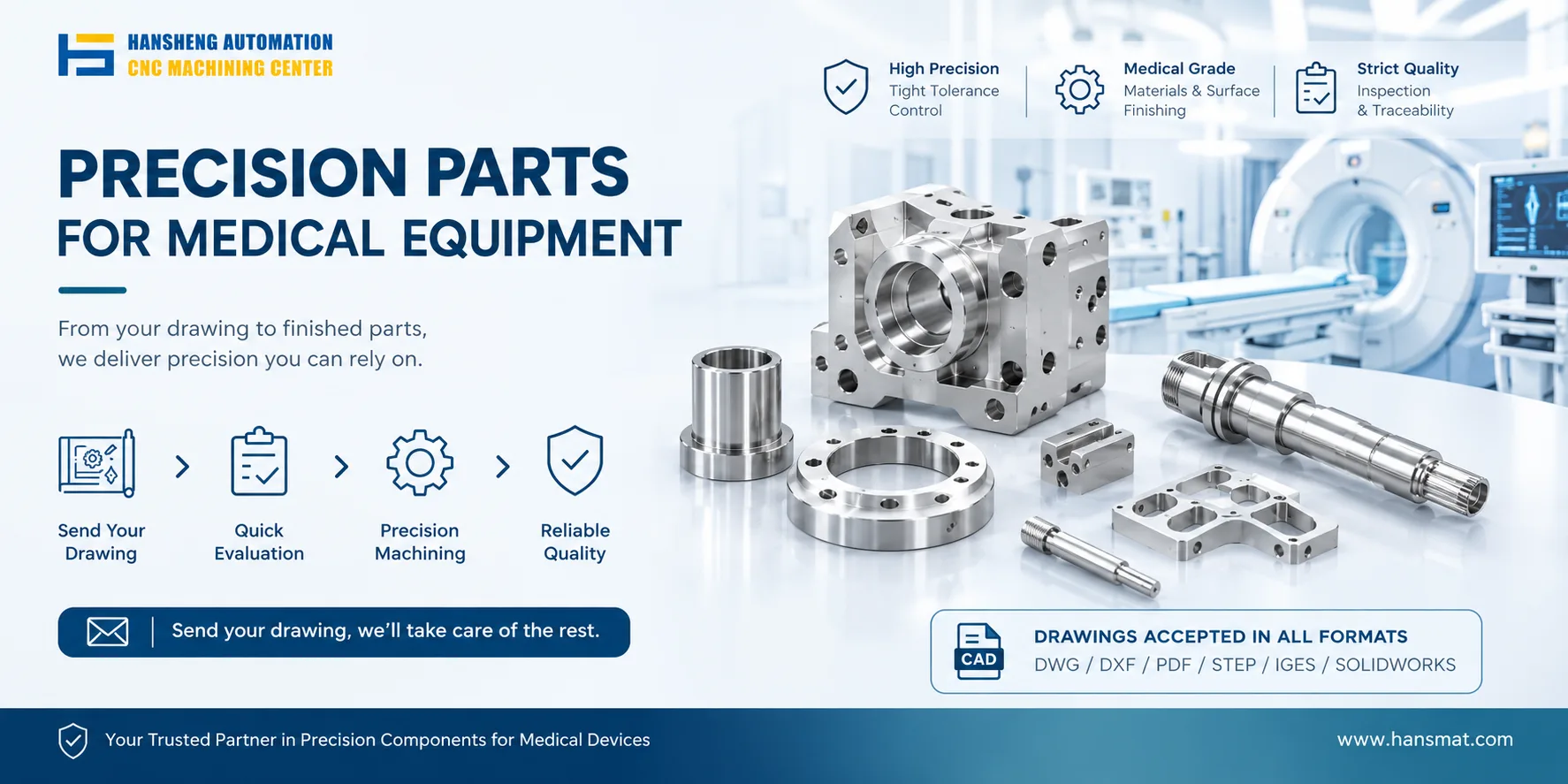
For non-standard rotor adapters, chamber components, bearing seats, and couplings used in high-speed centrifuges, Hansheng Automation can machine custom parts to customer drawings in single units or small batches.
Applications
High-speed centrifuges are widely used in many fields.
Molecular biology: high-speed centrifuges play an important role in protein purification, RNA extraction, and DNA extraction.
Medical research: centrifuges are used to separate blood components, such as plasma and blood cells during hemodialysis, and for urine sediment analysis and sperm separation in clinical testing.
Biological research: they are used in cell division studies and organelle separation, such as separating mitochondria, endoplasmic reticulum, and Golgi apparatus from cells.
Industrial applications: in chemical, food, and pharmaceutical industries, high-speed centrifuges are used to separate solid particles, precipitates, and liquids. They are widely used in dairy products, beer brewing, and drug production.
Selection points
When choosing a suitable high-speed centrifuge, consider the following factors.
Speed and centrifugal force: choose a speed range based on experimental requirements to ensure enough centrifugal force for sample separation.
Capacity and sample type: choose the centrifuge type based on the sample volume to be processed.
Safety: the centrifuge needs complete safety protection, including overload prevention and automatic stop functions.
Precise temperature control: for some sensitive samples, temperature control is important. A centrifuge with a precise temperature control system can keep temperature within the ideal range during centrifugation.
Ease of operation: modern high-speed centrifuges usually have digital displays and automatic programs, which simplify operation and improve work efficiency.
Maintenance and care
To ensure long-term stable operation of a high-speed centrifuge, perform the following maintenance and care work.
Cleaning and disinfection: regularly clean the rotor, bucket, and internal working area to prevent sample residue and stain buildup.
Regular inspection: regularly check speed, temperature control, and safety performance to ensure the device works normally.
Maintenance records: keep equipment maintenance records that document each service, inspection, and repair. This helps extend equipment service life.
If a rotor adapter, seal seat, or drive coupling needs replacement, Hansheng Automation can produce it from customer drawings.
Our precision parts machining service is not limited to high-speed centrifuge components. Hansheng Automation also produces custom parts for laboratory instruments, medical devices, filling machinery, tobacco packaging machinery, printing equipment, food processing equipment, yacht hardware, and RC car components. We work from customer drawings and deliver single units or small batches. The service remains focused on precision parts manufacturing, not complete equipment sales.