Recommended troubleshooting and cleaning steps:
- If the power indicator light is on, check carbon brush wear. If wear exceeds one third, replace the carbon brush promptly.
- If the power indicator light is off, check the indicator fuse, the room distribution panel fuse, and the power cord. If a fuse is blown, replace it and keep the circuit continuous.
- Check the vacuum pump gauge and oil pressure reading. If oil pressure is too high and the main unit cannot start, check whether oil passages are blocked, especially the orifice. If blocked, clean it until flow is clear.
- If the bearing is damaged or rolling is obstructed, or if the bearing lacks oil or has heavy dirt that increases friction and prevents the motor from reaching rated speed, clean or replace the bearing.
- Oxide on the commutator, uneven burning, or poor contact between the brush and the commutator edge can reduce speed. Clean the commutator and brush so they make good contact.
- If the rotor coil has a short or open circuit, use a multimeter to check it and rewind the coil. During use, the rotor can suffer metal fatigue, overspeed, overstress, chemical attack, improper selection, imbalance during operation, or temperature runaway. These conditions can cause tube rupture, sample leakage, and rotor damage.
- Clean the centrifuge chamber and rotor. Wipe dry any condensation in the chamber.
- After use, open the door until the chamber returns to room temperature.
- Balance samples before centrifugation.
- After centrifugation, disinfect and sterilize as needed.
- Pre-cool the rotor if necessary. Maintain and store the rotor properly. Protect the count ring at the bottom.
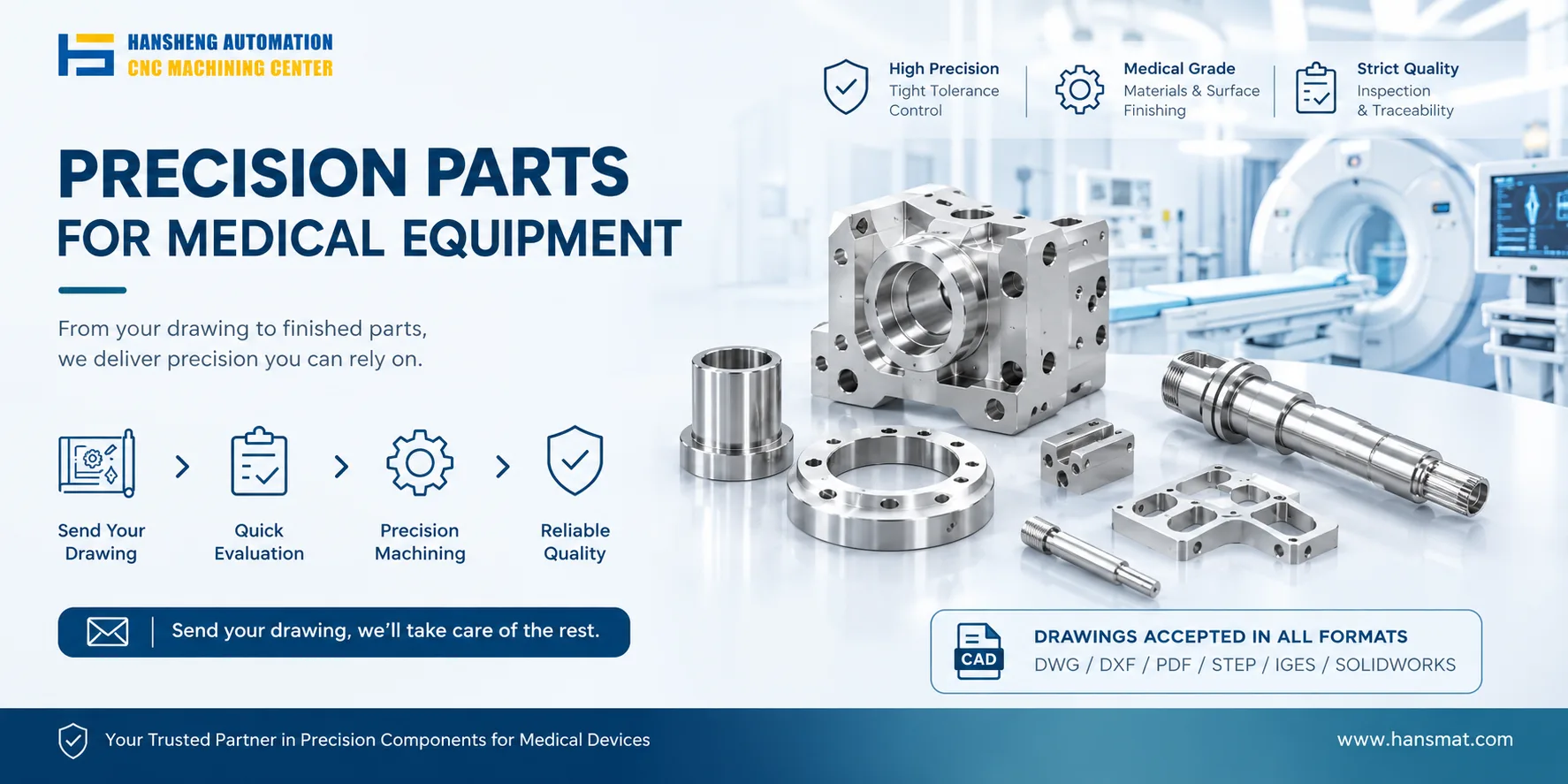
For rotor adapters, bearing seats, and drive couplings in benchtop low-speed centrifuges, Hansheng Automation can machine custom parts to customer drawings in single units or small batches.
A centrifuge is a machine that uses centrifugal force to separate components in a mixture of liquid and solid particles, or liquid and liquid. It is mainly used to separate solid particles from liquid in a suspension, or to separate two immiscible liquids of different densities in an emulsion, such as separating cream from milk. It can also remove liquid from wet solids, similar to how a washing machine spins water out of wet clothes. Special ultracentrifuges and tubular separators can separate gas mixtures of different densities. Some settling centrifuges use differences in settling speed based on density or particle size to classify solid particles by density or size.
Our precision parts machining service is not limited to centrifuge components. Hansheng Automation also produces custom parts for laboratory instruments, medical devices, food processing equipment, filling machinery, printing equipment, tobacco packaging machinery, yacht fittings, and RC car structural parts. We work from customer drawings and deliver single units or small batches. The service remains focused on precision parts manufacturing, not complete equipment sales.