High-efficiency coating machines are widely used in pharmaceutical manufacturing to coat tablets, pellets, micropellets, and granules. By combining spraying, hot-air drying, and continuous product mixing, these machines distribute coating materials evenly over the product surface and form a stable protective or functional film.
Based on the heat-transfer structure, high-efficiency coating machines are generally divided into perforated coating machines and non-perforated coating machines. Perforated coating machines use a perforated drum structure that allows hot air to pass more efficiently through the product bed, resulting in higher heat-transfer efficiency. They are commonly used for pharmaceutical tablets and larger pellets, including organic film coating, water-soluble film coating, and sustained- or controlled-release coating.
Non-perforated coating machines have relatively lower heat-transfer efficiency and are often used for micropellets, small pellets, drop pills, and granules. Typical applications include sugar coating, organic film coating, water-soluble film coating, and sustained- or controlled-release coating.
From a production-scale perspective, high-efficiency coating machines can also be classified into production-type and laboratory-scale models. Production-type machines are designed for pharmaceutical manufacturing and typically feature automated operation, stable performance, energy efficiency, and compliance with GMP requirements. Laboratory-scale coating machines are mainly used for new-drug development, formulation testing, and process validation. Some models support multiple batch sizes, such as 5 kg, 40 kg, 80 kg, and 150 kg, making them suitable for different stages of coating process development.
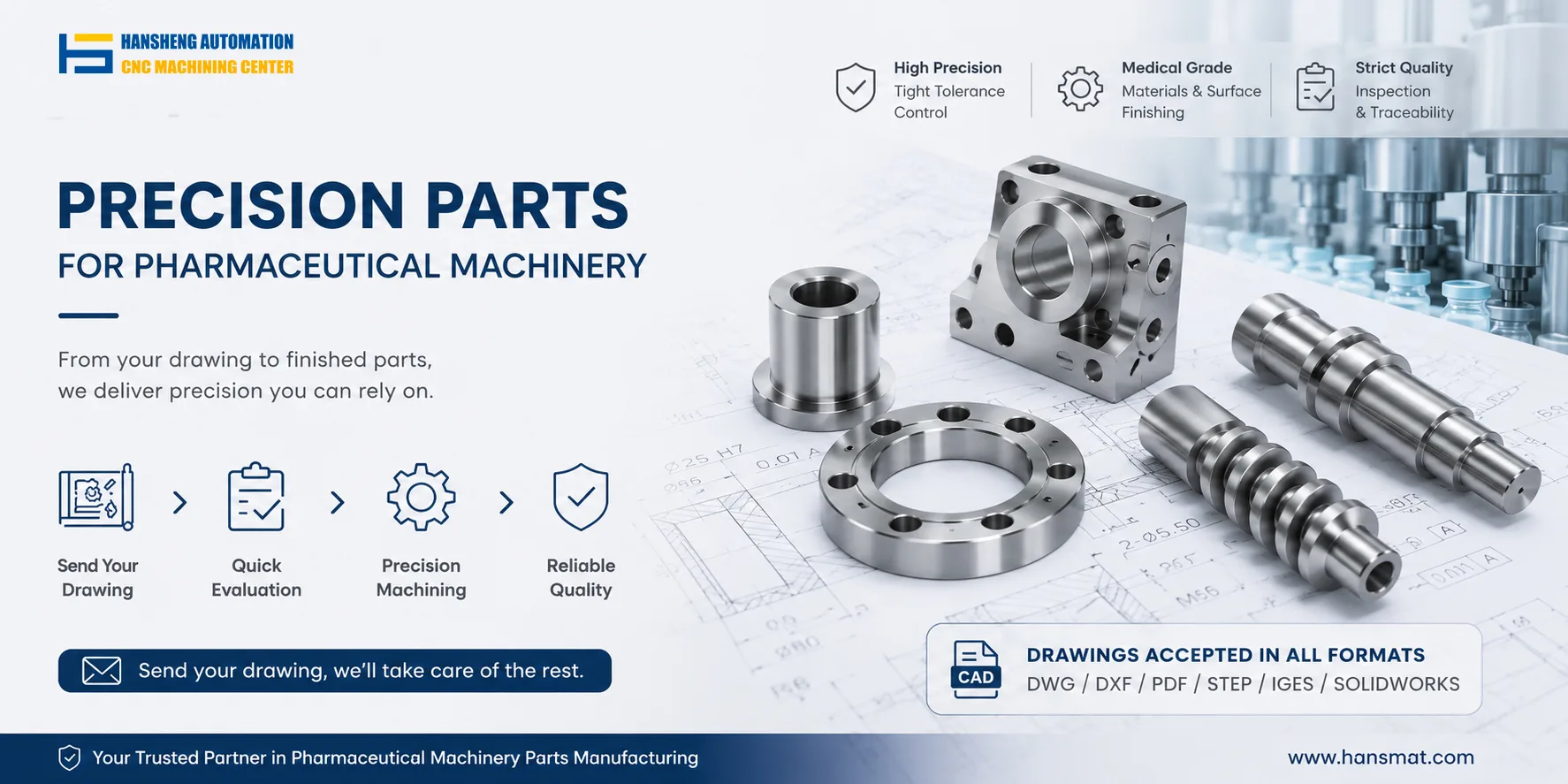
Besides the complete machine, the precision of internal components such as drums, spray assemblies, shafts, supports, and other mating parts also affects equipment performance and operating stability. Hansheng Automation can manufacture custom precision components for pharmaceutical machinery according to customer drawings and technical specifications. We support both prototype and small-batch production and can select suitable machining processes based on material, dimensional tolerances, surface finish, and application requirements.
Working Principle of a High-Efficiency Coating Machine
A high-efficiency coating machine uses a programmable control system to coordinate drum rotation, spraying, and hot-air circulation. After the tablets or other products enter the coating drum, continuous rotation causes them to tumble and move along a controlled path.
During the coating process, the control system operates the spray guns according to preset process parameters, applying the coating liquid as a fine mist onto the product surface. At the same time, the heating and air-handling system supplies filtered hot air, which passes through or circulates around the product bed. This promotes rapid evaporation of water or solvents and helps the coating layer dry evenly.
As spraying, mixing, and drying continue, the coating material gradually forms a continuous, durable, and smooth film on the product surface. Moist exhaust air is removed through the exhaust system and subjected to appropriate dust removal before discharge.
By controlling parameters such as inlet air temperature, airflow, spray rate, and drum speed, the machine can maintain stable coating conditions and improve coating uniformity.
For pharmaceutical machinery manufacturers, components used in coating equipment often require controlled dimensional accuracy, tight fits, good surface finish, and suitable corrosion resistance. We can manufacture shafts, bushings, connectors, support components, and other non-standard parts from customer-supplied 2D drawings or 3D models. Depending on the operating environment, we can also provide suitable material selection and surface-treatment solutions.
Overall, neither perforated nor non-perforated coating machines is universally superior. The appropriate configuration depends on the product characteristics, coating process, production scale, and heat-transfer requirements. As pharmaceutical equipment moves toward greater automation, precision, and production flexibility, the demand for high-quality custom-machined components continues to increase.
Hansheng Automation specializes in made-to-drawing precision machining and provides custom manufacturing services for pharmaceutical machinery and other industrial equipment manufacturers.