Injection molding machines can release volatile organic compounds (VOCs), non-methane hydrocarbons (NMHC), and other fumes during plastic processing. The type and concentration of emissions depend on the resin formulation, processing temperature, material residence time, additives, and operating conditions.
Common exhaust gas treatment options include activated carbon adsorption systems, UV photocatalytic equipment, low-temperature plasma systems, direct-fired thermal oxidizers (TO), and regenerative thermal oxidizers (RTO).
Each technology has different operating requirements and treatment capabilities. Equipment selection should be based on the actual exhaust composition, airflow, pollutant concentration, and applicable emission limits.
Activated Carbon Adsorption Systems
Working principle:
Activated carbon adsorption systems use the porous structure and large internal surface area of activated carbon to capture suitable VOC molecules from the exhaust stream.
As the exhaust passes through the carbon bed, organic compounds are retained on the adsorbent surface. This reduces the VOC concentration in the treated gas.
Suitable applications:
Activated carbon adsorption is commonly considered for low-concentration exhaust streams with relatively low pollutant mass flow rates. It can be used for certain VOC-containing emissions from injection molding operations, provided that the compounds can be effectively adsorbed.
Advantages:
The equipment has a relatively simple structure and does not require a high-temperature oxidation process. Installation and operation are comparatively straightforward.
Limitations:
Activated carbon has a limited adsorption capacity. Once the carbon approaches breakthrough, its removal performance decreases and the adsorbent must be replaced or regenerated.
High humidity and elevated gas temperatures can reduce adsorption performance. The system also requires regular monitoring of outlet VOC concentrations, carbon bed temperature, and pressure drop. Used activated carbon must be regenerated or disposed of according to the applicable requirements.
UV Photocatalytic Waste Gas Treatment Equipment
Working principle:
UV photocatalytic equipment uses ultraviolet radiation to activate a photocatalyst, commonly titanium dioxide (TiO2), and promote oxidation reactions involving organic pollutants.
When exposed to suitable UV radiation, the catalyst generates reactive species, including hydroxyl radicals and superoxide radicals. These species react with certain VOC molecules and odor-causing compounds, helping break them down into smaller oxidation products.
Some equipment also generates ozone to support the oxidation process. However, UV photolysis, ozone oxidation, and photocatalytic oxidation are separate reaction mechanisms and should be evaluated according to the actual equipment configuration.
Suitable applications:
This technology may be considered for selected low-concentration VOC and odor-control applications where the exhaust composition is suitable for UV oxidation.
Advantages:
The equipment generally has a compact structure and does not require the high operating temperatures used by thermal oxidation systems. It can be integrated into a multi-stage exhaust treatment process.
Limitations:
Treatment performance depends on VOC composition, concentration, humidity, UV intensity, catalyst activity, and gas residence time. Some compounds are difficult to degrade through UV treatment alone.
Incomplete oxidation may produce intermediate compounds, and equipment using ozone-producing lamps may leave residual ozone in the treated gas. Additional treatment may be necessary to control these by-products.
UV photocatalytic equipment should not be assumed to provide high VOC removal efficiency for every injection molding process without performance testing.
Low-Temperature Plasma Treatment Equipment
Working principle:
Low-temperature plasma equipment uses a high-voltage electric field to generate energetic electrons, ions, and reactive species within the exhaust stream.
These active species collide with pollutant molecules and initiate chemical reactions that can break down or transform certain VOCs and odor-causing compounds.
Unlike conventional thermal oxidation, the process does not require heating the entire gas stream to a high combustion temperature.
Suitable applications:
Low-temperature plasma technology may be considered for selected low-concentration exhaust streams and odor-control applications. Its suitability depends on the pollutant composition and the required treatment performance.
Advantages:
The equipment can have a compact structure and can operate without a conventional high-temperature combustion chamber. It may also be integrated with other treatment technologies.
Limitations:
Treatment efficiency can vary with exhaust concentration, gas composition, humidity, airflow, and operating conditions. High pollutant concentrations may exceed the effective treatment capacity of the system.
Plasma discharge can also generate ozone, nitrogen oxides, and partially oxidized organic compounds. These by-products should be evaluated when selecting the treatment process.
For injection molding exhaust with complex compositions or strict emission requirements, low-temperature plasma should not be used as the sole treatment method without supporting performance data.
Direct-Fired Thermal Oxidizers (TO)
Working principle:
A direct-fired thermal oxidizer heats the exhaust gas in a combustion chamber to a temperature sufficient for VOC oxidation.
Under suitable operating conditions, organic pollutants react with oxygen and are converted primarily into carbon dioxide and water.
Three main factors determine oxidation performance:
Temperature: The combustion chamber must reach the required oxidation temperature.
Residence time: The exhaust must remain in the chamber long enough for the oxidation reactions to occur.
Mixing: The exhaust gas and combustion air must be adequately mixed to support effective oxidation.
Suitable applications:
Direct-fired thermal oxidizers are commonly considered for relatively high-concentration VOC exhaust streams with lower airflow rates, particularly when the pollutant heating value can contribute to the oxidation process.
They can also be used for other exhaust conditions when the required combustion temperature, fuel consumption, and equipment capacity are economically acceptable.
Advantages:
Thermal oxidation can achieve high VOC destruction efficiency when the equipment is properly designed and operated. The process is suitable for many organic compounds that are difficult to treat through adsorption alone.
Limitations:
The system requires fuel to heat the exhaust to the required oxidation temperature. When VOC concentrations are low, fuel consumption can be substantial.
The inlet concentration must also remain within the equipment's safety limits, with appropriate monitoring of the lower explosive limit (LEL).
Where the exhaust contains halogenated or sulfur-containing compounds, combustion may generate acidic gases that require additional downstream treatment.
Regenerative Thermal Oxidizers (RTO)
Working principle:
An RTO uses ceramic heat storage media to recover thermal energy from treated exhaust and transfer it to incoming gas.
The incoming exhaust passes through a heated ceramic bed, where its temperature increases before entering the oxidation chamber. VOCs are oxidized in the combustion chamber, and the hot treated gas then passes through another ceramic bed, transferring heat to the ceramic media before discharge.
The airflow direction is switched periodically so that the ceramic beds alternate between heat storage and heat release.
This regenerative heat exchange reduces the amount of auxiliary fuel required to maintain the oxidation temperature.
Suitable applications:
RTO systems are commonly used for large-volume exhaust streams with low to moderate VOC concentrations, where heat recovery can provide an economic advantage.
For injection molding operations with multiple production machines and centralized exhaust collection, an RTO may be considered when the combined airflow and VOC loading justify the equipment investment.
Medium- to high-concentration exhaust can also be treated under suitable conditions, but the VOC heat load and LEL safety limits must be evaluated before selecting the system.
Advantages:
The ceramic heat recovery system can achieve high thermal recovery efficiency, reducing fuel consumption compared with direct-fired thermal oxidation without heat recovery.
RTO systems can also provide high VOC destruction efficiency when temperature, residence time, and gas mixing are properly controlled.
Limitations:
RTO equipment has a relatively high initial investment cost and requires more installation space than activated carbon adsorption units.
The ceramic beds, switching valves, burners, and control system require regular inspection and maintenance. Particulate matter and condensable substances must also be controlled to prevent deposits and blockage within the heat storage media.
How to Select Exhaust Treatment Equipment for Injection Molding Machines
Equipment selection should consider the characteristics of the exhaust rather than relying on a simple concentration or airflow classification.
Low-concentration exhaust with relatively low airflow:
Activated carbon adsorption may be suitable when the VOC components have adequate adsorption characteristics. UV photocatalytic or low-temperature plasma systems can be considered for selected applications, but their actual removal performance and potential by-products should be verified through testing.
Higher-concentration exhaust with relatively low airflow:
A direct-fired thermal oxidizer may be suitable when the VOC heating value, combustion conditions, fuel consumption, and LEL safety requirements are acceptable.
Large-volume exhaust with low to moderate VOC concentrations:
An RTO may offer better operating economics because its ceramic media recover heat from the treated exhaust. The inlet VOC loading and airflow stability should be evaluated before equipment selection.
Exhaust with complex compositions or particulate contamination:
Additional filtration or other pretreatment may be necessary before the main treatment unit. The material compatibility of downstream equipment must also be checked when the exhaust contains corrosive or potentially catalyst-deactivating compounds.
Before finalizing the system, the resin type, additives, processing temperature, exhaust composition, airflow, and outlet emission requirements should be assessed. Representative sampling and testing can help determine the appropriate treatment process.
Custom Machining for Injection Molding and Industrial Equipment
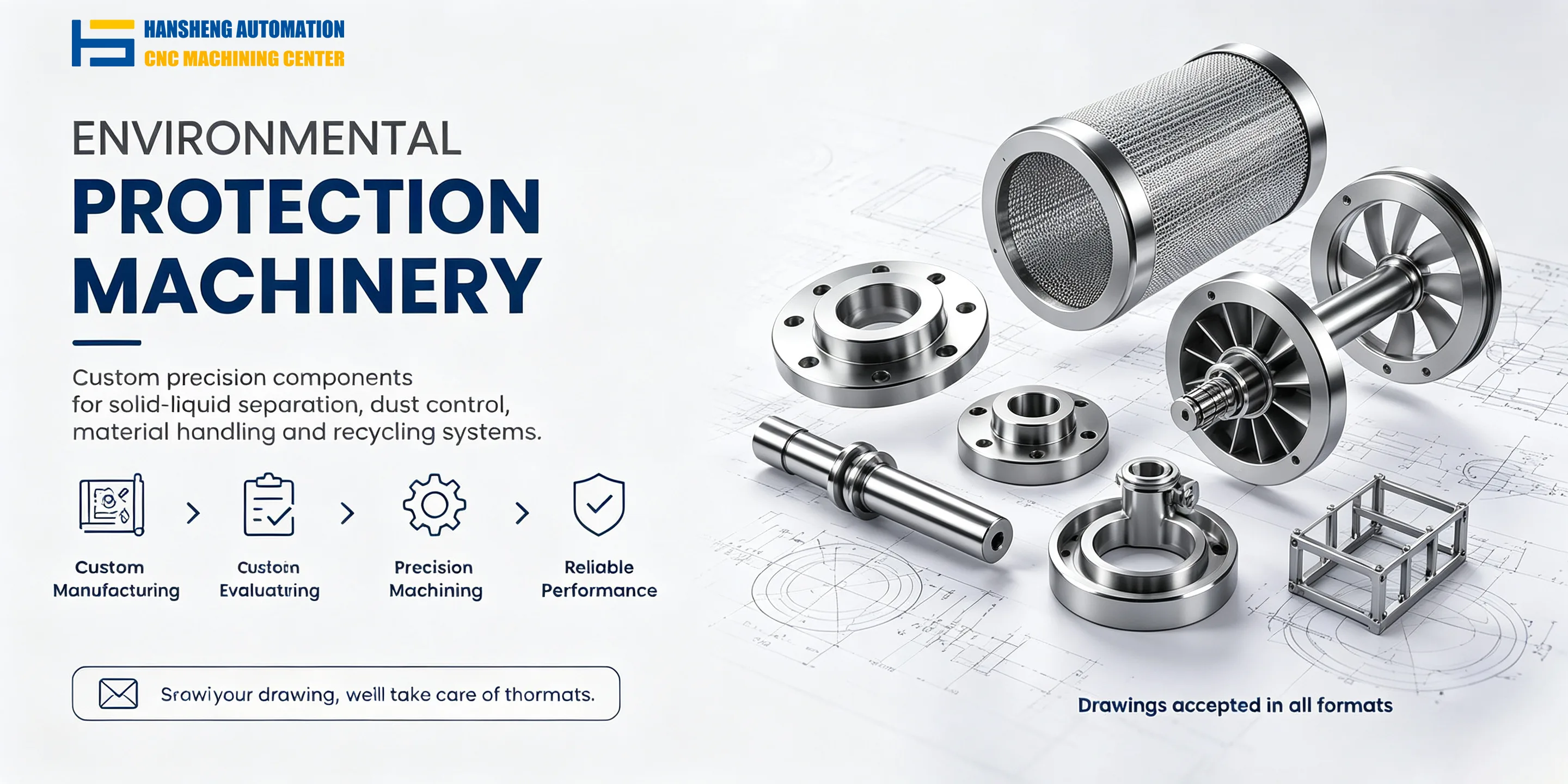
In addition to components used in injection molding and environmental protection equipment, Hansheng Automation provides drawing-based precision machining for non-standard industrial parts.
Our machining services also cover precision components for yacht equipment, remote-controlled racing cars, tobacco machinery, and filling and packaging equipment. We support single-piece and small-batch manufacturing according to customer drawings, dimensions, and assembly requirements.