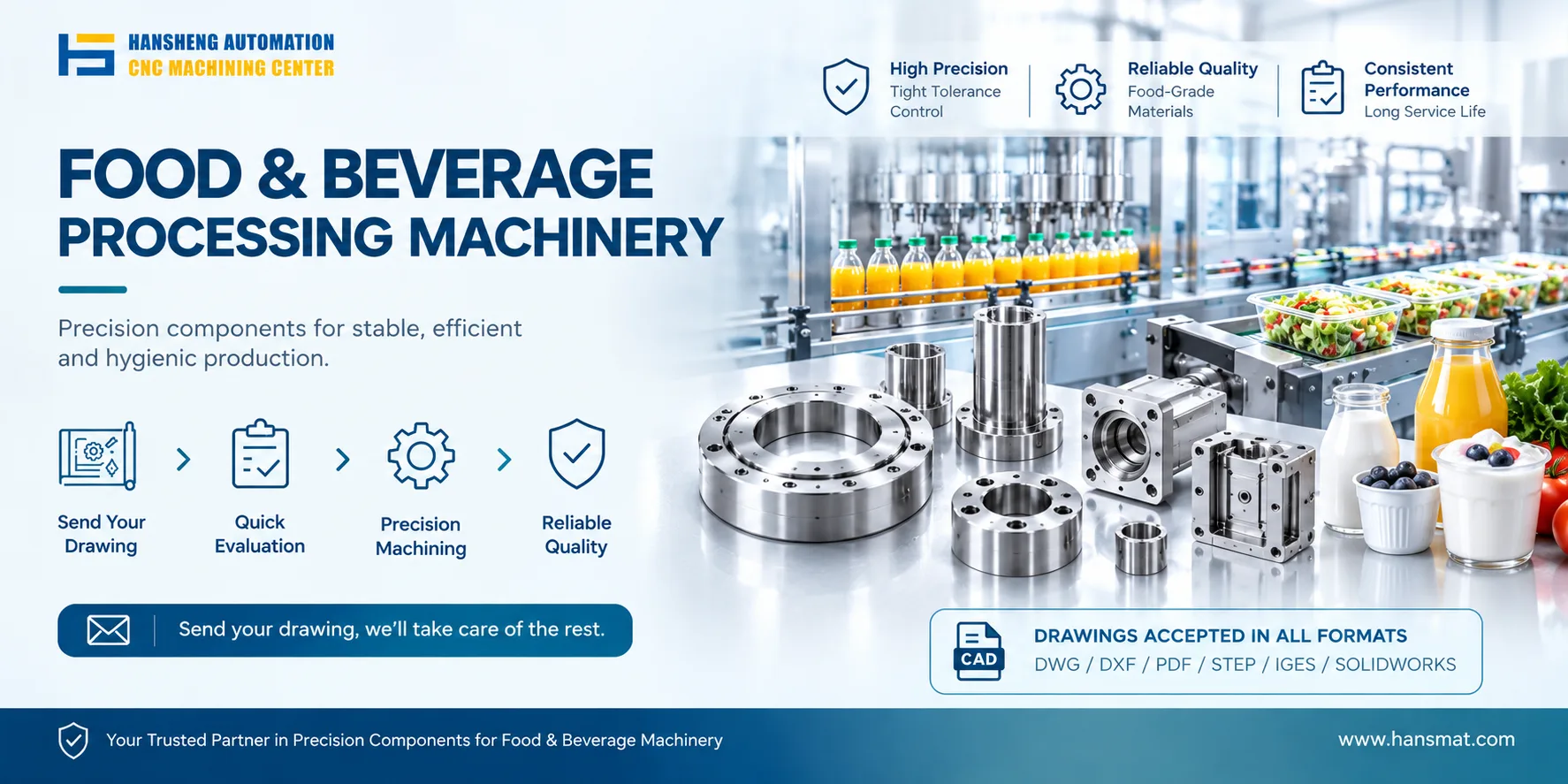
Commercial bread baking needs equipment across four stages: pretreatment, dough processing, baking, and post-baking handling. The right configuration depends on whether the operation is a retail bakery or a mass-production plant. Hansheng Automation can machine custom molds, conveyor components, and other non-standard parts for bakery equipment to customer drawings.
Pretreatment Equipment
Flour Sifting
Flour sifters come in vibrating and air-classifying types. They remove lumps and impurities and keep flour fine and consistent. Clean flour supports even hydration and stable dough development. Equipment should meet the cleaning requirements of GB 14888-2014, the general hygiene standard for food production.
Ingredient Weighing
Weighing equipment includes manual electronic platform scales and automatic central batching systems. Accurate weighing of flour, yeast, sugar, and fat prevents batch-to-batch quality differences. Scales should be calibrated on a regular schedule.
Egg Handling
Vertical or horizontal egg beaters separate and whip egg liquid. Some models can also mix sugar and oil ingredients at the same time. Egg temperature and whipping time affect volume and crumb structure in the finished bread.
Dough Processing Equipment
Mixers
Spiral mixers are the mainstream commercial type. They suit high-gluten flour and develop the gluten network fully. Commercial capacities range from 20 L to 200 L to match different output levels. For high-end European bread, a vacuum mixer can reduce air bubbles inside the dough and give a finer crumb structure. When replacement mixing arms or bowls are needed, we can machine them to drawing.
Dough Dividers
Automatic dividers cut the bulk dough into pieces of fixed weight. Dividing accuracy can reach within ±2 g, which suits volume production. Consistent piece weight keeps proofing and baking even across the batch.
Dough Rounders
Rounders work with the divider to shape pieces into smooth balls. Rounding tightens the surface and helps the dough proof and bake evenly.
Intermediate Proofing Cabinets
Proofing cabinets control temperature at 30 to 38 C and humidity at 70 to 85 percent. They let the divided dough relax, releasing internal stress from mixing and making the next shaping step easier.
Shaping Machines
Shaping machines include toast shapers and baguette shapers. They roll and form the dough into the standard shape for each bread type. The shaping step sets the final appearance and internal structure of the loaf.
Core Baking Equipment
Deck Ovens (Stone Hearth)
Deck ovens are the mainstream baking equipment in commercial bakeries. Each deck can be controlled independently. A stone hearth inside stores heat and gives the bottom crust a crisp texture. Deck ovens suit European bread, toast, and similar products.
Tunnel Ovens
Tunnel ovens are continuous baking equipment for large-scale production. The line feeds continuously and uses multiple temperature zones. Output can reach several thousand loaves per hour. Tunnel ovens suit plants that run a steady product mix at high volume.
Convection Ovens
Convection ovens use a fan to circulate hot air, so bread browns evenly. They suit volume production of small buns and Danish pastries that need uniform heat.
Baking Trays
Baking trays should meet GB 4806.9-2016, the standard for food contact metal materials and products. Non-stick or steel trays are selected to match the oven type and the product.
Post-Baking Handling Equipment
Cooling Racks
Multi-tier stainless steel cooling racks let baked bread cool naturally in a ventilated area. Proper cooling prevents internal moisture from condensing and making the bread soft or soggy.
Packaging Equipment
Packaging equipment includes semi-automatic heat shrink packaging machines and automatic horizontal packaging machines. They seal the finished bread and protect it from moisture and microorganisms, which extends shelf life.
Toast Slicers
Toast slicers are designed for toast bread. Slice thickness can be adjusted from 8 to 15 mm. Machine slicing avoids the uneven thickness that comes with hand cutting.
Temporary Refrigerated Storage
Commercial refrigerated or freezer cabinets store unbaked dough or finished bread. Cold storage slows staling and helps the bakery manage production schedules.
Matching Equipment to Production Scale
A retail bakery can start with a spiral mixer, a deck oven, a divider, a rounder, and a proofing cabinet. A mass-production plant needs a tunnel oven, automatic dividing and shaping, a continuous proofing system, and automated packaging. Product type also affects the equipment list. European bread needs a stone hearth oven, while soft buns and pastries need a convection oven.
Maintenance and Replacement Parts
Regular maintenance should cover mixer arms and bowls, divider blades, conveyor belts, oven door seals, and tray surfaces. Worn divider blades affect piece weight. A damaged oven seal causes uneven heat and higher energy use. When replacement parts are needed, Hansheng Automation can machine non-standard components such as mixing arms, divider parts, and custom trays to drawing.
Our precision custom machining capability is not limited to bakery equipment. Hansheng Automation also produces parts for filling machinery, food processing equipment, and tobacco packaging machinery, along with precision components for yachts and RC cars. From single parts to small batch runs, we machine to customer drawings and deliver parts for assembly.