Papermaking equipment mainly uses five drive types: gear, belt, chain, hydraulic, and direct motor drive. Each one fits different torque, speed, and working environment needs.
Gear drive
This is the most widely used drive type. It suits high torque and high-precision synchronization.
Applications: The press section, dryer section with dryer cylinders, calender, and reel. These sections require multiple rolls to hold strict line speed synchronization. Precision gearboxes, in particular, keep sheet tension stable and prevent sheet breaks or wrinkles.
Advantages: High transmission efficiency up to 99%, compact structure, reliable operation, long service life, constant power output, and very high synchronization accuracy.
Disadvantages: High manufacturing cost, heavy weight, need for good lubrication, and high machining and installation accuracy requirements.
Belt drive
Belt drives are mainly used where center distance is large and shock absorption is needed.
Applications: Auxiliary equipment or the connection between a motor and the main drive, such as some rewinders, ventilation fans, and pumps. Synchronous belts can also be used where synchronization is required but the load is light.
Advantages: Cushions shock, runs smoothly with low noise, simple structure, low cost, and easy maintenance.
Disadvantages: Non-synchronous belts have a non-constant ratio. Transmission efficiency is lower at about 90% to 97%. Belt drives take up more space and have a shorter life, so they need periodic replacement.
Chain drive
Chain drives suit low speed, heavy load, high temperature, and dusty conditions.
Applications: Conveyors in the raw material handling section, waste paper chain plate machines, and pulpers.
Advantages: Reliable operation in high temperature, dusty, and humid environments. Constant transmission ratio and strong load capacity.
Disadvantages: Uneven instantaneous speed, vibration and noise, need for good lubrication and tensioning, and worn chain pitch that lengthens and can cause tooth skip.
Hydraulic drive
Hydraulic drives are used where wide-range stepless speed control and large inertia loads are required.
Applications: Most common on reels and rewinders in modern paper machines. Hydraulic motors provide constant tension and linearly changing torque control, which keeps roll density consistent from inner to outer layers.
Advantages: Wide-range stepless speed control, large output force, high control accuracy, flexible layout, and automatic overload protection.
Disadvantages: Lower transmission efficiency at about 80% to 90%, leakage risk, sensitivity to oil temperature and cleanliness, and high maintenance cost.
Direct motor drive
This is the preferred solution for modern high-speed paper machines, often called the drive point concept.
Applications: Each section of a high-speed paper machine, such as the wire, press, and dryer sections, or even each dryer cylinder, is driven directly by one or more variable-frequency motors.
Advantages: It removes complex mechanical transmission structures such as long shafts and gearboxes, so layout is very flexible. Variable-frequency control allows millisecond-level speed trim between sections, also called speed chain control, with the highest synchronization accuracy. It offers high efficiency, low energy consumption, and low maintenance.
Disadvantages: High initial investment and extremely high reliability requirements for motors and controls.
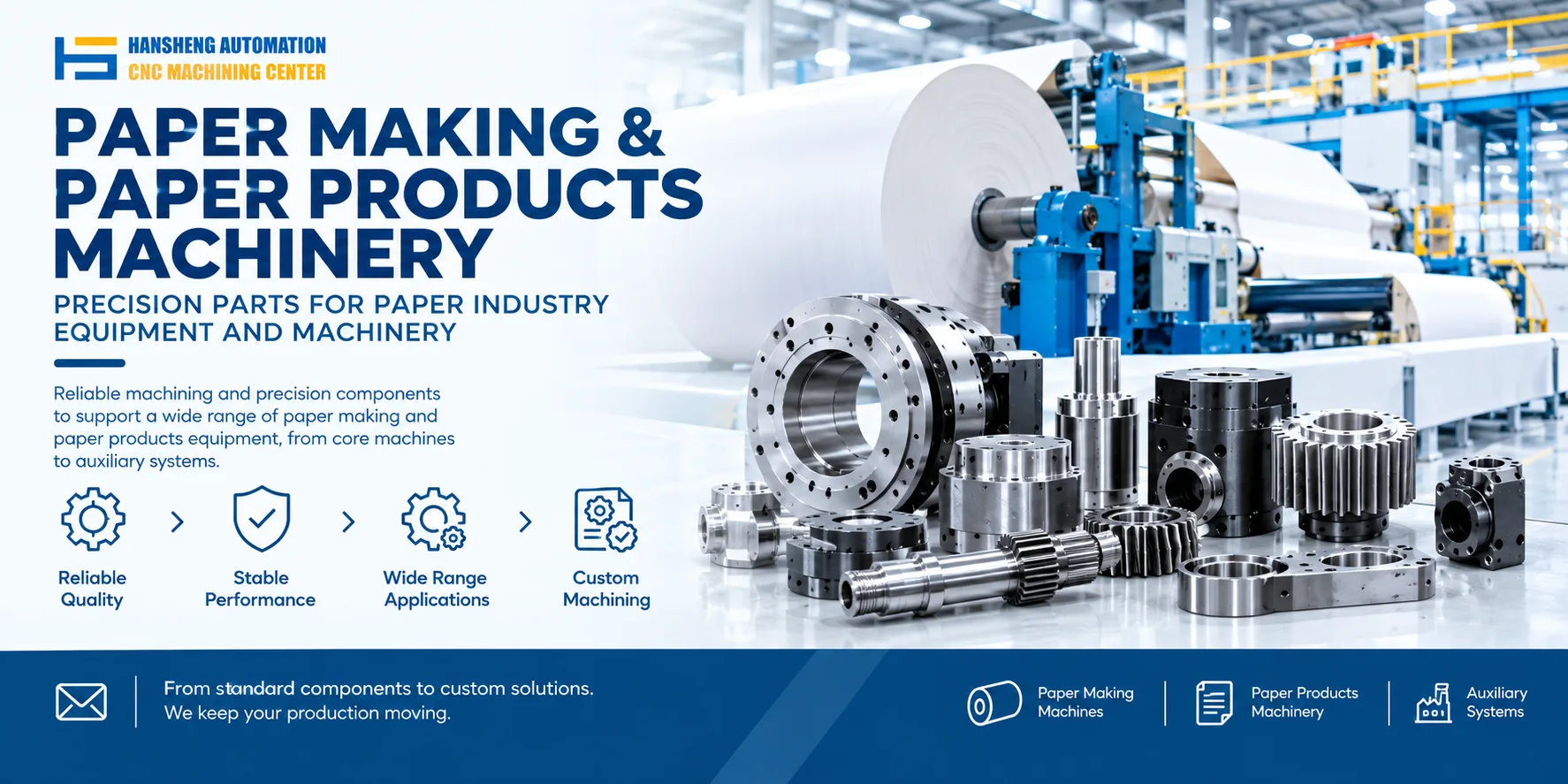
For paper machine drive components such as gears, shafts, bearing housings, and custom machined parts, Hansheng Automation can work from customer drawings and produce single pieces or small batches.
Beyond papermaking drive components, our precision component customization is not limited to this topic. We machine medical device parts, printing machinery parts, yacht precision components, RC car precision components, food machinery parts, filling machinery parts, and tobacco packaging machinery parts. Hansheng Automation works from customer drawings and delivers one-off or batch parts to the required material, tolerance, and surface finish.