The six axes of a six-axis robot are the rotation axis (S axis), lower arm axis (L axis), upper arm axis (U axis), wrist rotation axis (R axis), wrist bend axis (B axis), and wrist swivel axis (T axis). Each axis is located at a specific joint and contributes to overall motion.
The S axis is located at the connection between the robot base and the lower arm. It controls horizontal rotation of the entire robot body and determines the horizontal reach of the end effector.
The L axis connects the base and the upper arm. It controls vertical pitching movement of the upper arm, working together with the S axis to achieve initial positioning in three-dimensional space.
The U axis is located inside the upper arm. It further adjusts the vertical position of the end effector and, in coordination with the L axis, extends the available working height for different operating requirements.
The R axis is located at the end of the upper arm where it connects to the wrist. It controls rotation of the wrist, allowing the end effector to rotate around its own axis and adjust tool orientation, such as during screwdriving operations.
The B axis controls wrist pitching, enabling the end effector to tilt up and down. This is useful for working on inclined surfaces or adjusting tool angle, for example keeping a welding torch perpendicular to the workpiece.
The T axis is located at the end of the wrist. It controls horizontal swinging of the end effector and works together with the R and B axes to achieve arbitrary orientation in space, such as grasping objects from different directions.
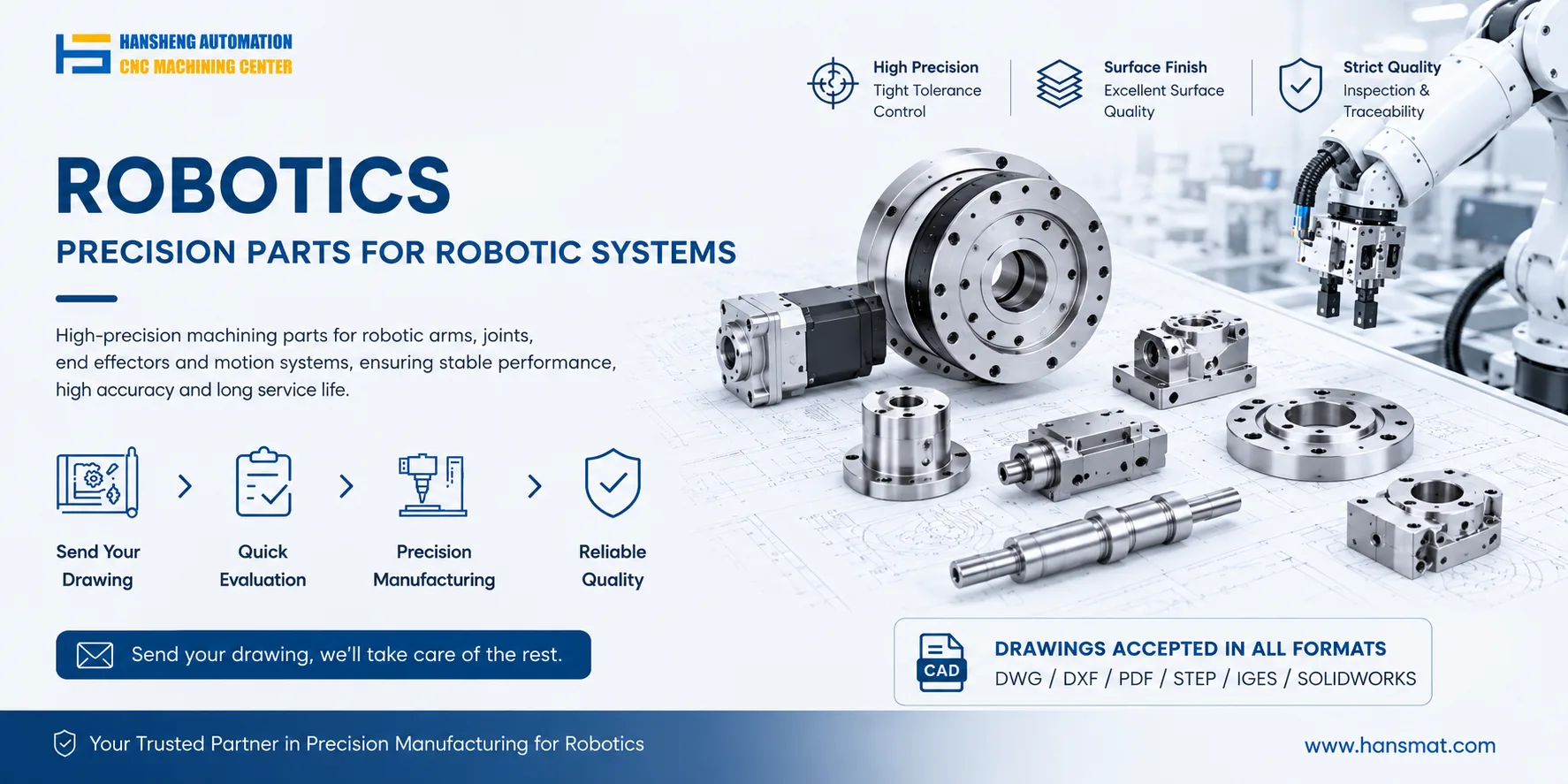
In summary, the first three axes (S, L, U) are primarily responsible for positioning the end effector, while the last three axes (R, B, T) handle orientation adjustment. Through coordinated motion of all six axes, the robot can reach any point within its workspace and complete operations at any required angle, meeting the demands of complex industrial scenarios. For critical joint components such as axis connection flanges, drive shafts, and wrist housings, Hansheng Automation provides custom precision machining based on customer drawings, supporting tight tolerances and a range of surface treatments.