Most roller coaster trains do not have their own onboard engines. After an initial lift or launch, they travel along the track mainly under the influence of gravity and inertia. Depending on how the train is lifted or accelerated, common systems include chain lifts, linear motor launches, hydraulic launches, and friction wheel drives. Some roller coasters use more than one of these systems.
Gravity and Inertia
On a traditional lift-hill coaster, a chain or cable first pulls the train to a certain height, giving it gravitational potential energy. After the train passes the crest of the lift hill, it descends and converts this potential energy into kinetic energy. The resulting momentum carries the train through the drops, curves, and other track sections.
During the ride, air resistance and friction between the wheels and track reduce the train's kinetic energy. Track height and layout must therefore be designed in relation to the train's mass, speed, and running resistance so that it can complete the intended circuit.
Chain Lift Systems
A chain lift is a common method of raising a traditional roller coaster train. Its main components typically include a drive motor, sprockets, a continuous chain loop, and chain dogs attached to the train.
The motor turns the drive sprocket, moving the chain along the lift hill. When the train enters the lift section, its chain dogs engage with the chain, which pulls the train uphill.
At the crest, the chain dogs disengage from the chain and the train begins its descent. An anti-rollback device is also installed to prevent the train from rolling backward if the lift stops because of a power failure or chain fault. A common arrangement uses a toothed rack along the lift track and a pawl or similar device on the train. The pawl engages the rack and restricts backward movement.
Linear Motor Launch Systems
A linear motor launch system uses electromagnetic force to accelerate the train. Unlike a conventional chain lift, it can propel the train directly along the track without first pulling it to the top of a lift hill. The two common types are the linear induction motor (LIM) and the linear synchronous motor (LSM).
A linear induction motor typically has stator coils installed along the track. When alternating current is supplied to the coils, they generate a changing magnetic field. As a conductive reaction plate attached to the train passes through this field, an induced current is generated in the plate. The resulting electromagnetic force propels the train forward.
A linear synchronous motor generates a moving magnetic field through controlled stator windings. This field interacts with permanent magnets on the train to produce propulsion. By controlling the current and the movement of the magnetic field, the system can regulate the train's acceleration and speed during launch.
Hydraulic Launch Systems
A hydraulic launch system uses pressurized hydraulic fluid to drive hydraulic motors and deliver high power over a short period. A typical system includes hydraulic pumps, accumulators, hydraulic motors, a winch drum, launch cables, and a catch car.
Before launch, hydraulic pumps supply fluid to the accumulators, compressing the nitrogen gas inside them and storing energy. When a launch is initiated, the accumulators release the pressurized fluid, which drives the hydraulic motors and rotates the winch drum at high speed. The drum winds in the launch cable and pulls the catch car along the track. The catch car is connected to the roller coaster train and accelerates it rapidly. Once the train reaches the required speed, the launch mechanism disengages.
The term "water-pressure drive wheel system" is not an appropriate general name for this type of equipment. A typical hydraulic launch uses hydraulic oil to drive hydraulic motors. The accumulators store and release energy, while the cable and catch car transfer the pulling force to the train.
Friction Wheel Drive Systems
A friction wheel drive system, also known as a tire drive system, uses electric motors to rotate a series of rubber drive wheels. These wheels contact friction surfaces on the underside or sides of the train and propel it through friction.
Friction wheels can be used for low-speed transport in station areas, as well as for lift hills and launch sections. Unlike a chain lift, this arrangement does not require a chain to engage continuously with the train along the track. It can also be adapted to some curved track sections. Its performance depends on factors such as contact conditions, tire wear, and the operating environment.
The Incredible Hulk Coaster at Universal's Islands of Adventure in Orlando, Florida, uses a friction wheel launch system. As the train enters the initial launch tunnel, motor-driven wheel assemblies grip the drive structure beneath the train and accelerate it up the inclined track. The system also uses flywheel energy storage to release power during launch and meet the high peak-power demand over a short period. This is a friction wheel launch, not a linear induction motor launch.
Flywheel Energy Storage and Its Role in Launch Systems
A flywheel stores kinetic energy through high-speed rotation and releases that energy when required. It can help meet the short-term power demand of a launch system. However, a flywheel is primarily an energy storage device. It should not be treated as the same type of propulsion system as a hydraulic launch, linear motor launch, or friction wheel drive.
In some roller coaster launch systems, an electric motor accelerates the flywheel between launches. The stored energy is then released over a short period when the train is launched, reducing the peak power that must be drawn from the electrical supply. The flywheel installation used with The Incredible Hulk Coaster is one example.
Conclusion
The selection of a roller coaster propulsion system depends on the track layout, train mass, target speed, acceleration requirements, and available installation space. Chain lifts are used to pull trains to an elevated position. Linear motors and hydraulic systems can provide rapid launches. Friction wheels are suitable for low-speed transport, lifting, and launching. Flywheels can also be integrated into these systems to store and release energy.
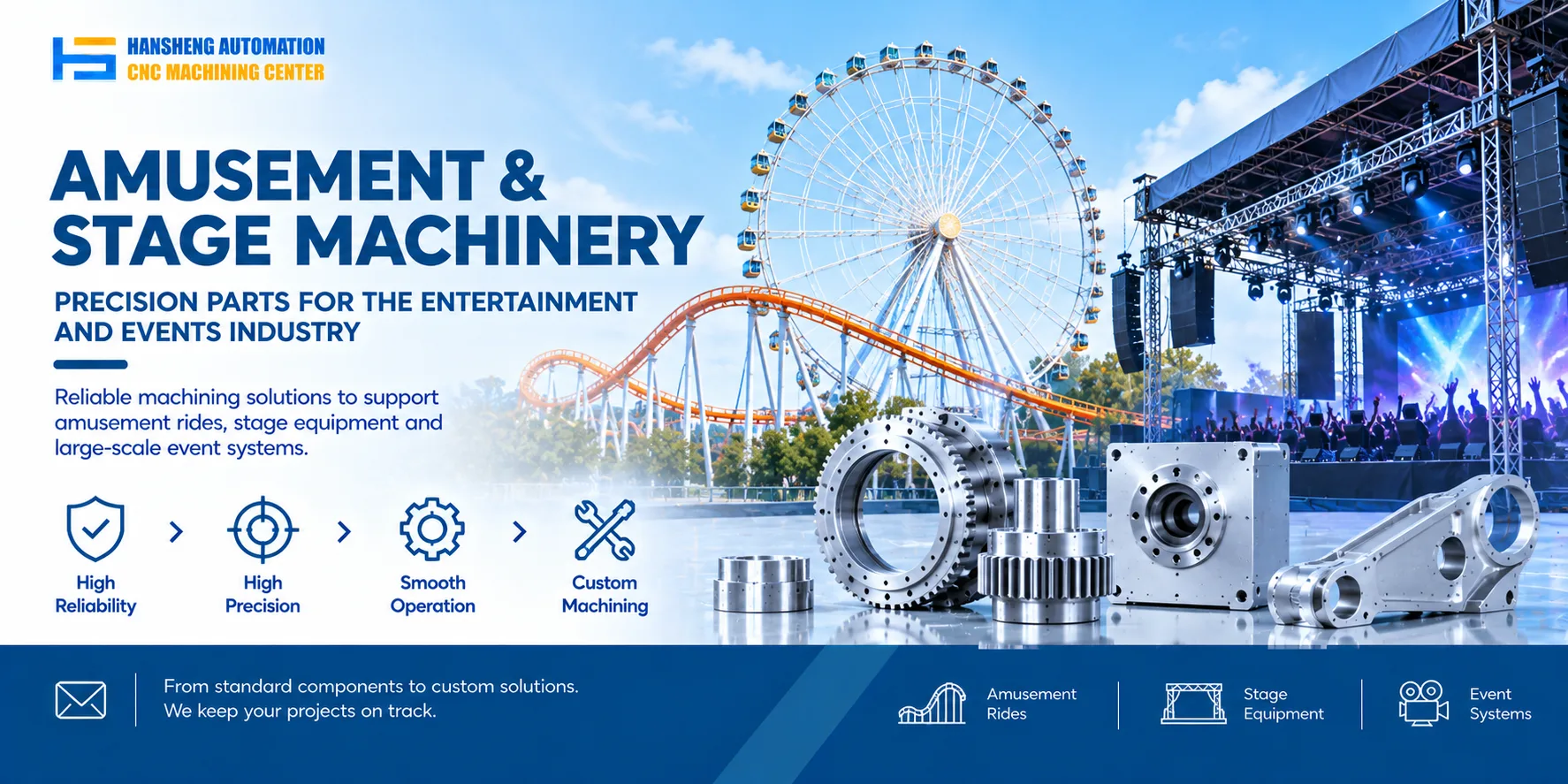
Hansheng Automation provides custom precision machining based on customer drawings, with support for both single-piece and small-batch production. Our machined components are used in amusement and stage machinery, yacht equipment, RC racing car structures, tobacco machinery, packaging machinery, and filling equipment. Machining methods are selected according to the component geometry, material, and drawing requirements.