The technologies used for solid waste resource recovery depend on the composition, physical properties, and reuse potential of the waste. Common methods include compaction, shredding, and sorting, as well as incineration, pyrolysis, gasification, biological treatment, and metal recovery. Solidification and stabilization are also used to control environmental risks associated with waste containing heavy metals and other hazardous substances.
Each method serves a different purpose. Compaction and shredding mainly reduce waste volume or prepare materials for subsequent processing. Sorting separates recyclable materials from mixed waste, while thermal and biological processes convert certain types of waste into energy or other useful products. The main treatment technologies and their applications are described below.
Mechanical Pre-treatment and Sorting Technologies
Mechanical pre-treatment is generally carried out at the beginning of a solid waste processing line. It uses compression, shredding, screening, and sorting to change the size, shape, or composition of waste materials before further treatment.
Compaction
Compaction applies mechanical pressure to solid waste to reduce the space it occupies. Compressed waste is generally easier to store, load, and transport. It can also improve the use of available space in landfills.
This method is suitable for materials with good compressibility, including paper, plastic bottles, aluminum cans, and certain packaging waste. Recycling centers and waste transfer stations commonly use hydraulic compactors or balers to compress loose materials into more manageable blocks for transportation and recycling.
Compaction does not separate materials or directly convert them into recycled products. Its main function is to reduce waste volume and simplify handling, making it a mechanical pre-treatment method.
Shredding
Shredding uses mechanical forces to reduce the size of solid waste so that the material meets the feed requirements of subsequent screening, sorting, incineration, or biological treatment processes. Common shredding methods include impact, shearing, compression, and attrition. Specialized processes, such as cryogenic and wet shredding, are also used for certain materials.
Common equipment includes shear shredders, hammer mills, and rotary drum shredding equipment. Each type is suited to different materials.
Shear shredders handle bulky waste, discarded plastics, wood, and certain types of industrial waste. They reduce material size through the shearing and tearing action of their cutters.
Hammer mills use high-speed hammers to impact materials. They are suitable for certain brittle or easily fragmented waste materials.
Rotary drum shredding equipment processes materials through tumbling, impact, and friction. Depending on its design, it can perform size reduction or other pre-treatment operations.
Cryogenic shredding uses low temperatures to make certain materials brittle before mechanical size reduction. Wet shredding uses water as part of the processing operation and can help control dust under suitable operating conditions.
Shredded materials are generally easier to screen and sort. The required output size depends on the material properties, equipment design, and downstream processing requirements. Smaller particles are not necessarily better for every application.
Sorting
Sorting separates recyclable materials, hazardous components, and other unwanted substances from mixed solid waste. It can also classify materials by particle size. The purpose is to improve recovery efficiency and reduce the amount of waste requiring final disposal.
Common sorting methods include:
Magnetic separation: Magnetic separators use differences in magnetic properties to remove ferrous metals, such as scrap steel and iron-containing materials.
Eddy current separation: This method uses an alternating magnetic field to induce eddy currents in non-ferrous conductive metals. It is commonly used to recover aluminum, copper, and other non-ferrous metals.
Screening: Screens separate materials according to particle size, allowing different fractions to enter the appropriate processing stages.
Air classification: Air classifiers use differences in weight, shape, and aerodynamic properties to separate lightweight materials, such as paper and plastic film, from heavier fractions.
Optical sorting: Optical sorting systems identify materials based on characteristics such as color and spectral response. They are commonly used to separate plastics and other recyclable materials.
In practice, mechanical sorting lines often combine several methods. For example, mixed waste may first pass through shredding and screening equipment, followed by magnetic separation, eddy current separation, or air classification to recover different material fractions.
Thermal Treatment and Thermochemical Conversion Technologies
Thermal treatment uses heat to change the chemical composition of waste. Combustible materials can be converted into heat, gases, or other useful products. The main methods include incineration, pyrolysis, and gasification.
Incineration
Incineration uses high temperatures and an oxygen-rich environment to oxidize and decompose combustible components in solid waste. It reduces waste volume and can recover heat for steam generation or electricity production.
Incineration is generally suitable for combustible waste with sufficient calorific value after appropriate sorting or pre-treatment. Examples include certain types of municipal solid waste and industrial combustible waste. Feed conditions and operating parameters depend on the calorific value, moisture content, ash content, and other properties of the waste.
Incineration temperatures should not be treated as a single fixed range for all facilities. Under Article 50 of the EU Industrial Emissions Directive 2010/75/EU, waste incineration plants must be designed and operated so that the gas, after the last injection of combustion air, reaches at least 850°C for at least two seconds under the specified operating conditions. When hazardous waste containing more than 1% halogenated organic substances, expressed as chlorine, is incinerated, the required temperature is at least 1,100°C.
Incineration facilities also require flue gas cleaning and residue treatment systems. Bottom ash and fly ash have different compositions and contamination characteristics, so their potential for recovery or disposal must be assessed separately.
Pyrolysis
Pyrolysis heats organic materials in the absence of oxygen or under oxygen-deficient conditions, causing them to decompose. Unlike direct incineration, pyrolysis does not rely on complete combustion to break down the material. Instead, heat drives the decomposition process.
Pyrolysis can produce three main types of products:
Gas: The gas phase mainly contains carbon monoxide, hydrogen, and other volatile gases. After suitable cleaning, it can be used as a fuel.
Liquid: Condensable vapors produced during pyrolysis can be collected through condensation to form liquid products, including pyrolysis oil. Their composition depends on the feedstock and operating conditions.
Solid: The solid residue mainly consists of carbonaceous material and may also contain ash, minerals, and metal components.
For solid waste treatment, the European Commission's Waste Incineration Best Available Techniques (BAT) Reference Document gives an approximate pyrolysis temperature range of 250°C to 700°C. The actual operating temperature depends on the waste composition, reactor design, and process requirements.
Pyrolysis products may have energy or material recovery value, but further treatment is usually necessary before use. This may include gas cleaning, liquid separation, and solid residue treatment. Capital investment, operating costs, and secondary pollution control also depend on the specific process. Pyrolysis should not automatically be considered less expensive than incineration or assumed to have a lower pollution risk.
Gasification
Gasification is another thermochemical conversion process. It uses a limited supply of oxygen, air, or steam to partially oxidize and convert carbon-containing materials in waste. The main product is synthesis gas, which primarily contains carbon monoxide and hydrogen.
Unlike complete combustion, gasification does not convert all combustible components directly into carbon dioxide and water. After cleaning, the synthesis gas can be used for heating, power generation, or further chemical processing.
Gasification temperatures vary with the feedstock, gasifying agent, and reactor design. The European Commission's Waste Incineration BAT Reference Document gives a typical range of 500°C to 1,000°C, although temperatures can reach 1,600°C in some processes. Pyrolysis and gasification are related thermal conversion methods, but they differ in their reaction conditions and mechanisms.
Biological Treatment and Bioleaching Technologies
Biological treatment uses microorganisms or enzymes to convert organic solid waste. Depending on the material composition and treatment objectives, aerobic or anaerobic processes can be selected.
Composting
Composting uses aerobic microorganisms to decompose organic waste in the presence of oxygen. The process gradually converts biodegradable materials into relatively stable humus-like products.
Common feedstocks include food waste, garden waste, agricultural residues, and other biodegradable organic materials. Moisture content, aeration, and feedstock composition need to be controlled to maintain suitable conditions for microbial activity.
After sufficient decomposition and quality testing, compost products that meet the relevant requirements can be used as organic fertilizers or soil amendments. Waste containing significant amounts of plastic, heavy metals, or other contaminants must be sorted and pre-treated. Such materials should not be used directly to produce fertilizer.
Anaerobic Digestion and Biogas Production
Anaerobic digestion uses microorganisms to break down organic waste in an oxygen-free environment. The process produces biogas, which mainly consists of methane and carbon dioxide, along with digestate.
After purification, biogas can be used for boiler heating or electricity generation. It can also be upgraded to produce biomethane. Digestate can be used for further purposes after appropriate treatment and quality testing.
This technology is mainly suitable for food waste, agricultural organic waste, and other biodegradable materials. Impurities, fat content, and hazardous substances in the feedstock can affect the digestion process. Waste classification and pre-treatment are therefore necessary before feeding the material into the digester.
Biological Conversion of Cellulose
Agricultural residues, waste paper, and other suitable lignocellulosic materials can be processed through pre-treatment, enzymatic hydrolysis, and microbial fermentation. These processes break down cellulose and related components into fermentable sugars, which can then be used to produce various biological products.
Certain properly processed materials may also be used as feed ingredients. However, their suitability depends on the original material, contaminant levels, and feed safety requirements. This method is intended for selected cellulose-rich feedstocks and is not suitable for untreated mixed municipal solid waste.
Bioleaching
Bioleaching uses specific microorganisms and their metabolic products to convert target metals in waste materials into soluble forms. The dissolved metals can then be recovered through subsequent separation and purification processes.
This method can be applied to certain types of electronic waste, metal-bearing industrial residues, tailings, and metallurgical by-products. Copper and gold are examples of metals that can be recovered through bioleaching.
The recovery efficiency depends on the waste composition, pH, solid-to-liquid ratio, microbial species, and operating conditions. Compared with conventional chemical leaching, bioleaching uses microorganisms as part of the metal extraction process. However, its reaction rate and range of applications are limited by the feedstock properties and process conditions. The method must be evaluated according to the target metals and waste composition.
Solidification and Stabilization Technologies
Solidification and stabilization are mainly used to treat hazardous waste, contaminated soil, and industrial sludge containing heavy metals or other harmful substances. Their purpose is to reduce the mobility and leaching potential of contaminants.
Solidification typically involves adding binding materials such as cement or asphalt to form a more stable solid structure. This reduces the permeability of the treated material and helps prevent contaminants from escaping.
Stabilization works primarily through chemical reactions that change the form of contaminants, reducing their solubility and mobility. For example, suitable stabilizing agents can be used to convert certain heavy metals into less soluble forms.
These methods can be used separately or together, depending on the treatment requirements. After processing, the treated material should undergo leaching tests, mechanical strength testing, and durability evaluation to confirm whether it meets the requirements for its intended disposal or use.
It is important to distinguish solidification and stabilization from direct resource recovery. These processes generally do not destroy or remove the contaminants. Instead, they physically contain them or chemically reduce their mobility. They are therefore mainly used for pollution control and hazardous waste pre-treatment rather than direct material recovery.
How to Select a Suitable Solid Waste Treatment Technology
Different types of solid waste have different compositions and recovery potential. In practice, process selection should consider the material properties, treatment capacity, and intended use of the recovered products. Several technologies may also need to be combined.
Select the Technology According to Waste Composition
Combustible waste with a high calorific value that is unsuitable for material recycling may be assessed for incineration, pyrolysis, or gasification.
Biodegradable materials, such as food waste, garden waste, and agricultural residues, are suitable for processes such as composting or anaerobic digestion.
Mixed solid waste containing recoverable metals can be processed using magnetic separation and eddy current separation.
Electronic waste, industrial residues, and tailings containing target metals may require mechanical separation, chemical leaching, or bioleaching, depending on their composition.
Heavy metal-contaminated soil and certain types of hazardous waste may require solidification and stabilization based on the contaminants present and their leaching characteristics.
Consider Processing Capacity and End-Use Requirements
Processing capacity also affects equipment configuration and process selection. Large continuous production lines need to account for equipment throughput, material conveying, automated control, and coordination between different treatment stages.
The quality requirements of the final products, energy consumption, pollutant emissions, residue disposal methods, and operating costs must also be evaluated. Materials intended for recovery should undergo the necessary separation and quality testing before their suitability for further production or use can be determined.
Custom Machining for Solid Waste Processing Equipment
Solid waste resource recovery rarely relies on a single machine or treatment method. Mechanical pre-treatment, material sorting, thermochemical conversion, biological treatment, and pollution control often need to work together. Selecting suitable processes helps improve material recovery and reduce the amount of waste requiring final disposal.
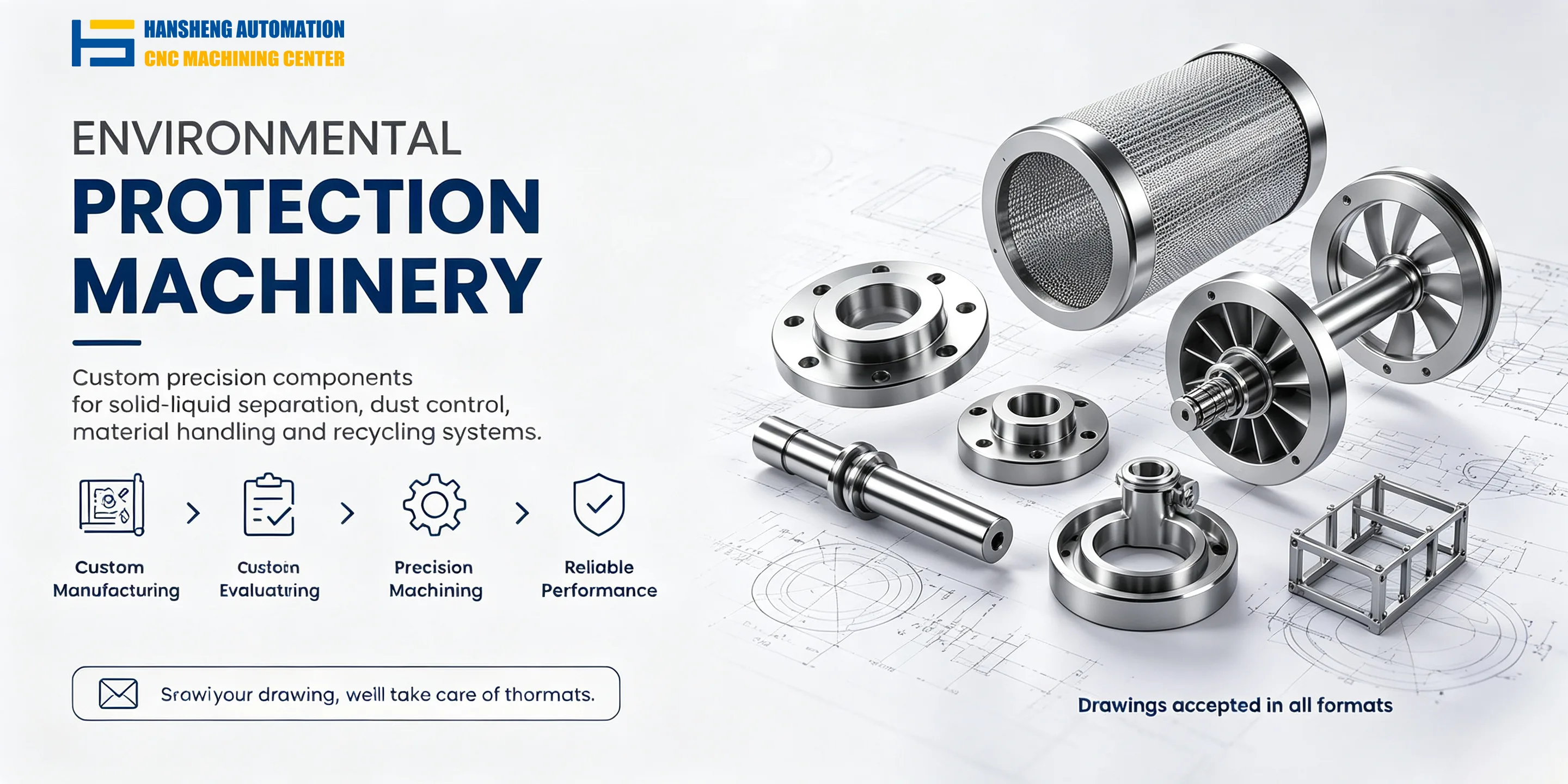
For components used in solid waste processing equipment and related machinery, we provide custom precision machining based on customer-supplied drawings. Hansheng Automation also manufactures precision components for other industries, including non-standard parts for tobacco packaging machinery and filling machinery, as well as precision structural components for yacht equipment and radio-controlled racing cars. We support single-piece and small-batch production according to specific drawing and machining requirements.