A six-axis robot has six joint modules, each responsible for a specific motion function.
Axis 1: This joint connects the base and mainly supports the weight of the upper structure while enabling left and right rotation of the base. The rotation is driven by a motor and reducer. Each axis represents one independent motion mode.
Axis 2: This joint controls the forward and backward swing of the robot's main arm and also drives the vertical movement of the main arm body.
Axis 3: Axis 3 also controls forward and backward swing of the robot arm, but its swing range is smaller than that of Axis 2.
Axis 4: Axis 4 controls the upper cylindrical section of the robot arm and allows free rotation. Its motion range is similar to a human forearm, but it is not a full 360° rotation because internal wiring limits the movement.
Axis 5: Axis 5 controls fine-tuned upward and downward flipping motion. It is usually the joint that allows a picked product to be turned over after gripping.
Axis 6: Axis 6 is the rotating part at the end flange. It can rotate 360°.
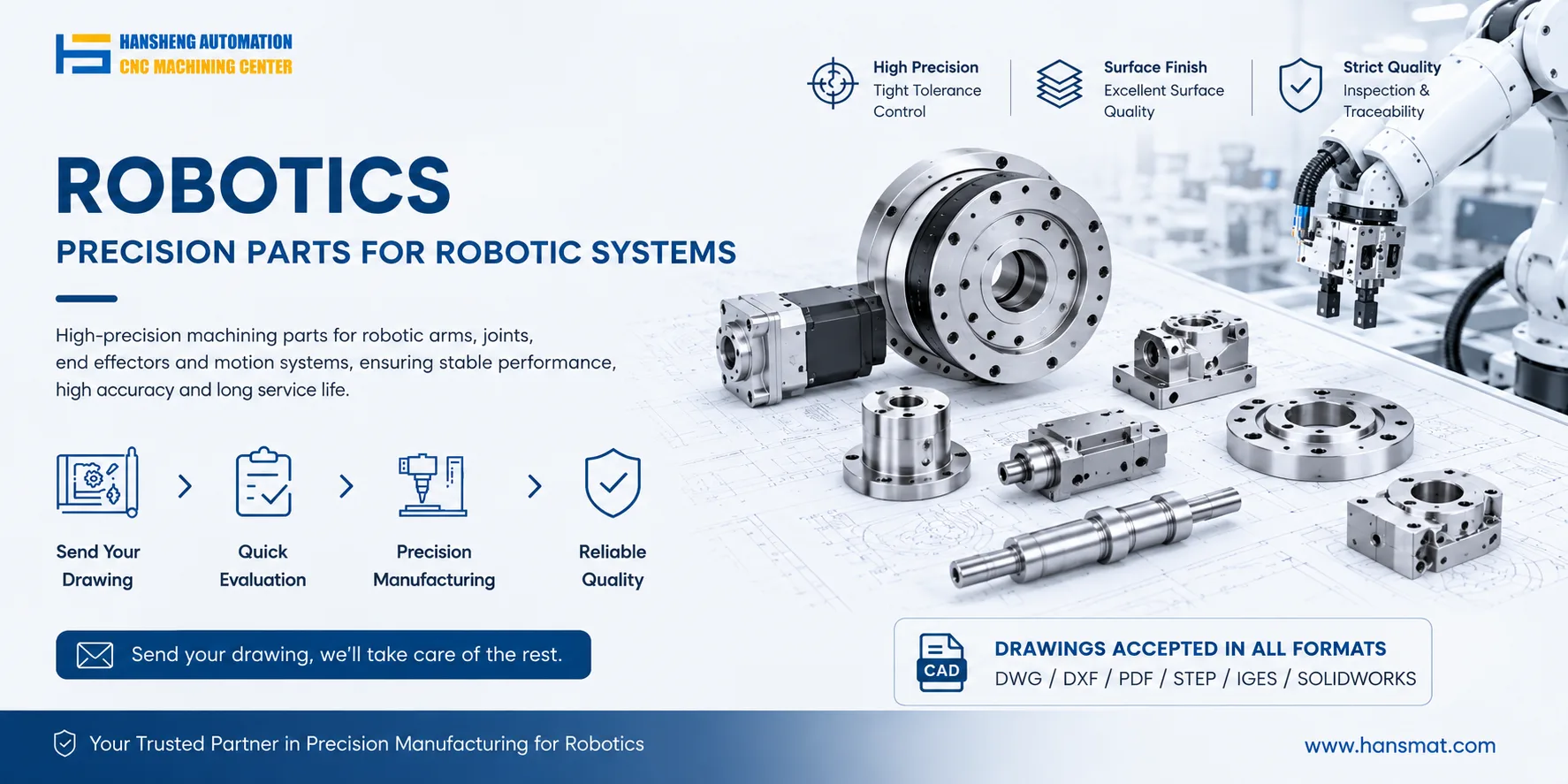
For non-standard joint module housings, adapter flanges, or replacement mechanical parts used in these six-axis robot joints, Hansheng Automation provides custom machining services based on customer drawings, supporting prototype development and small-batch production.