Laser marking machines and laser engraving machines differ mainly in working principle, laser source, applicable materials and industries, processing depth, speed, processing technology, and price.
Working Principle
A laser marking machine uses a laser beam to create permanent marks on the surface of various materials. The mark is produced by evaporating surface material to expose deeper layers, by chemical or physical changes caused by light energy, or by burning certain substances to reveal the desired etched pattern or text.
A laser engraving machine uses the thermal energy of the laser to engrave and cut materials. It is also referred to as a laser cutting machine or laser etching machine.
Laser Source
Laser marking machines are mainly divided into CO2 laser marking machines, semiconductor laser marking machines, fiber laser marking machines, and YAG laser marking machines. Different lasers have different service lives. Metal tube lasers and YAG solid-state lasers generally last around 30,000 hours, while fiber lasers used in marking machines can last up to 100,000 hours.
Laser engraving machines can be divided into CO2 non-metal laser engraving machines and fiber metal engraving machines. CO2 non-metal machines typically use carbon dioxide glass tubes, whose service life is generally 2,000 to 10,000 hours. Fiber lasers can operate continuously for more than 100,000 hours.
Applicable Materials and Industries
CO2 laser marking machines are suitable for a wide range of non-metal materials, including garment accessories, pharmaceutical packaging, wine packaging, building ceramics, beverage packaging, fabric cutting, rubber products, shell nameplates, craft gifts, electronic components, and leather.
Fiber laser marking machines are widely used on metal products.
Laser engraving machines are roughly divided into non-metal and metal types. They can process not only metals but also non-metal materials such as bamboo, wood, crystal, horn, cardboard, acrylic, marble, cloth, leather, rubber, and plastic. They are used for clothing, embroidery, fabric toys, household textiles, handbags, gloves, leather cutting and surface engraving, as well as precision cutting of acrylic sheets and medium-density decorative boards in industries such as crafts, models, advertising, decoration, electrical appliances, and plastics.
Processing Depth
Laser marking only affects the material surface, with a very shallow depth, generally less than 0.5 mm.
Laser engraving can reach much greater depths, ranging from 0.1 mm to 100 mm depending on the material, and can cut deeper into the object.
Processing Speed
For laser engraving machines, the maximum cutting speed is generally around 200 mm/s, and the engraving speed is about 500 mm/s.
Laser marking machines are typically about three times faster than laser engraving machines.
Processing Technology
Laser engraving machines can be equipped with electric lifting platforms and rotary axes, allowing them to engrave cylindrical, irregular, spherical, and other regular or irregular objects.
Laser marking machines, due to the stable control of the Q-head and the optical path arrangement, allow the focal length of the platform to be adjusted from left to right and up and down, making them most suitable for flat surface marking.
Price
For laser engraving machines, deeper engraving requires higher power. Low-power non-metal laser engraving and cutting machines are often much cheaper than laser marking machines, but high-power models can also be more expensive.
Ordinary laser marking machines have very shallow marking depth and low laser power, and their price is generally lower for standard models.
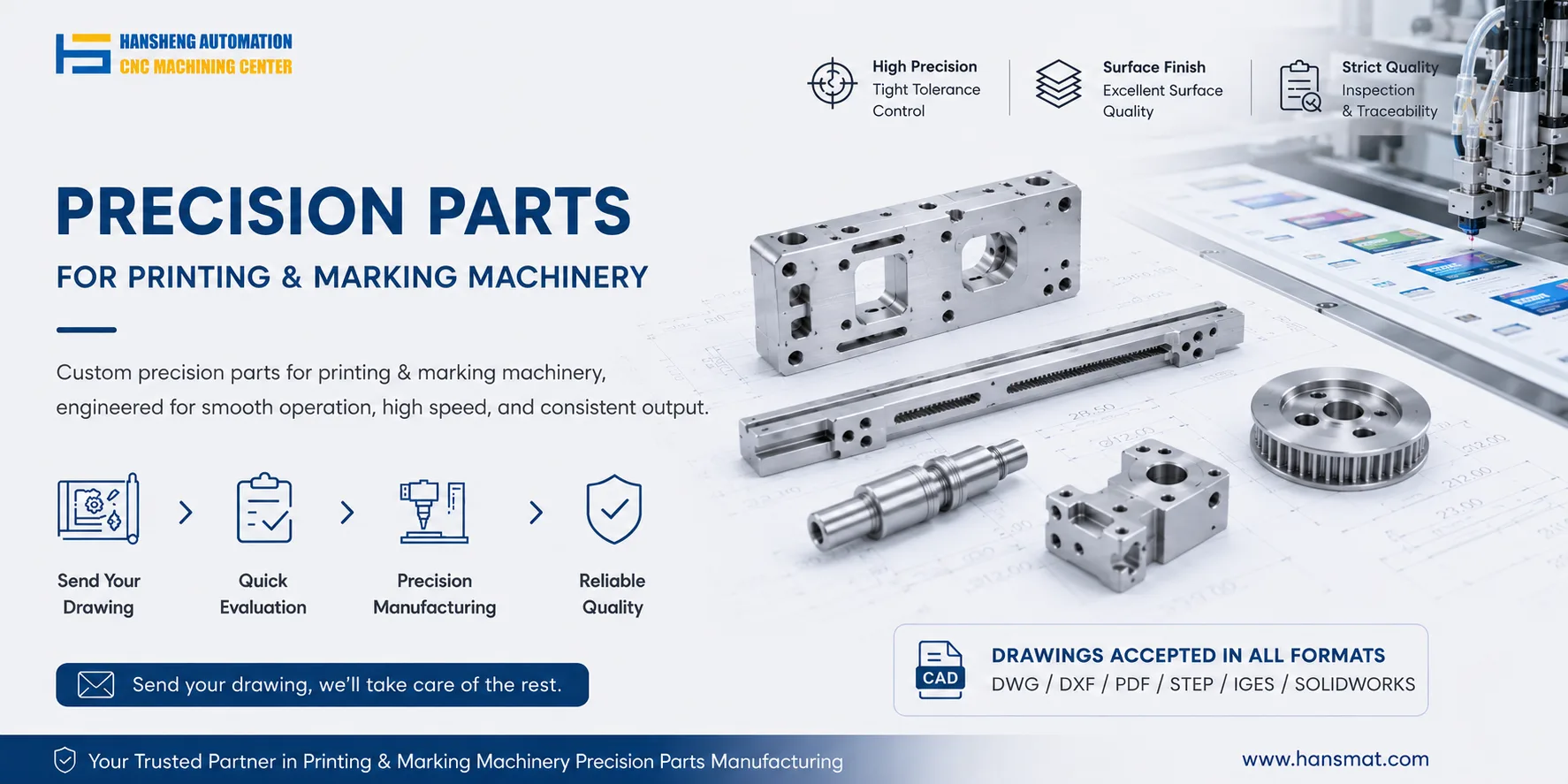
Both types of equipment depend on high-precision motion platforms, optical mounting brackets, and custom fixtures to maintain consistent marking or engraving quality. For non-standard components such as laser mounting seats, rotary axis adapters, and precision guide rails, Hansheng Automation provides custom machining based on customer drawings or samples, including single-piece and small-batch orders.