Common robotic arms can be classified by industry, mainly including robots for daily life, injection molding robotic arms, stamping robotic arms, lathe robotic arms, six-axis industrial robots, and other industrial robots. The details are as follows.
1. Robots for Daily Life
Robots for daily life are mainly used to replace manual basic operations, such as food-serving robots in restaurants and versatile robots shown on television. These robots can usually imitate human movements, language, and even facial expressions, but most are still in the research or experimental stage and have not yet been widely deployed.
2. Injection Molding Robotic Arms
Injection molding robotic arms, also called injection molding machine manipulators or plastic machine manipulators, are designed specifically for automation in injection molding production. Their functions include automatic sprue cutting, in-mold inserts, labeling, assembly, shaping, sorting, stacking, packaging, and mold optimization. Through automatic control, they can replace heavy manual labor, improve working conditions, increase production efficiency, stabilize product quality, and reduce scrap rates and production costs.
3. Stamping Robotic Arms
Stamping robotic arms, also known as stamping press manipulators, are used for automated operations in stamping production. They can perform workpiece gripping, transfer, and other actions according to preset programs. They are suitable for loading and unloading on a single machine, and can also be used on a production line composed of multiple presses to automatically transfer workpieces, forming an automated production line. Their advantage is that the working program can be flexibly adjusted to adapt to frequent product changes in small and medium-sized stamping production.
4. Lathe Robotic Arms
Lathe robotic arms, also called automatic loading and unloading manipulators for lathes, are mainly used for automation in machine tool manufacturing processes. By integrating machining technology, they perform operations such as loading, unloading, workpiece turnover, and process transfer. Compared with traditional dedicated machines or manual loading and unloading, they have the advantages of small footprint, simple structure, easy maintenance, high flexibility, and good adaptability to rapid product updates. They also reduce labor intensity, decrease work-related injuries, and improve production efficiency and product quality stability.
5. Six-Axis Industrial Robots
The six-axis industrial robot is a widely used process testing instrument in engineering and technology fields. Its six axes simulate human joint movements as follows:
Axis 1: connects to the base, supports the weight of the upper axes, and enables left-right rotation.
Axis 2: controls the forward-backward swing and vertical movement of the main arm.
Axis 3: assists the main arm in forward-backward swing, with a smaller range than Axis 2.
Axis 4: controls the rotation of the central cylindrical part, with a motion range similar to a human forearm, but not a full 360° rotation.
Axis 5: provides fine-tuned upward and downward flipping motion for posture adjustment after product gripping.
Axis 6: the end flange can rotate 360° to complete complex movements.
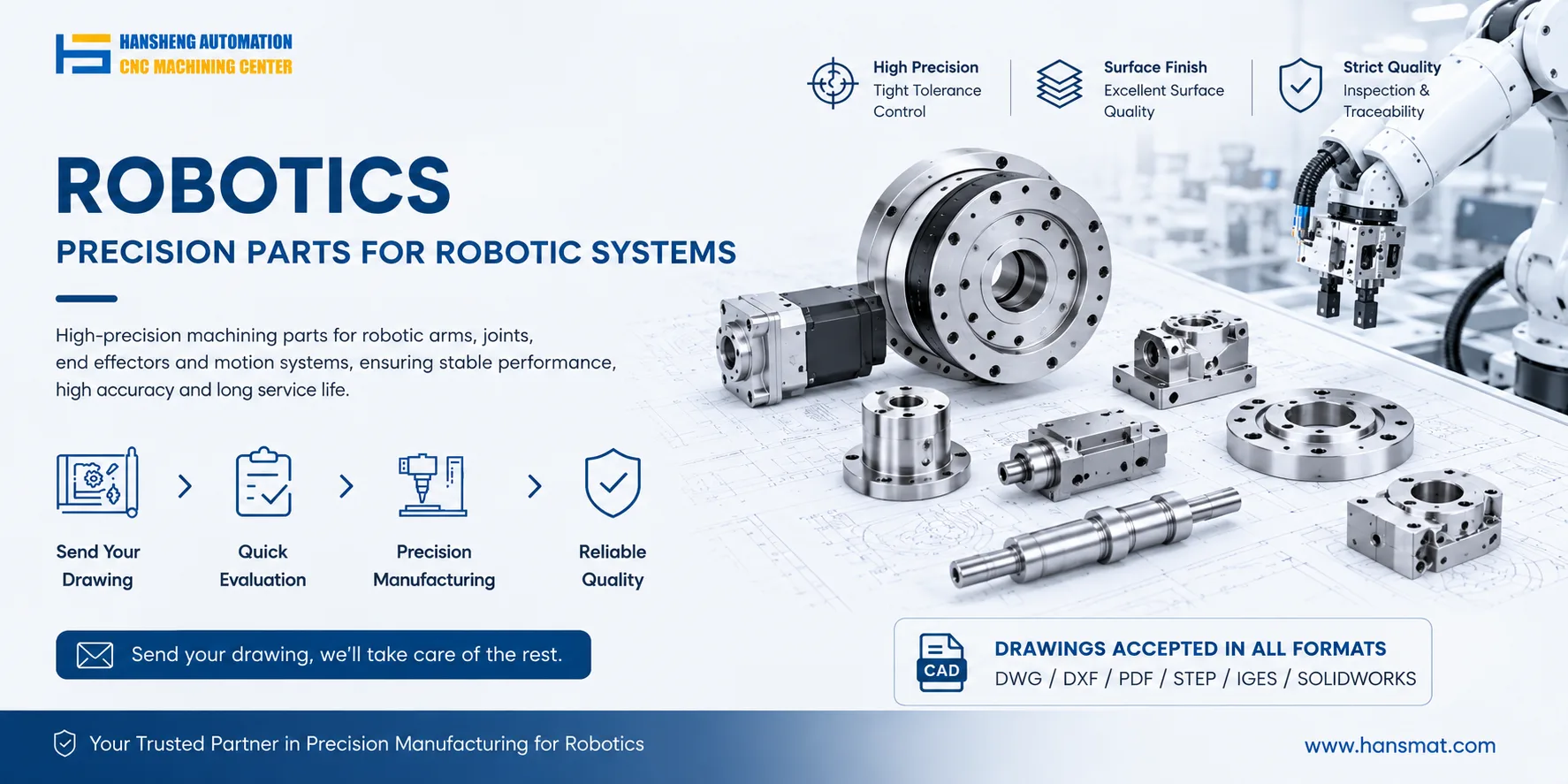
For non-standard replacement parts, end flanges, or joint components used in six-axis industrial robots, Hansheng Automation provides custom machining services based on customer drawings, helping maintain motion accuracy and operational reliability.
6. Other Industrial Robots
With the development of intelligent industry, more sectors are adopting industrial robots to replace manual labor, such as specialized robotic arms in welding, assembly, and painting. These robots are usually designed for specific scenarios and feature high precision, high efficiency, and high stability.