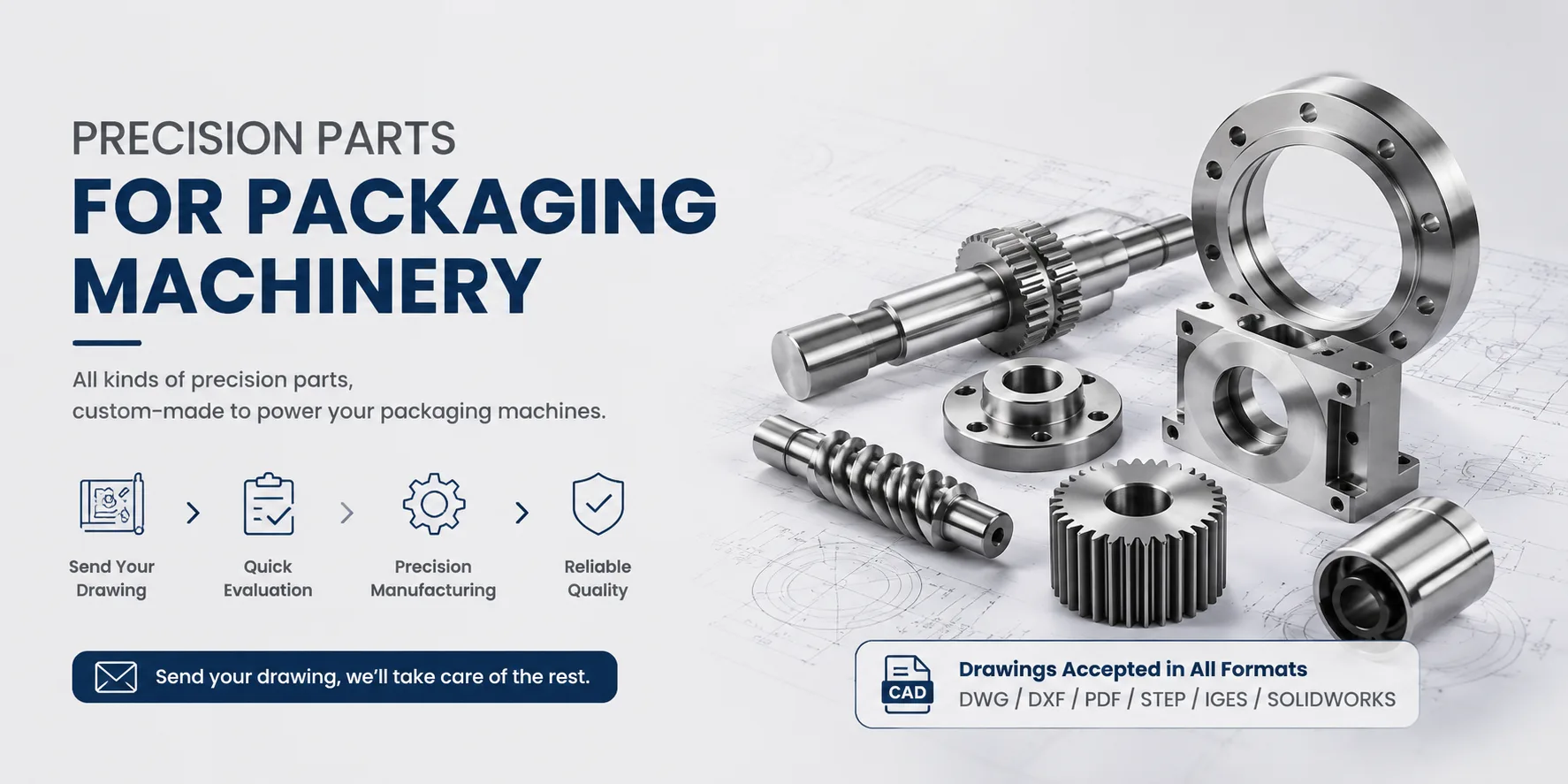
Hansheng Automation machines replacement and custom parts for wrapping machines, working from customer drawings for one-off and small-batch orders.
Wrapping machines fall into groups by use, structure, and automation level.
By use
Pallet wrapping machine
It wraps loads of different shapes and sizes. Multiple film layers protect the load during transport and storage. The wrap keeps goods from collision damage, moisture, and dust.
Stretch film wrapping machine
Food, chemical, and building material plants use this type. Stretch film ties and reinforces the product. This keeps the load stable during handling or stacking and prevents it from falling apart or deforming.
Cylindrical wrapping machine
It handles cylindrical objects such as paper tubes and metal tubes. Tight wrapping protects the contents and adds structural strength to the cylinder. It raises load capacity and helps prevent deformation in transit.
Box wrapping machine
It handles cartons, wooden boxes, plastic boxes, and similar box-shaped items. Stretch film holds the box structure and keeps contents from shifting. It also improves compression strength and reduces transport loss.
By structure
Vertical wrapping machine
The load sits on a vertical turntable and turns. Film wraps in the vertical direction to build multiple layers. The machine is compact and uses floor space well. It suits standard packaging for small and medium loads.
Horizontal wrapping machine
The load turns around a horizontal turntable. It suits large items such as long steel sections and large equipment, and irregular shapes. The horizontal layout makes loading and unloading heavy goods easier. The operator can adjust the wrap angle.
Gantry wrapping machine
It uses a gantry frame. The load can move horizontally and vertically at the same time. The design gives high stability and high accuracy. It suits applications that need strict wrap position, such as precision instruments and fragile goods.
By automation level
Manual wrapping machine
The operator turns the turntable and raises or lowers the load by hand. Wrap layers and tension depend on operator experience. It costs less and is flexible, but output is lower. It suits small batches or temporary packaging.
Semi-automatic wrapping machine
Mechanical or electrical systems control turntable and load movement. The operator starts the machine and monitors the process. It balances cost and output. The price is moderate, and small and medium factories often use this type.
Automatic wrapping machine
It uses sensors, a PLC control system, and a robotic arm. It can handle load infeed, positioning, wrapping, film cutting, and outfeed automatically. It runs at high automation and high output. It suits large production lines.
The right type depends on load size, weight, output, and floor layout.