The three core equipment types in semiconductor testing are the automatic test equipment (ATE), the handler, and the wafer prober. Each plays a distinct role in verifying chip function, performance, and quality across different manufacturing stages.
Test Equipment (ATE, Automatic Test Equipment)
Definition and function: The tester is the core device in semiconductor testing, used to verify chip functionality and performance. It applies input signals to the chip and collects output signals to determine whether the chip meets design specifications.
Application stages:
Wafer test (CP): used together with a prober to test bare dies on a wafer.
Final test (FT): used together with a handler to test packaged chips.
Importance: The tester is essential for ensuring chip quality and performance. Its accuracy and stability are critical to the semiconductor industry.
Handler
Definition and function: The handler is another important piece of test equipment. It automatically transfers chips one by one to the test position and connects them to the tester's functional modules. After testing, the handler marks, sorts, collects, or tapes the chips according to the test results.
Application stage:
Final test (FT): used together with a tester for packaged chip testing.
Importance: The handler improves test automation, reduces manual intervention, and increases test efficiency and consistency.
Wafer Prober
Definition and function: The prober automatically transfers wafers one by one to the test position and connects the chip pads to the tester's functional modules through probes and dedicated connection lines. Based on the test results, the prober can also ink-mark chips and generate a wafer map.
Application stage:
Wafer test (CP): used together with a tester to test bare dies on a wafer.
Importance: The prober ensures that every die on the wafer is tested accurately, making it an indispensable tool in semiconductor manufacturing.
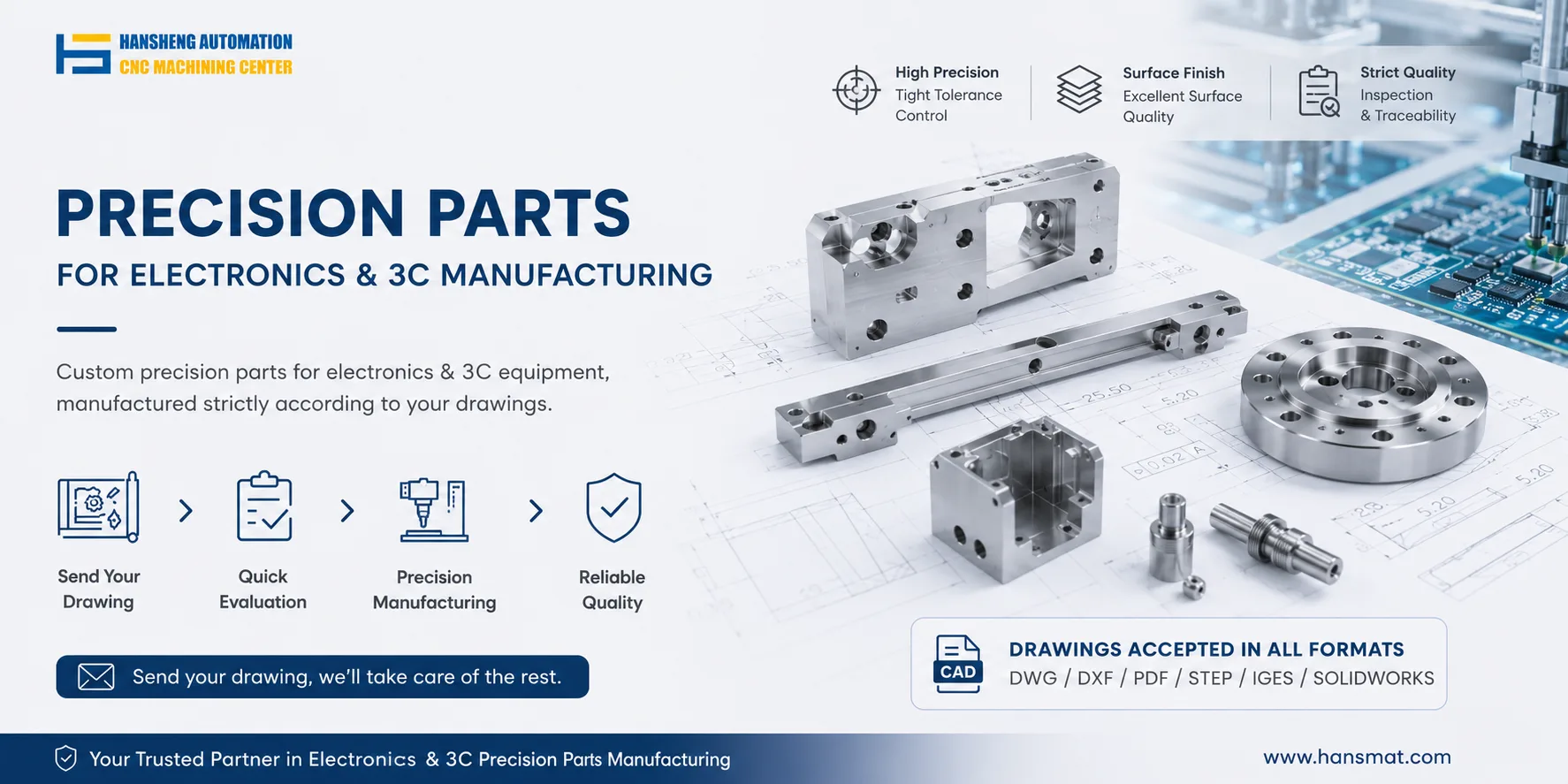
For precision components in these systems-such as test sockets, contactors, prober stages, handler guide rails, and vacuum pickup tools-Hansheng Automation provides custom machining based on customer drawings, supporting single-piece or small-batch delivery.
Test Flow: Wafer Test (CP)
The prober automatically transfers wafers to the test position. The chip pads are connected to the tester's functional modules through probes and dedicated lines. The tester applies input signals and collects output signals to judge whether the chip meets design specifications. The test results are sent to the prober via a communication interface, and the prober marks the chips accordingly, forming a wafer map.
Test Flow: Final Test (FT)
The handler automatically transfers each chip to the test position. The chip pins are connected to the tester through the test socket and dedicated lines. The tester applies input signals and collects output signals to verify functionality and performance. The test results are transmitted to the handler, which then marks, sorts, collects, or tapes the chips based on those results.
Summary
The three core semiconductor test equipment types-tester, handler, and prober-work together to ensure chip quality and performance. As semiconductor technology continues to advance, these systems will be further upgraded to meet increasingly demanding test requirements.