During the wet granulation process, if the finished granule hardness fails to meet tableting or subsequent processing requirements, it often leads to loose granules, excessive fine powder, or insufficient tablet hardness. This issue typically requires systematic investigation and targeted adjustments across four dimensions: formula composition, process parameter control, precision of key equipment components, and post-treatment stages.
1. Formula and Excipient Ratio Optimization
Adjust Binder Type and Dosage: Prioritize evaluating the binding performance of the current binder. If the cohesive force is insufficient, replace conventional excipients with high-efficiency binders such as povidone (PVP) or hypromellose (HPMC), or increase the starch paste concentration to 8%–10%. Moderately increase the overall binder dosage, while avoiding excessive viscosity that could complicate subsequent sizing.
Optimize Fillers and Wettability: If the proportion of lactose or sucrose in the formula is too high, introduce compressible starch or microcrystalline cellulose to enhance the physical bonding force between particles. For highly hydrophobic active pharmaceutical ingredients (APIs) or excipients, add 0.1%–0.3% Tween-80 to improve surface wetting performance, thereby enhancing kneading consistency.
Control Lubricant Usage: Excessive use of lubricants like magnesium stearate (e.g., exceeding 0.5%) creates a barrier effect, weakening the secondary bonding force between granules. Keep the usage strictly within a reasonable range of 0.3%–0.5%.
2. Precise Control of Key Process Parameters and Drying
Optimize Granulation Time and Shear Speed: Appropriately extend the wet mixing/granulation time, lower the chopper shear speed to reduce forced breakage, and increase the impeller speed to enhance the densification of materials under shear force.
Control Wet Granule Moisture: Maintain the initial moisture content of wet granules within a safe process range of 2%–5%. Excessively low moisture leads to poor kneading and loose granules, while excessively high moisture can cause clumping.
Graduated Temperature-Controlled Drying: Avoid rapid temperature rises during drying, which can cause the granule surface to crust prematurely, resulting in hollow, low-hardness structures inside. We recommend a graduated heating profile (e.g., pre-drying at 50°C for 1 hour, then gradually raising the temperature to 60°C–70°C for deep drying) to allow uniform and slow moisture evaporation.
3. Equipment Component Performance and Customized Solutions
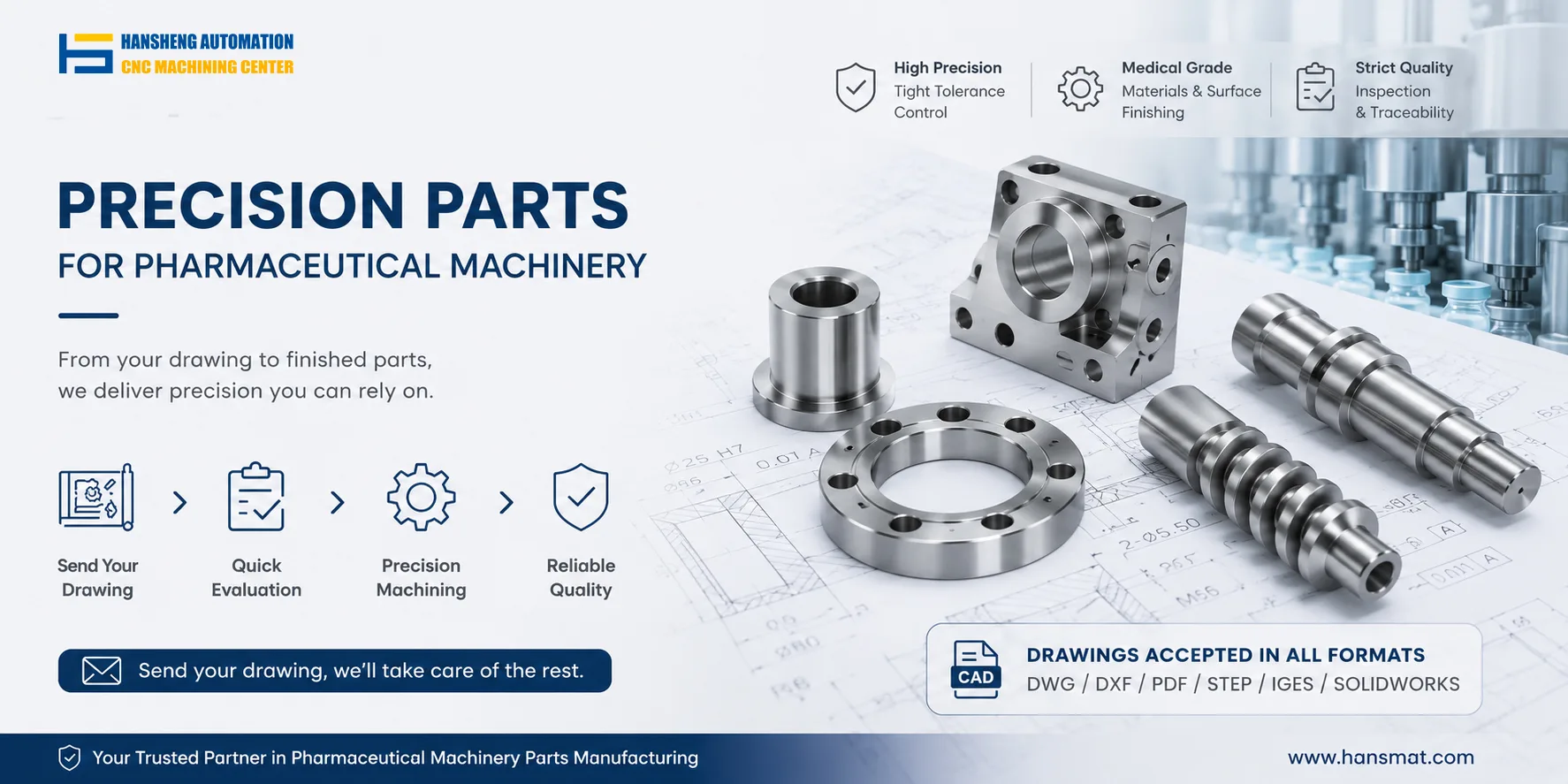
Wear on critical drive and shear components from long-term equipment operation is a common mechanical cause of uneven kneading force and low granule hardness. Hansheng Automation provides high-precision customized machining services for consumable parts of granulation equipment:
Custom Precision Impellers and Chopper Blades: Wear on impeller blades increases the clearance between the blades and the bowl wall, preventing the material from being sufficiently squeezed; worn choppers fail to disperse binders effectively, causing localized dry or overwet zones. We can custom-machine high-precision impellers, chopper blades, and precision drive shafts according to design drawings provided by our clients, utilizing highly wear-resistant and corrosion-resistant materials such as SUS316L and Hastelloy. Through rigorous control of geometric tolerances (such as coaxiality and perpendicularity), we ensure the precise fit of the mixing and chopping systems, rendering uniform force on the material and significantly improving its cohesive density.
Customized Sieve Screens and Screen Frames: If the selected sieve screen aperture is too large, the granulated structures will be relatively coarse with poor cohesive force. Hansheng Automation supports the precise manufacturing of non-standard stainless steel screen frames and quick-locking mechanisms based on customer drawings. This helps clients rapidly adjust the screen mesh to a smaller size (such as 14–16 mesh) to increase the contact area and compaction of the granules. Additionally, the high-rigidity screen frames we machine effectively prevent deformation under heavy loads, avoiding powder leakage and uneven particle size distribution.
4. Post-Treatment and Standardized Operations
Standardize Sizing Force: During the wet sizing process, select screens with appropriate apertures and control the sizing machine speed. Avoid destroying the already solidified physical structure of the granules due to excessive squeezing or harsh rubbing.
Control Total Blending Time: In the final blending stage prior to tableting, limit the blending time to 10–15 minutes to prevent long-term high-speed shear from causing secondary breakage of the qualified granules, which could otherwise degrade the final granule hardness.
Note: Any adjustments to process parameters or formula ratios should first be validated on a pilot scale to ensure process stability and reproducibility before proceeding to large-scale production.