A robot joint module is the core unit that drives a robot joint to rotate, turns a wheel, or controls gripper motion. Its types, design, working principle, and applications are below.
Common types
Rotary joint modules
Function: control rotary motion of robot mechanical parts, with speed adjustment and pause capability.
Features: different sizes and torque options for flexible joint movement, such as robotic arm rotation and wheeled robot steering.
Applications: industrial robot joints, service robot head rotation, collaborative robot joint drive.
Linear joint modules
Function: push or pull mechanical parts for linear motion, such as arm extension or gripper opening and closing.
Features: the active end connects to a lever arm and converts rotary motion into linear displacement. It suits applications that need precise push and pull.
Applications: 3C electronics assembly, medical robot surgical instrument operation, logistics sorting robot gripping.
Design points
Take a linear joint module as an example. Design should consider the following.
Power matching
Mechanical output power is set by load demand, such as the force needed to move an object. Input power must be enough without waste. A robot that lifts heavy loads needs a high-power module. Light operation can use a low-power model.
Duty cycle optimization
Duty cycle is the ratio of working frequency to duration. Temperature has a clear effect on it. Design needs heat dissipation space or high-temperature materials to avoid power drop from heat buildup.
Efficiency improvement
Efficiency equals mechanical output power divided by electrical input power. High-efficiency design reduces energy loss. Methods include low-friction materials and improved transmission structures such as harmonic reducers.
Service life extension
Key points:
Keep the rated duty cycle and avoid overload.
Reduce side load, such as lateral force when the arm bends.
Maintain recommended voltage and current and avoid voltage fluctuation.
Avoid extreme environments such as high temperature, moisture, and corrosive gas.
Working principle
Energy conversion
The module converts electrical energy into mechanical motion, rotary or linear. A motor drives a transmission mechanism such as a roller screw or gearbox.
Linear joint module core mechanism
Roller screw structure uses the inclined plane principle to convert rotary motion into linear motion. The motor drives the screw to rotate. The nut moves along the screw axis and drives the load for push and pull.
Advantages: high precision, low backlash, and long life. It suits applications that need repeated positioning.
Control signal response
An encoder or sensor feeds back position and speed information for closed-loop control and motion accuracy.
Applications
Industrial automation
Automotive manufacturing: joint drive for welding and painting robots.
Electronics assembly: precise component picking and placing.
Logistics and warehousing: steering and lifting mechanisms for AGVs.
Service and medical
Service robots: limb movement and facial expression simulation.
Surgical robots: precise operation of minimally invasive instruments, such as the Da Vinci surgical system.
Special robots
Space robots: joint drive for space robotic arms.
Rescue robots: limb extension and gripping in complex terrain.
Key selection factors
Use and function
Choose a rotary or linear module based on task type, such as handling, welding, or inspection.
Physical constraints
Weight and size: small robots need lightweight modules to avoid self-weight affecting motion performance.
Installation space: confirm module size is compatible with the robot structure.
Performance parameters
Strength and power: make sure the module can carry the maximum load.
Communication protocol: support industrial buses such as EtherCAT and CANopen for multi-axis coordinated control.
Core advantages
High precision: closed-loop control and low-backlash transmission support micron-level positioning.
Easy control: supports PWM speed control and position, speed, and torque mode switching.
High efficiency: low energy conversion loss, suitable for long running.
Safety: built-in overload protection and emergency stop.
Easy maintenance: modular design allows quick replacement after a fault.
Controllable cost: standardized products reduce development time and cost.
Robot joint modules cover many types and rely on careful design and efficient working principles. They are a core part of precise robot motion. Applications span industrial, service, and medical fields. Selection should consider function, physical constraints, performance, and communication needs.
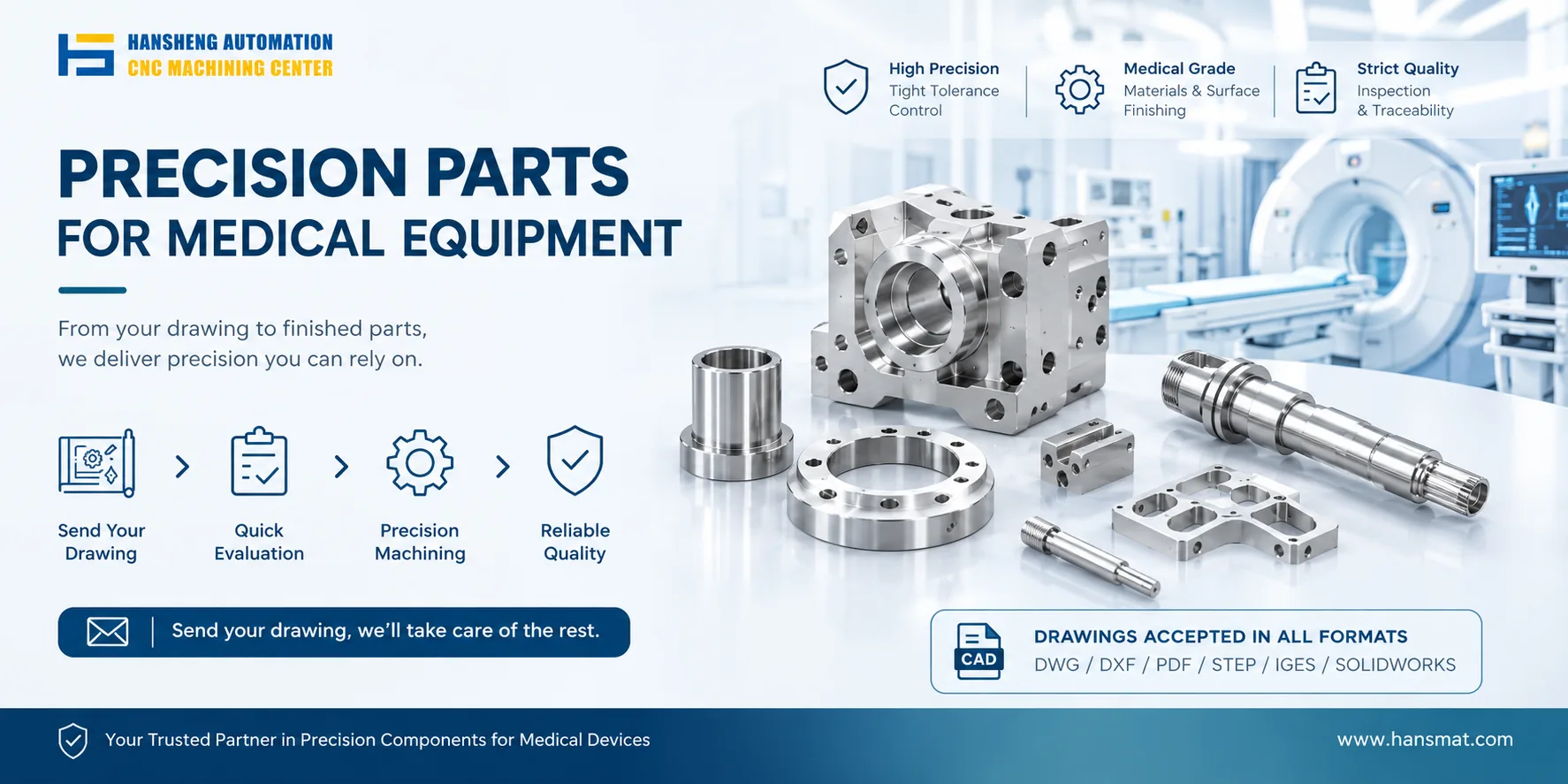
Hansheng Automation machines harmonic drives, planetary gears, and other precision parts for robot joint modules from customer drawings. Single-piece and small-batch orders are supported.