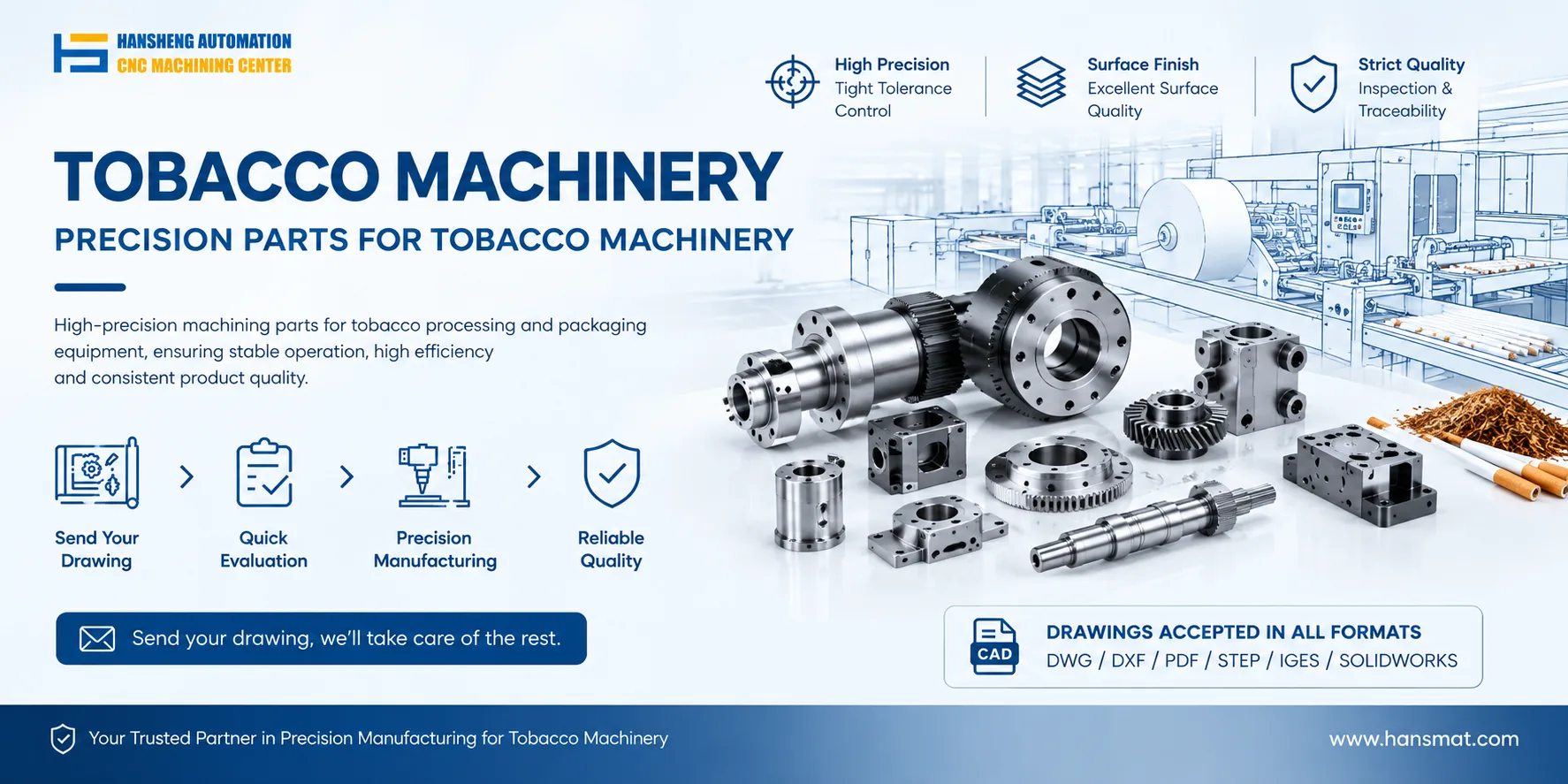
Cigarette making machinery is a highly integrated automation system. From tobacco feeding, cigarette forming, filter tipping, to packaging and inspection, every process relies on a large number of high-speed, precision-mating dedicated components.
I. Tobacco Feeding and Conditioning System
This system stably supplies cut tobacco, expanded tobacco, and stem tobacco in the required blend ratio through vibrating conveyors, belt weighers, and pneumatic conveying. Tobacco opening and foreign material removal are achieved by picker rollers, air separators, and similar devices. Components such as vibrating conveyor troughs, air separator blades, and picker roller bearing housings in this section are often subject to wear and corrosion caused by tar, dust, and high-velocity air. They are typically made of wear-resistant alloys or stainless steel with surface hardening treatment.
II. Cigarette Forming System
The forming system is the core of cigarette making machinery. Loose tobacco is formed into a continuous, uniform tobacco rod under high-pressure airflow by a suction tape or leveler. The rod is then wrapped with cigarette paper, glued, and sealed by a garniture tape and heated iron, producing a continuous cigarette rod. An online microwave density gauge or nuclear scanner provides real-time feedback on rod density and adjusts feed rate accordingly. Components such as suction tape guides, garniture troughs, tape pulleys, heating irons, and cutters in this section require extremely high straightness, surface roughness, and thermal stability. They are often manufactured from SKD11, powder high-speed steel, or zirconia ceramic.
III. Filter Tipping System
The continuous cigarette rod is cut by a double-blade cutting drum into double-length cigarette sections. These are then aligned and wrapped in parallel with double-length filter rods and tipping paper. After wrapping, the assembly is cut in the middle to produce two finished filter cigarettes per cycle. Components such as slitting knives, drum suction claws, guide rollers, and rolling drums in this process must have precise dynamic balance and tight fitting clearances, as these directly affect cigarette end quality and tipping paper lap precision.
IV. Packaging and Inspection System
Finished cigarettes undergo machine vision inspection, laser perforation, and automatic rejection of defective products. They are then packed into aluminum foil, inner frames, and soft or hard packs in arrangements such as 7-6-7, followed by cellophane wrapping and carton packing. This stage involves many non-standard parts such as inspection brackets, laser positioning fixtures, rejection nozzle seats, packaging pushers, and folding devices.
V. Key Parameters and Customization Response
Modern high-speed cigarette making and tipping machines can reach speeds of 16,000–20,000 cigarettes per minute, with cigarette weight standard deviation ≤23 mg and draw resistance standard deviation ≤30 Pa. Achieving this precision requires not only proper machine design but also high consistency in the machining of critical actuating components. Hansheng Automation provides precision machining services for cigarette machinery components based on customer drawings, covering small-batch manufacturing of non-standard parts, wear parts, and fixtures, along with material selection advice and rapid prototyping.
VI. Safety Notice
Cigarette making machinery is high-speed precision equipment involving high-pressure airflow, heated irons (approximately 150°C), lasers, and high-speed moving parts. Non-professionals are strictly prohibited from operating, adjusting, or replacing components. All maintenance and part disassembly must be carried out only after complete power shutdown, pressure release, and compliance with lockout/tagout (LOTO) procedures.