

With its high precision, high torque density, compact structure and excellent transmission efficiency, planetary gearboxes have become the core of power transmission in automation, robotics, high-end equipment and other fields. Its excellent performance comes from rigorous design and precise manufacturing process. The following is a detailed description of the core process.
1. Planetary gearbox core process
1) Design
The manufacturing of precision planetary gearheads begins with a thorough design phase. Our engineers accurately define the core parameters of the reducer based on the customer's clear demand for output torque, speed, installation space and key precision indicators (especially backlash requirements): the reduction ratio covers a wide range from 3 to 100, the structure adopts a single-segment or double-segment design, and the backlash level is strictly set - standard backlash ≤ 5 arc min, precision backlash ≤ 3 arc min, and ultra-precision backlash ≤ 1 arc min. Based on the customer's requirements, we manufacture drawings and detailed technical specifications, and ensure that the design meets the performance targets and manufacturability requirements through strict multi-party reviews.
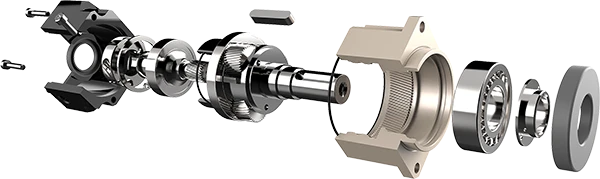
2) Component Manufacturing
The core of manufacturing lies in the precision machining of key components, we also have strong gear processing and precision CNC machining capabilities. Gears (sun wheel, planetary wheel, inner ring) and main structural parts are made of high strength alloy steel (e.g. 20CrMnTi, 42CrMo).Tooth blanks are formed by forging (to ensure internal densities) or precision casting (for complex shapes), and then undergo roughing and finishing processes. The most critical part is the tooth profile finishing: high precision hobbing is used for the initial shaping, and then the profile grinding process is used to reach ISO/DIN/GB grade 5 (tooth shape error fα ≤ 3μm, tooth direction error fβ ≤ 4μm).The case, planetary carrier, output shaft and other components also need precision turning, milling, drilling and grinding to ensure that the roundness error of the bearing mounting position is controlled within 5 μm, and that other key dimensions and tolerances meet the stringent requirements.
3) Heat treatment and surface strengthening
In order to give gears excellent mechanical properties, carburizing and quenching is an essential core process. Deep carburizing (typical depth of penetration layer 0.8-1.5mm) in a controlled atmosphere furnace, followed by quenching and low-temperature tempering treatment, enables the gear surface to obtain a hardness as high as HRC 58-62, while maintaining the toughness of HRC 30-45 in the core, thus significantly improving its wear resistance, pitting resistance and bending fatigue strength. After heat treatment, the tooth flanks are typically honed or power blasted to reduce the surface roughness to Ra ≤ 0.4 μm and optimize the contact condition. For extreme working condition applications, advanced surface strengthening technologies such as ion nitriding or PVD coating (e.g. CrN) may also be used to further enhance the hardness, wear resistance and anti-gluing properties of the tooth surface.
4) Precision assembly
Assembly is the decisive link in transforming precision parts into high-performance complete machines. Especially for products requiring ultra-precision backlash of ≤1 arc minute, it must be carried out in a constant temperature, clean and specialized workshop. The assembly process pays high attention to several key points: precision angular contact ball bearings or tapered roller bearings need to be applied with precisely calculated preload to optimize stiffness and temperature rise; the load distribution between multiple planetary wheels is ensured through the manufacture of high-precision planetary carriers and planetary wheel selection; backlash is strictly controlled at the target level of the design (≤5/3/1 arcminute) through the use of precision adjusting shims, eccentric bushings, or optional technology; all parts need to be thoroughly cleaned before assembly. All parts need to be thoroughly cleaned before assembly, the assembly process is strictly dustproof, and constant torque tools are used to ensure the consistency of screw fastening, and ultimately realize the low noise, high rigidity and high reliability of the whole machine.
5) Strict testing and inspection
Every planetary gearhead needs to undergo a comprehensive and stringent testing and inspection before leaving the factory. Advanced gear measuring center is used to test the accuracy of the gear pair (tooth shape, tooth direction, tooth pitch).The performance test of the whole machine includes: using precision torque meter to measure the backlash under rated load to verify that it meets the commitment of ≤5/3/1 arc minutes; measuring the input and output power to calculate the full-load transmission efficiency, which is usually ≥96% for single-segment efficiency and ≥94% for double-segment efficiency; conducting no-load and load noise test in a professional noise reduction room (the target is often lower than 65 dB(A)); and running for a long period of time to monitor the temperature rise under rated working conditions (the temperature rise of the key bearing parts is required to be ≤45%).temperature rise under rated operating conditions for a long period of time (temperature rise of critical bearing parts is required to be ≤45°C); vibration tests (vibration speed target ≤2.8 mm/s); accelerated life tests to verify rated life (usually ≥20,000 hours) and overload capacity; and strict sealing inspections to prevent leakage. Only products that pass all test programs are allowed to be released.

6) Painting, packaging and delivery
Qualified products passing the final inspection are subject to thorough cleaning, necessary anti-corrosion treatment (such as phosphatization) and surface painting. According to the specific model and size of the reducer, a customized protective packaging solution is adopted, usually using sturdy wooden crates or high-strength cartons with cushioning lining materials to ensure that the products are protected from damage during transportation and storage. Delivered with the product is a complete technical documentation package containing detailed performance test reports, installation instruction manuals, maintenance instructions and warranty documents to provide comprehensive technical support to customers.
2. Key process elements for high performance
Planetary gearboxes can achieve their nominal high precision (backlash ≤1/3/5 arc minutes), high efficiency (≥94%/96%), and long service life (≥20,000 hours) by relying on several core processes: high-precision molding and grinding of gears; deep controlled carburizing and quenching processes; and zero-defect precision assembly in a constant-temperature, dust-free environment, where the design intent is translated into the design intent by means of a scientific process, precise tooling, and skillful operation. Through the scientific process, precise tooling and skillful operation, the design intent is transformed into actual load balancing performance and backlash accuracy. The strict quality inspection system (covering spectral analysis, flaw detection, coordinate measurement, gear testing, and complete machine bench test) throughout the whole process from raw material warehousing, process processing to finished product testing is the ultimate guarantee of product consistency and reliability.
Summarize
The manufacture of planetary gearboxes is a combination of material science, precision machining, heat treatment engineering, assembly technology and quality control. Only through high-precision grinding to achieve micron-level gear precision, deep controlled carburizing and quenching to obtain HRC 58-62 tooth hardness, precision assembly in a constant temperature and clean environment to accurately control the backlash to within 1 arcminute, supplemented by strict testing throughout, can we stably produce high-performance planetary gearheads that can satisfy the needs of a wide range of gear ratios from 3 to 100, single-segment or double-segment structures, and have standard ≤5 arcminutes, precision ≤3 arcminutes, and ultra-precision ≤1 arcminute backlash levels. Precision ≤1 arcminute backlash level of high-performance planetary gearheads. Its 96%+ single-stage efficiency, low operating noise of less than 65 dB(A), excellent rigidity, and 20,000-hour design life make it the preferred solution for driving precision motion and transmitting reliable power.