A pin barrel structure improves the shearing, mixing, and plasticizing performance of a conventional screw extruder by installing pins along the inner wall of the barrel in a specific arrangement. The pins interact with the rotating screw to divide and redistribute the rubber compound as it moves through the extrusion system.
1. Pin barrel structure and functions
1.1 Basic components
The pin barrel structure consists mainly of the pins and the barrel. Pins are commonly made from wear resistant, heat resistant alloy steel, such as 38CrMoAl, and may undergo nitriding treatment to achieve a surface hardness above HV 900.
The pins are fixed to the inner barrel wall in staggered, circumferential, or helical patterns. Their arrangement is designed to work with the rotating screw and influence the flow and deformation of the rubber compound.
1.2 Main functions
Improved shear
The pins extend into the screw channel and divide the flowing compound, increasing shear action. This can reduce compound viscosity during processing and improve plasticization uniformity.
Better mixing
The pins disturb the flow pattern and redistribute the material inside the barrel. This helps mix different ingredients and is useful for compounding, filler dispersion, and color mixing.
Temperature control
The pin structure increases contact between the compound and the barrel surfaces. This can improve heat transfer and help reduce localized overheating, supporting more stable extrusion temperatures.
Reduced material buildup
The pins can help remove rubber adhering to the screw surface and reduce stagnant areas where material may accumulate and degrade.
2. Main design parameters
Pin geometry, arrangement, and installation position affect the extrusion process. The following values are reference guidelines from the supplied material.
Pin diameter and length
The pin diameter is typically 5% to 10% of the screw diameter. The pin should extend into the screw channel by no more than 70% of the channel depth to avoid interference with the screw.
Actual dimensions must be determined according to the screw geometry, barrel design, and required operating clearances.
Pin arrangement and quantity
Common arrangements include equally spaced circumferential patterns, staggered patterns, and helical patterns.
The number of pins depends on the extruder size and mixing requirements. A pin barrel may contain several dozen to more than one hundred pins.
Pin shape
Cylindrical pins are common. Tapered and bullet shaped designs are also used to reduce flow resistance and limit energy consumption, depending on the machine design.
Installation position
Pins are commonly concentrated in the compression and metering sections. A pin barrel extruder is a typical example of this design approach.
3. Pin barrel extruders vs. conventional screw extruders
|
Feature |
Pin barrel extruder |
Conventional screw extruder |
|---|---|---|
|
Mixing efficiency |
High potential for distributive and dispersive mixing |
Generally relies on screw geometry for mixing |
|
Shear action |
Strong and controllable, suitable for highly filled compounds |
Generally less intensive |
|
Temperature control |
More uniform temperature distribution, with fluctuations reported to remain within ±1°C |
More susceptible to localized overheating and temperature variation |
|
Compound quality |
Can improve compound uniformity and product density |
May experience uneven mixing, depending on the screw design and process |
|
Energy consumption |
Specific energy consumption for mixing may be lower |
May require more energy to achieve comparable mixing results |
|
Typical applications |
High quality, highly filled, and colored rubber compounds |
Conventional products with less demanding mixing requirements |
These comparisons describe the general characteristics presented in the source material. Actual performance depends on the screw design, pin geometry, compound formulation, throughput, and temperature control system. The reported temperature variation of ±1°C should be treated as a reference value rather than a universal specification.
4. Applications and equipment selection
Pin barrel structures are particularly useful when rubber processing requires consistent mixing, good filler dispersion, and close temperature control.
High performance tire components
Tread compounds and inner liner compounds require consistent material properties. Pin barrel extrusion can help improve compound distribution during processing.
Specialty rubber products
High strength seals and vibration damping components may require uniform compound properties to meet their performance requirements.
Colored and conductive rubber
Pins can help disperse pigments and conductive fillers, including carbon black, throughout the rubber compound.
Highly filled rubber compounds
Compounds containing high proportions of silica or calcium carbonate require effective filler dispersion. A suitable pin arrangement may improve mixing performance in these applications.
When selecting an extruder, consider the compound properties, required output, product quality requirements, and equipment investment. A conventional screw extruder may be more economical for standard products, while a pin barrel extruder may be worth considering for applications with more demanding mixing and temperature control requirements.
During operation, follow the manufacturer's startup procedure and temperature requirements. Do not start the machine from a cold condition unless the equipment instructions explicitly permit it. Inspect the pins regularly for wear or breakage, since damaged or worn pins can reduce mixing effectiveness.
5. Custom machining for rubber extrusion equipment
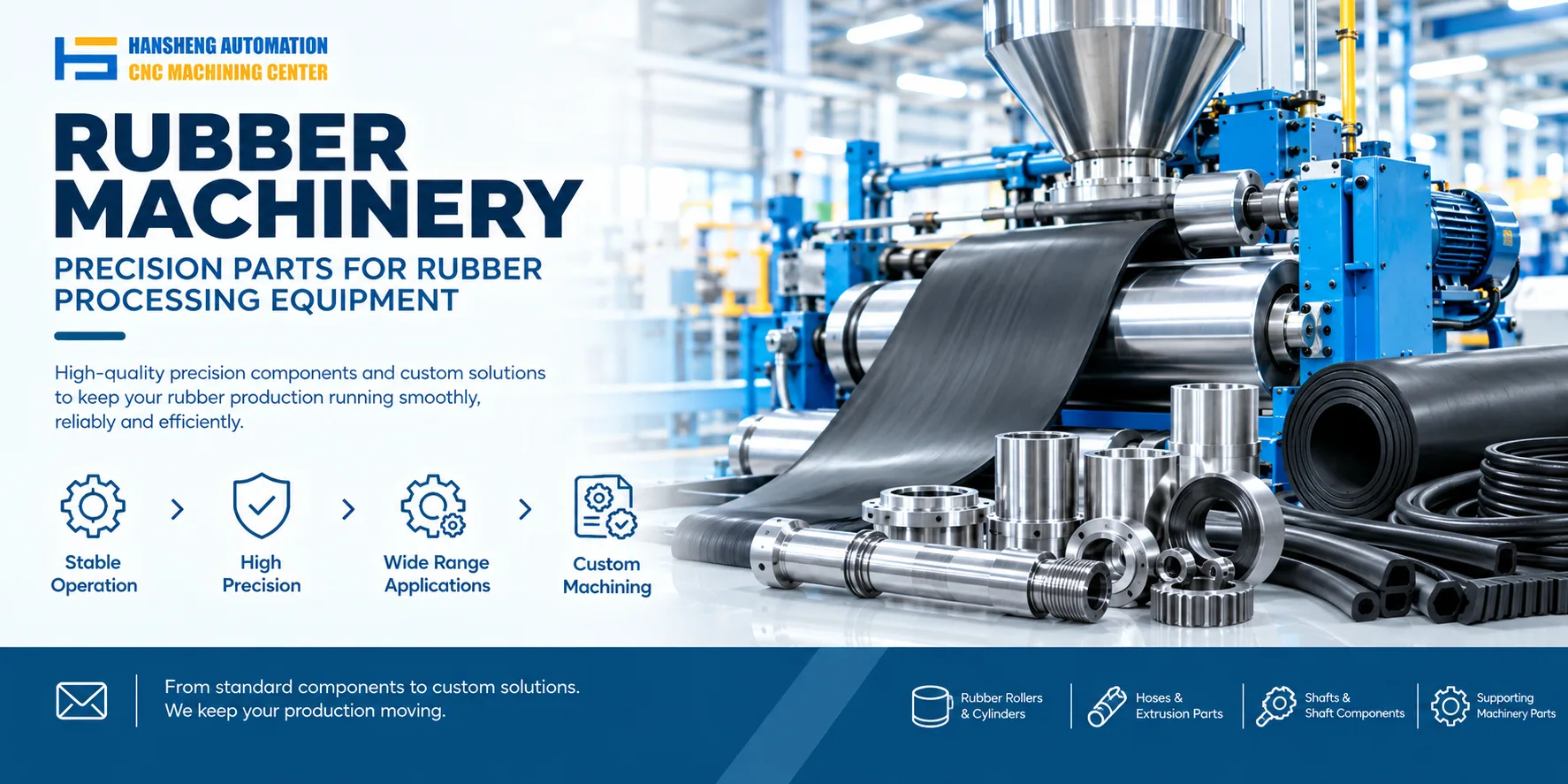
Pin barrel extruders rely on components with specific material, dimensional, and installation requirements. Hansheng Automation can assess custom machining for suitable metal components based on customer drawings, material specifications, and dimensional tolerances.
Our precision machining services also cover non-standard parts for packaging machinery, filling equipment, and tobacco machinery. We can assess precision components for yacht equipment and RC racing cars according to the supplied drawings and machining requirements.