

The material determines the service life, load-bearing capacity, noise characteristics, and cost-effectiveness of the final project of the gear. Incorrect material selection will affect the performance of gears and may even render them unusable. As a professional precision mechanical components manufacturer, after collaborating with numerous clients, I believe you may be considering whether to choose the absolute strength of alloy steel, the corrosion resistance of brass, or the noise reduction effect of engineering plastics for your gear transmission project?
Hansheng Automation will analyze the three most common helical gear materials - steel, brass, and POM plastic - and some selection strategies in the article, hoping to be helpful to you.
Key Factors in Material Selection
Before explaining the specific materials, let's first establish selection criteria. When a customer chooses us to customize a helical gear for them, we will evaluate the application scenario based on the following five main factors when confirming the gear material selection.
Load Requirements
The load that gears must transmit. High torque applications require materials with high tensile strength and yield strength to prevent tooth fracture or deformation. If the gear tooth surface cannot withstand contact stress, pitting and fatigue will quickly occur.
01
Operating Environment
Where will the gears run? Extreme temperature, humidity, and chemical exposure have a significant impact on industrial gear applications.
02
Noise & Precision
Silent operation is crucial for consumer electronics, medical equipment, or office devices. At this point, precision gear tolerances (AGMA or ISO standards) need to be evaluated, such as Hansheng Automation's precision gear accuracy reaching ISO level 5.
03
Speed & Duration
High speed operation generates a large amount of heat due to friction. The selected material must be able to dissipate this heat or maintain dimensional stability at high temperatures. In addition, the service life (working cycle) determines whether you need wear-resistant hardened materials or can use softer and lower cost alternatives to meet intermittent usage needs.
04
Budget
Finally, cost should also be considered. This includes not only raw material costs, but also processability. Materials that are difficult to process will increase the processing cycle and tool wear, thereby increasing the price of the final component.
05
Steel Helical Gears
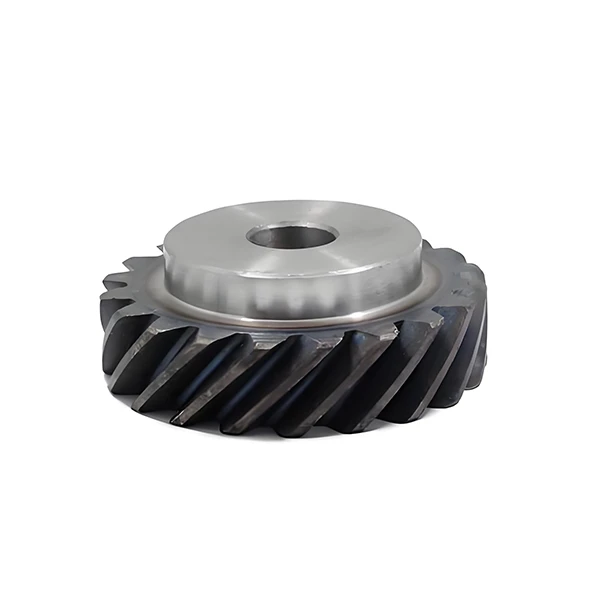
Steel helical gears are usually the most suitable choice for industrial power transmission. Steel gears are typically made of carbon steel (such as 1045), alloy steel (such as 4140 or 8620), or stainless steel (303, 304, or 316). The characteristic of steel is that it can accept various forms of heat treatment, such as carburizing, induction hardening, or nitriding processes. Heat treated gears can achieve extremely high surface hardness while maintaining a tough and ductile core to absorb impact loads.
Advantages
The main advantage of steel high strength gears is their load-bearing capacity.According to AGMA 2001-D04 calculation methods, factors such as material grade, hardness level, and heat treatment type directly influence the gear's load capacity-with carburized and case-hardened steels (such as 8620 or 9310) achieving surface hardness of 58-62 HRC, providing optimal resistance to both contact fatigue (pitting) and tooth bending fatigue.
Steel gears have extremely strong wear and abrasion resistance, making them very suitable for continuous, high-speed, and high torque operation. If lubricated and maintained properly, a set of steel gears can last for decades. In addition, CNC machined steel gears can maintain extremely tight tolerances (ISO 1328-1 Grade 5 or better).
Disadvantages
Its disadvantage is that it has a high weight and increases system inertia, which is not friendly to equipment or applications that require frequent start stop. And without a continuous supply of oil or grease, steel to steel contact can cause biting and jamming. Another disadvantage is that ordinary steel is prone to rusting and corrosion, and has high operating noise.
Best For
Industrial steel gears are the best choice for applications such as automotive transmission systems and differentials, heavy-duty industrial equipment (conveyors, crushers, mining machinery), high-precision CNC mechanical drive devices, etc.
Brass Helical Gears
Brass helical gears provide moderate mechanical strength (tensile strength typically 300-500 MPa, approximately 40-60% of carbon steel) and good friction performance, mainly used in the field of precision instruments. Brass gears are usually machined from alloys such as C36000 (easy cutting brass) or navy brass. The biggest feature is excellent processability; It produces small chips and has minimal wear on cutting tools. At an acceptable cost, it can produce highly complex and precise precision brass gears.
Importantly, brass excels in worm gear applications - brass worm wheels paired with steel worms represent the industry standard configuration due to optimal load distribution and wear characteristics.
Advantages
The core characteristic of this material is its high natural lubricity. Especially when brass is used in conjunction with steel, the effect is excellent. Low noise gears are also typically made of brass, as this material is softer than steel and provides better vibration damping. In addition, brass gears have excellent corrosion resistance to water.
Disadvantages
The disadvantages of brass are also evident, as its tensile strength and yield limit are significantly lower than steel, making it unsuitable for high impact or heavy-duty applications. Another disadvantage is that compared to steel, brass is not heat-resistant; As the temperature increases, its strength will rapidly decrease. Finally, due to the significant fluctuations in copper prices, the cost of brass raw materials also has to consider whether they are cheaper than standard steel.
Best For
Self lubricating gears made of brass (or paired with steel) are highly suitable for precision instruments, meters, and gauges, clock mechanisms, worm gear drives (brass worm gear paired with steel worm gear is standard), low-noise applications requiring moderate intensity, marine environments, or water metering equipment, and more.
Note: Brass gears are generally recommended for contact stresses well below those of hardened steel gears, making them unsuitable for heavy-duty power transmission applications.

POM (Plastic) Helical Gears
In engineering thermoplastics, especially POM helical gears, you may know about this material through the trade names Delrin (DuPont Seisteel) or Acetal (Acetal). POM, as a semi crystalline engineering thermoplastic, has rigidity, excellent dimensional stability, and can also be mass-produced through CNC machining or injection molding. Plastic helical gears made of POM have a naturally smooth and chemically resistant surface.
Advantages
The most obvious advantage of POM is its light weight, which is about 80% lighter than steel. It is the best material for silent gears and has excellent low noise and vibration damping. POM gears are essentially self lubricating plastic gears, which means they can typically operate without any oil or grease. At the same time, it also has excellent fatigue resistance and wear resistance. In addition, it can also tolerate solvents and fuels. For the medical and food industries, food grade gears made from specific POM grades comply with FDA and USDA compliance requirements.
Disadvantages
The biggest disadvantage is that its strength cannot be compared to metal. Among the three materials described in this article, it has the lowest load-bearing capacity and will fail under high torque or impact loads. Secondly, temperature is also a major limiting factor; The typical rated operating temperature of POM is between -40 ° C and 90 ° C, beyond which it will soften and deform. In addition, although plastic has good dimensional stability, slight dimensional changes may occur due to moisture absorption or thermal expansion, which can affect meshing in high-precision applications.
Best For
Delrin gears and acetal components made of POM are the preferred choice for applications such as office equipment (printers, copiers), medical device gears (where lubrication may pose a risk of contamination), food processing equipment (conveyors, bottling), and lightweight transmission for robots.

Quick Comparison Table
To help you better understand the differences between the three materials, we have compiled a table for your reference.
|
Property |
Steel |
Brass |
POM (Polyoxymethylene) |
|
Strength |
Highest |
Medium |
Low |
|
Weight |
Heavy |
Medium |
Very Light |
|
Noise Level |
Medium / High |
Low |
Very Low (Quiet) |
|
Corrosion Resistance |
Low – High |
High |
High |
|
Cost |
Medium |
High |
Low |
|
Temperature Range |
-40 ~ 300°C |
-40 ~ 150°C |
-40 ~ 90°C |
|
Best Application |
Heavy-duty / High-speed |
Precision / Low-friction |
Lightweight / Clean-environment |
Note: The corrosion resistance of steel largely depends on the type (stainless steel vs. carbon steel) and the surface coating.
How to Choose: Quick Decision Guide
Seeing this, you may still be unsure of what material to ultimately choose, but it's okay. Hasnheng Automation also provides you with a decision guide.
Please note that this gear selection guide is based on our own manufacturing experience in customizing various types of gears and is for reference only. If you are unable to make a decision or need someone to help you with a scientific strategy, please feel free to contact us and we can respond quickly to your needs.
Choose Steel if you need
- High load, high torque applications: mobile heavy-duty conveyors, driving vehicle wheels.
- Long service life: The machine operates 24/7, and the cost of stopping and replacing gears is too high.
- Adverse working environment: high temperature, high vibration or high impact load.
- Budget allowance: You have budget for heat treatment and lubrication system.
Choose Brass if you need
- Low noise operation: The environment cannot accept the sound of metal impact, but the plastic strength is insufficient.
- Precision instruments: require smooth movement and anti bite performance.
- Corrosive environment: exposed to water or salt spray, and stainless steel processing is too difficult.
- Medium load capacity: striking a balance between the weaknesses of plastic and the excessive toughness of steel.
Choose POM if you need
- Light load application: the internal structure of electronic products or small household appliances.
- Extremely noise sensitive environments: hospitals, food packaging machinery, or household consumer goods.
- Lightweight design: Every gram of weight is important for portable devices or drones.
- No lubrication requirements: cleanroom environment, paper processing or textile machinery.
- Food grade/medical applications: direct contact with food or sterile environments.
If you are still learning how to choose gear material, remember that many transmission systems use a hybrid approach, such as steel worm drives brass gears, or steel pinion drives POM gears, to maximize the advantages
FAQ
Can I mix different materials, like pairing a Steel gear with a Plastic gear?
Sure, this is actually quite common. The usual practice is to use metal pinion gears paired with plastic helical gears large gears. This not only reduces noise, but also reduces friction and wear between mating gears. However, remember that the load limit of the entire system after mixing and matching depends on the weaker plastic gear.
Why are Helical Gears more expensive to manufacture than Spur Gears?
Yes, custom helical gears are generally slightly more expensive than spur gears. Mainly because the Helix Angle is difficult to handle, the setting of CNC gear machining is more complex, the machining path becomes longer, and in order to ensure the accuracy of this angle, detection is also more complicated.
How does helix angle affect gear material choice?
It will have an impact. When a helical gear rotates, there will be axial thrust, and the greater the angle, the greater the thrust. If it is a plastic gear such as POM helical gears, excessive axial force can easily cause creep or deformation. So if the axial load is high, using Steel helical gears or high-strength brass will be more secure.
What information do I need to provide for a custom gear quote?
In order to provide you with the most accurate gear material selection advice and quotation, please provide the following:
Detailed drawings (including parameters such as modulus, number of teeth, helix angle, etc.).
Workload (torque and speed).
Application environment (such as whether the temperature is high or not, and whether there is corrosiveness).
Accuracy level requirements (AGMA or ISO).
Expected service life and noise requirements.
Work with a Professional Manufacturer
Material selection is the first step, and manufacturing the gears according to the drawings is the second. Even slight errors in the helix angle or pitch diameter can lead to gear failure, regardless of the material.
This is why partnering with a professional custom gear manufacturer is crucial. A professional supplier doesn't just provide machining services; at Hasnheng Automation, we also offer Design for Manufacturing (DFM) advice. We can tell you whether your chosen 316 stainless steel will incur unnecessary costs due to machining difficulties, or whether a specific grade of POM would be more suitable for your requirements.
In our factory, we utilize advanced CNC gear machining capabilities to process a wide range of materials. We understand the unique cutting parameters required for steel and plastics. Whether you need a single prototype or 10,000 units for mass production, our rigorous quality control ensures that the gears produced meet your specifications. As a precision gear supplier, we aim to provide you with a one-stop solution for precision gear transmission, saving our customers time, effort, and cost.
Conclusion
Finally, what Hansheng wants to express is that there is no such thing as the "best" material for each gear, only the material that is most suitable for your specific application. Steel provides unparalleled strength, Brass offers smooth precision, and POM brings quietness and lightweight. By carefully evaluating your load, environment, and budget, you can optimize the performance and lifespan of your design.
Need help selecting the right material for your custom helical gears? Contact our engineering team for a free consultation and quote.
References
As a professional precision gear supplier, our manufacturing and testing processes strictly adhere to internationally recognized industry standards.
AGMA 2001-D04: Fundamental Rating Factors and Calculation Methods for Involute Spur and Helical Gear Teeth.
ISO 1328-1:2013: Cylindrical gears - ISO system of flank tolerance classification.
VDI 2736: Thermoplastic Gear Teeth.
Machinery's Handbook (31st Edition): Gearing Section - Materials and Heat Treatment.
ASTM B16 / B16M: Standard Specification for Free-Cutting Brass Rod, Bar and Shapes.