Regular maintenance helps identify wear, leakage, lubrication problems, and control system faults before they affect equipment operation. A practical maintenance schedule should include daily inspections, weekly checks, and monthly inspections of mechanical components and auxiliary systems.
1. Daily inspection
Daily checks focus on operating condition, leakage, bearing temperature, and instrument readings.
Machine operation: Check whether the equipment runs normally. Investigate and address any abnormal noise, vibration, or movement.
Pneumatic, lubrication, and hydraulic systems: Inspect the air lines, lubrication circuits, and hydraulic lines for leakage.
Bearing temperature: Check the temperature of each bearing location and look for abnormal increases.
Rotor end face seals: Inspect the rotor end face seals for signs of rubber leakage.
Instruments and indicators: Check the displayed readings of all relevant instruments during operation. Investigate readings that are abnormal or inconsistent with the expected operating conditions.
2. Weekly inspection
Weekly maintenance includes all daily inspection items, together with checks of fasteners, lubricant levels, seals, and control systems.
Fasteners: Inspect bolts and other fasteners throughout the machine for looseness.
Oil levels: Check the oil levels in the lubrication tank and reducer to confirm that they meet the specified requirements.
Discharge door sealing: Inspect the discharge door sealing surfaces for wear, damage, or leakage.
Control systems: Check and adjust the hydraulic system, temperature control system, pneumatic control system, and electrical control system as required.
3. Monthly inspection
Monthly maintenance includes the weekly checks and a more detailed inspection of sealing components, cylinders, couplings, cooling equipment, and the discharge mechanism.
3.1 Inspect the rotor end face sealing assembly
Remove the sealing assembly and inspect the stationary ring and rotating ring for wear. Clean the components and check their condition before reassembly.
Check whether the lubricant pressure and oil supply to the sealing assembly meet the specified requirements. Investigate any insufficient oil supply or abnormal pressure before returning the equipment to service.
3.2 Check the feeding and ram cylinders
Inspect the feeding door cylinder and pressure ram cylinder to confirm that both operate correctly.
Clean the air and water separator and the pneumatic silencer. Check for contamination or obstruction that could affect pneumatic operation.
3.3 Inspect the couplings
Check the condition of the gear coupling and pin coupling. Look for wear, damage, or abnormal movement that could affect power transmission.
3.4 Check the cooling system
Verify that the cooling system operates normally. Check for restricted circulation, leakage, or other conditions that could affect temperature control.
3.5 Inspect the rotary joint seals
Check the seals in the rotary joints for wear and leakage. Replace damaged sealing components as required to maintain proper sealing performance.
3.6 Inspect the discharge door locking mechanism
Check whether the discharge door locking mechanism moves freely and whether its opening and closing times meet the specified requirements.
For a falling type discharge door, inspect the contact position between the pad on the discharge door seat and the pad on the locking mechanism. Adjust the position if it falls outside the specified range.
Inspect both the locking pad and discharge pad for wear. Apply M062 lubricating grease to their contact surfaces as specified in the source maintenance procedure.
For a sliding type discharge door, check the clearances between the door and the retaining ring, as well as between the door and the mixing chamber. Adjust the clearances to meet the equipment requirements.
4. Custom machining for rubber processing equipment
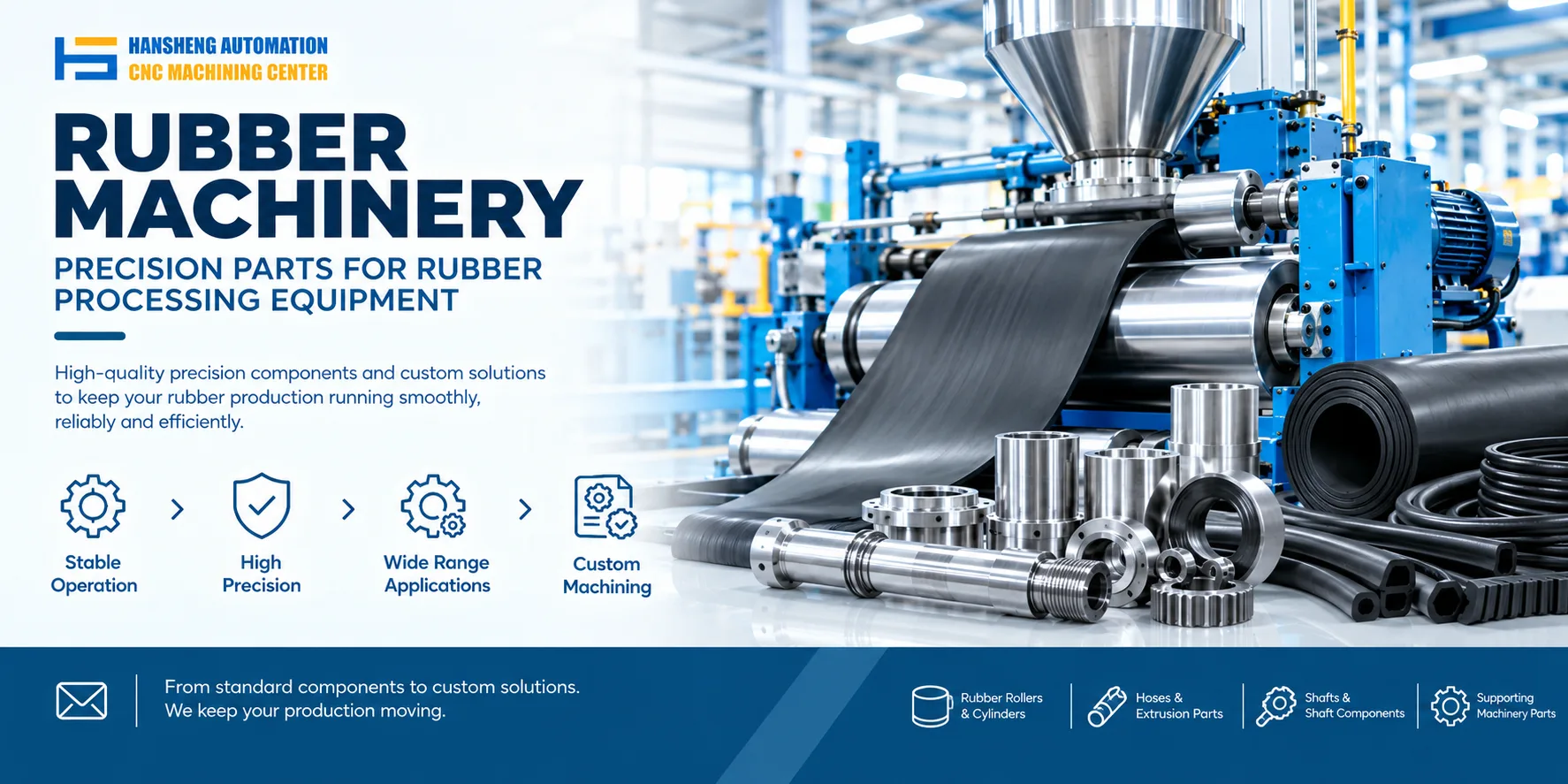
Maintenance may require replacement of worn sealing rings, shafts, metal pads, and other mechanical components. Hansheng Automation can assess custom machining for suitable precision parts based on customer drawings, dimensional requirements, and material specifications.
Our machining services also cover non-standard components for tobacco packaging machinery, filling equipment, and other industrial machinery. We can assess precision parts for yacht equipment and RC racing cars according to the supplied drawings and machining requirements.