Internal mixers and kneaders are both used to process rubber and other polymer materials, but their mixing mechanisms and material dispersion capabilities differ. An internal mixer generally provides more effective shear mixing, making it suitable for applications that require uniform dispersion of fillers and other compounding ingredients, particularly in highly filled compounds and silicone processing.
1. How Do Internal Mixers and Kneaders Differ in Mixing Performance?
A conventional kneader relies mainly on the movement and deformation of materials between its mixing elements. Compared with an internal mixer, it generally provides less effective shear and differential mixing action for demanding dispersion applications.
An internal mixer uses a pair of specially shaped rotors that rotate relative to each other inside an enclosed mixing chamber. This rotor arrangement subjects the material to repeated shearing and compression, helping distribute fillers and other ingredients throughout the compound.
The difference becomes more significant when processing highly filled materials. These compounds require effective dispersion to achieve consistent material properties. An internal mixer is often better suited to such applications, including the processing of silicone compounds.
2. Which Machine Is Better for Silicone Processing?
Both machine types can be used for polymer processing, but the choice depends on the material formulation and production requirements.
For silicone compounds containing substantial amounts of fillers or additives, the mixing action of an internal mixer can help improve dispersion and mixing consistency. A kneader may require a longer mixing cycle to achieve the required uniformity, depending on its design and the formulation being processed.
Vacuum processing is another consideration, particularly for liquid silicone. An internal mixer configured for vacuum operation can remove entrained air during mixing. This capability is useful when the process requires reduced air content in the compound. Vacuum capability depends on the machine configuration, so the equipment specification should be checked before selection.
3. How Does an Internal Mixer Work?
An internal mixer is designed primarily for rubber mastication and compounding. Its two rotors turn inside a closed mixing chamber, processing the material under controlled temperature and pressure conditions.
The main components include the mixing chamber, rotors, rotor sealing system, feeding and pressing mechanisms, discharge mechanism, drive system, and machine base.
During operation, the feeding mechanism introduces the material into the chamber. The rotors then work the compound until it reaches the required mixing condition, after which the material is discharged for the next production stage.
The enclosed chamber and rotor configuration allow the machine to process rubber compounds under controlled conditions. The actual mixing performance depends on factors such as rotor design, operating parameters, material formulation, and batch size.
4. When Should You Choose an Internal Mixer?
An internal mixer is a suitable option when the process requires effective dispersion of fillers, consistent compound quality, or controlled processing of demanding rubber formulations. It can offer advantages over a conventional kneader in applications where shear mixing and production efficiency are important.
A kneader may still be suitable for applications that match its mixing mechanism and processing capacity. The final selection should take into account the material being processed, the required mixing quality, the intended production volume, and whether vacuum operation is necessary.
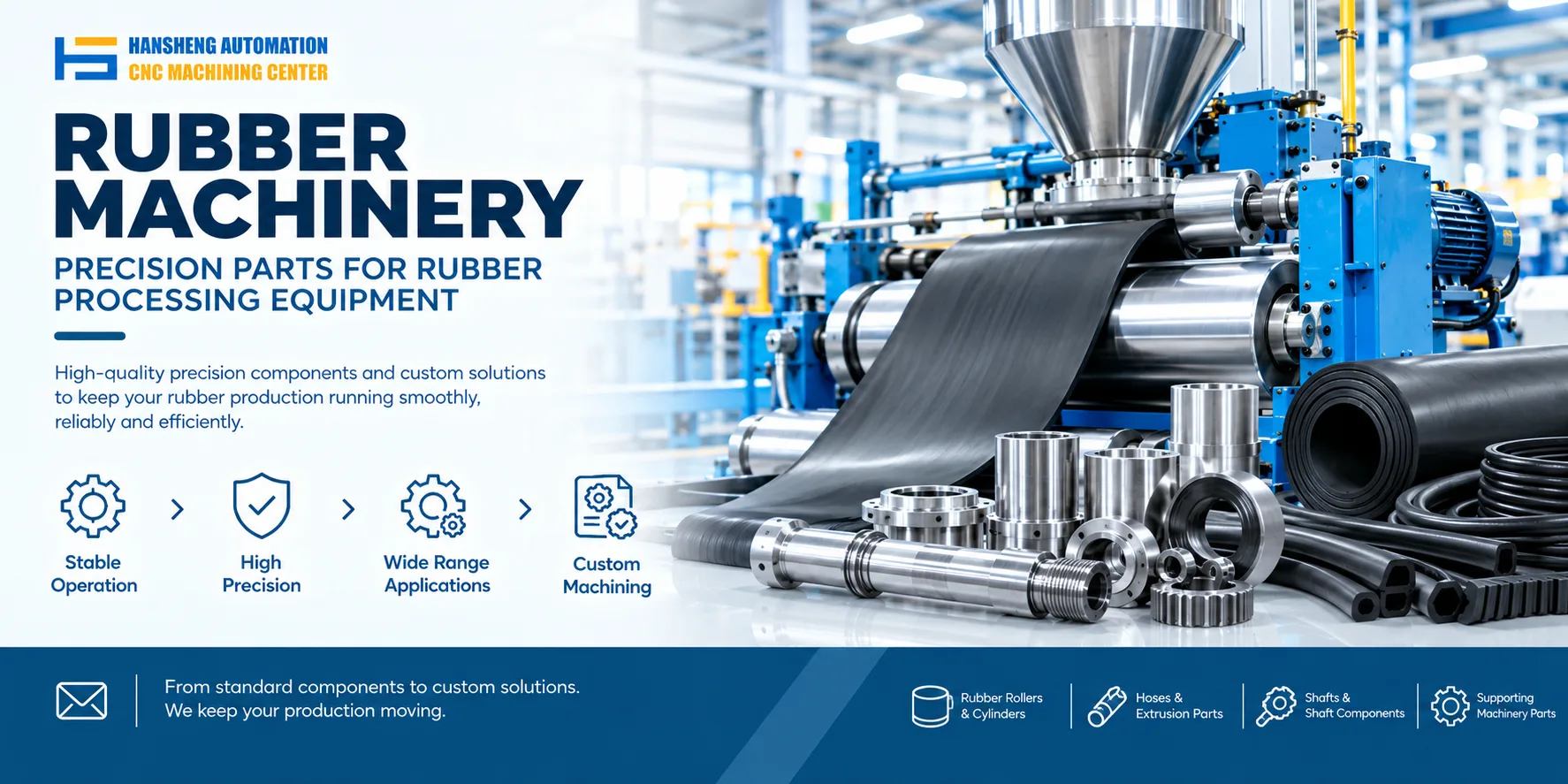
Custom precision machining for rubber processing equipment
Internal mixers, kneaders, and other rubber processing machines depend on mechanical components that meet specific dimensional and assembly requirements. Hansheng Automation provides custom precision machining based on customer drawings, with manufacturing processes selected according to component geometry, material specifications, and dimensional tolerances.
Our machining services also cover non-standard components for packaging and filling machinery, tobacco processing equipment, yacht systems, and RC racing cars. Customers can submit technical drawings for evaluation, whether they require individual prototypes or small batch production of precision mechanical parts.