Paper and paperboard both start as dilute stock. The stock is filtered on a forming fabric, fibers interweave, and a wet sheet forms. The sheet is then pressed, dried, and finished. The main differences between paper and paperboard come from layer count, thickness, basis weight, and production mode.
Forming method
Paper is usually formed as a single sheet on a paper machine. The machine can be a fourdrinier, cylinder, or gap former. Stock at 0.3% to 1.0% consistency flows from the headbox onto the wire. Water drains, fibers deposit, and a uniform wet sheet forms. The sheet leaves the wire at 14% to 22% dryness, goes through the press section to 30% to 40% dryness, and then dries on steam-heated cylinders to 92% to 95% dryness. After calendering, it is reeled.
Paperboard uses multi-layer forming. Several cylinder, fourdrinier, short wire, or gap formers each make a single wet layer. These layers combine into a wet board. The wet board goes through pre-pressing, then main pressing and multi-cylinder drying similar to a paper machine. Board grades often use high-yield pulp, and the pulp blend depends on board type and end use.
Thickness and basis weight
Paperboard under 1 mm thick and up to 800 g/m² is usually made continuously on a board machine. Formers produce separate wet layers, which are combined and then dewatered and dried.
Paperboard over 1 mm thick often uses batch production. A wet sheet is formed on a cylinder or fourdrinier of a wet machine, wound on a forming roll to the required thickness, cut off, pressed in a hydraulic press, and dried in a tunnel drying chamber.
Production mode
Paper making is continuous. The sheet forms, presses, dries, calenders, and reels in one linked line.
Paperboard making can be continuous or batch. Thin board runs continuously. Thick board uses the batch route. This difference affects equipment layout, floor space, and output.
Common steps
Both paper and paperboard share stock preparation steps: refining, blending, additive dosing, cleaning, and screening. Refining develops fiber flexibility and bonding. Additives include sizing agents, fillers, dyes, dry strength agents, wet strength agents, retention aids, drainage aids, preservatives, and defoamers. Cleaning removes sand and grit with conical cleaners. Screening removes fiber bundles and knots with pressure screens.
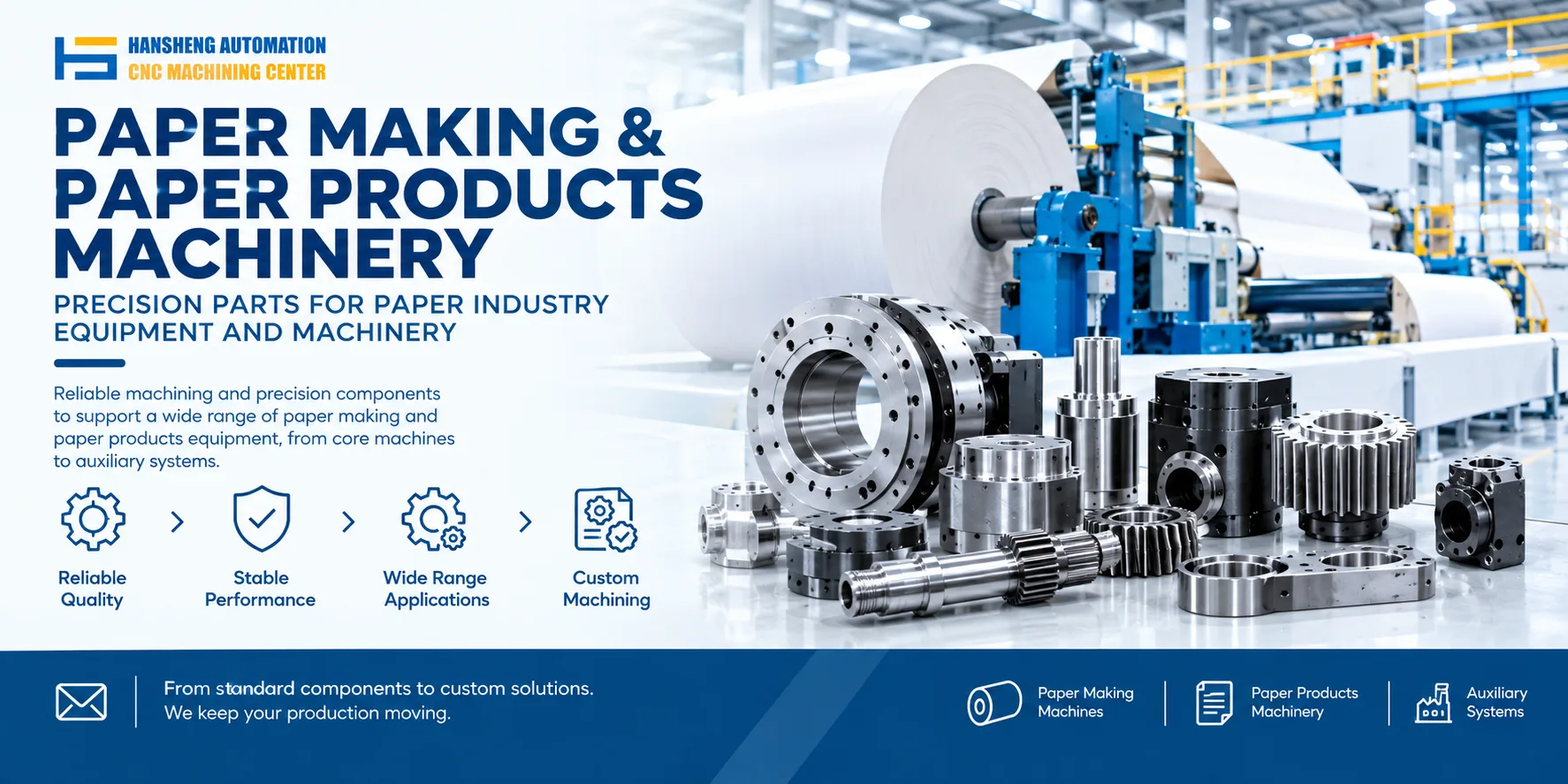
For paper and paperboard machine builders, Hansheng Automation can machine custom forming boards, suction box parts, press rolls, dryer cylinder components, and reel parts from customer drawings, in single pieces or small batches.
Beyond paper and paperboard equipment, our precision component customization covers more than one industry. We machine yacht precision components, RC car precision components, tobacco packaging machinery parts, filling machinery parts, printing machinery parts, food machinery parts, and medical device components. Hansheng Automation works from customer drawings and delivers one-off or batch parts to the required material, tolerance, and surface finish. Our scope is precision components, not complete machines.