ABB industrial robots require six-axis origin calibration under the following circumstances:
- After a serious mechanical fault or mechanical damage occurs, the joint positions of the six-axis robot may deviate significantly. In this case, origin calibration is needed to restore motion accuracy and precision.
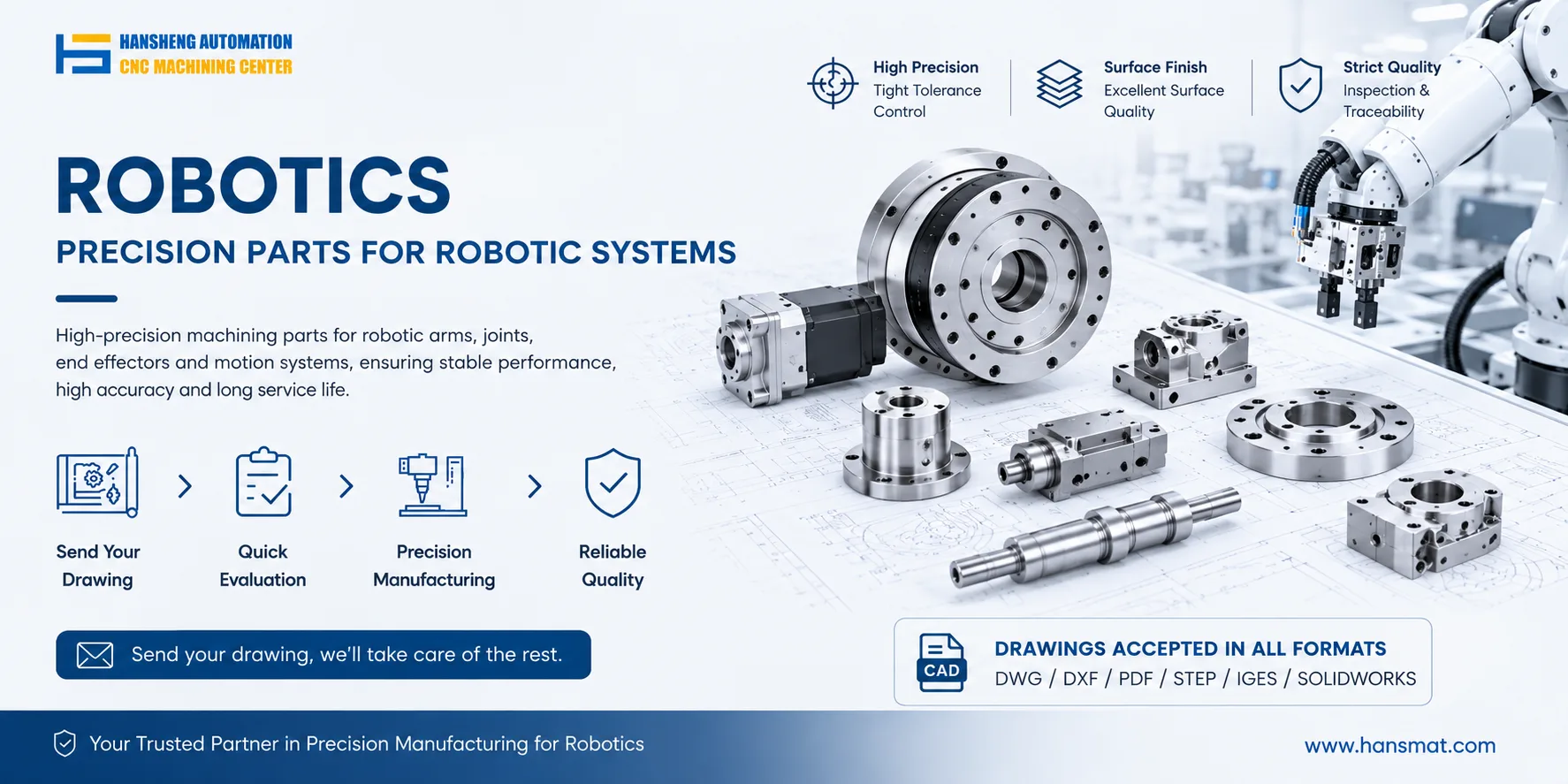
- After extensive maintenance work, especially when joints are disassembled or critical components are replaced, six-axis origin calibration may be required again. If such critical joint components need replacement, Hansheng Automation can provide custom machining services based on customer drawings, helping restore proper fit and robot accuracy.
The steps for six-axis origin calibration are as follows. These steps assume that the operator has appropriate training and qualifications to perform robot maintenance, because incorrect calibration may cause robot damage or unsafe conditions.
- Power off the robot: first make sure the robot is completely shut down and all power has been disconnected.
- Enter safe mode: enter the safe mode of the robot controller to prevent accidents during calibration.
- Manually move the robot: manually move the robot to a known and precisely positioned location. This can be done using the teach pendant or manual mode on the controller.
- Perform origin calibration: run the six-axis origin calibration program. The program automatically identifies the origin position of each joint and sets it as the zero point for joint angles. The calibration process usually follows the specific robot model and controller software.
- Confirm calibration: after calibration, perform a confirmation step to check that each joint has correctly returned to its predetermined origin position.
- Function test: after confirmation, carry out a series of function tests to ensure that robot motion and control work normally after calibration.
- Exit safe mode: after calibration and testing are complete, exit safe mode and return the robot to normal operating mode.
Please note that origin calibration of a six-axis robot is an important and sensitive operation. It should only be performed by trained professionals who are familiar with the specific robot model.