In the field of industrial drying and granulation, fluidized bed boiling dryers and vibrating fluidized bed dryers both utilize fluidization technology, yet they differ significantly in structural design, operating mechanisms, and suitable materials.
Operating Characteristics and Processing Limitations of Vibrating Fluidized Bed Dryers
Vibrating fluidized bed dryers achieve efficient material fluidization through the combined action of exciting force and thermal airflow. The thorough mixing of fluid and solid particles provides frequent surface renewals, substantially enhancing heat and mass transfer to ensure uniform temperature distribution within the bed. Featuring a high volumetric heat transfer coefficient, this equipment delivers exceptional throughput-handling up to hundreds of tons per hour on a single unit. Compared to traditional box-type or rotary drum dryers, it offers shorter residence times and higher drying rates, making it highly adaptable for continuous or batch drying of heat-sensitive materials.
However, vibrating fluidized beds impose strict boundaries on the physical properties of input materials:
- Particle Size Constraints: Suitable material particle sizes typically range from 30 μm to 6 mm. Particles smaller than 30 μm are easily entrained by airflow, while particles larger than 6 mm struggle to maintain stable fluidization.
- Physical Uniformity Requirements: When drying multi-component mixtures, relative material densities must be close; otherwise, lower-density particles are easily carried away, compromising final moisture consistency.
- Material Condition Limits: High-viscosity, sticky, or cake-forming wet materials can block distribution plates or adhere to bed walls. For materials with stringent requirements for physical appearance or uniform dryness, standard configurations may prove inadequate. Additionally, handling precious or toxic materials requires high-precision exhaust recovery systems.
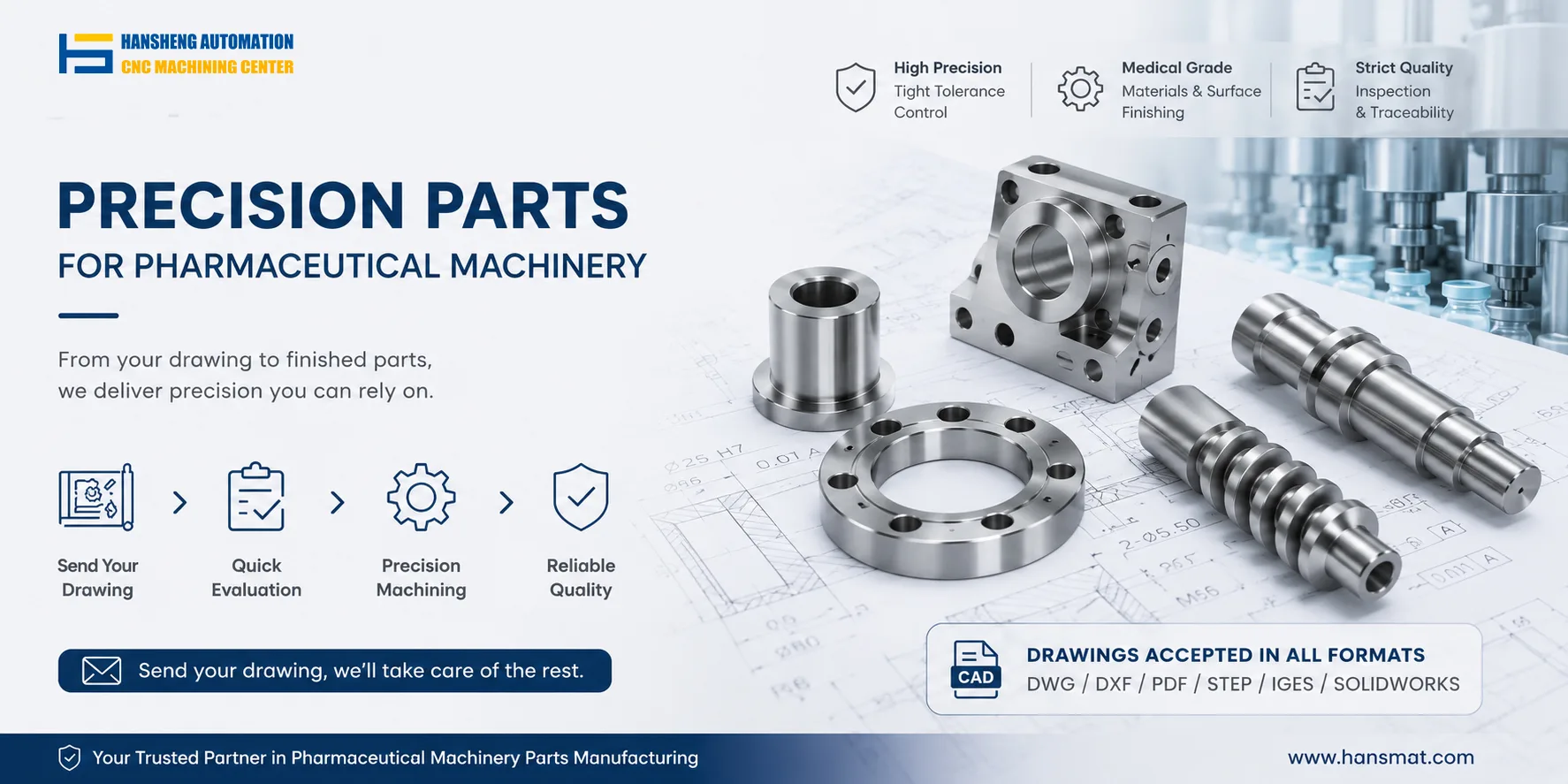
To address wear, corrosion, and clogging caused by varied material properties, Hansheng Automation can custom-machine key components-such as air caps, gas distribution plates, guide plates, and vibration transmission mechanisms-based on customer design drawings, helping equipment manufacturers optimize fluidization uniformity and mechanical durability.
Operating Principles and Application Advantages of Fluidized Bed Boiling Granulators
Fluidized bed boiling granulators integrate preheating, mixing, atomized granulation, and drying into a single operation. Material powder achieves a circulating fluidization state within the bed. Preheated by purified hot air, a binder solution is atomized and sprayed via nozzles, causing fine particles to aggregate into granules. As continuous hot air evaporates moisture, the binder solidifies, ultimately forming uniform, porous spherical granules.
Key process advantages include:
- One-Step High-Efficiency Granulation: Completes mixing, granulation, and drying in a single vessel, significantly improving powder flowability and dissolution rates.
- Safety and Compliance: Equipped with anti-static filter bags and pressure relief vents for safe operation in dusty environments. The dead-corner-free structure allows fast loading/unloading and thorough CIP cleaning, complying with GMP standards.
- Broad Application Scope: Extensively used in pharmaceuticals (tablets/capsules), food (instant beverages, seasonings), agrochemicals (fertilizers, pesticides), and fine chemicals (pigments, dyes), while extending to precision coating processes such as protective, sustained-release, and enteric coatings.
Summary of Technical Differences
In summary, vibrating fluidized bed dryers focus on large-scale, continuous pure drying, whereas boiling granulators specialize in multi-step composite precision particle forming. In practical applications, customizing internal components and material selection according to specific fluidization properties remains key to ensuring optimal drying and granulation performance.