The core difference between dual-arm robots and humanoid robots lies in design philosophy and functional positioning. A dual-arm robot is a specialist focused on specific operations, while a humanoid robot is a generalist pursuing all-around adaptation.
1. Appearance and Form
Dual-arm robots usually do not have a complete humanoid structure. Their most prominent feature is the two robotic arms, which are often mounted directly on a fixed base or mobile platform. Humanoid robots, by contrast, aim to imitate the overall human form, with a head, torso, two arms, and two legs, making them appear much closer to a real person.
2. Functions and Uses
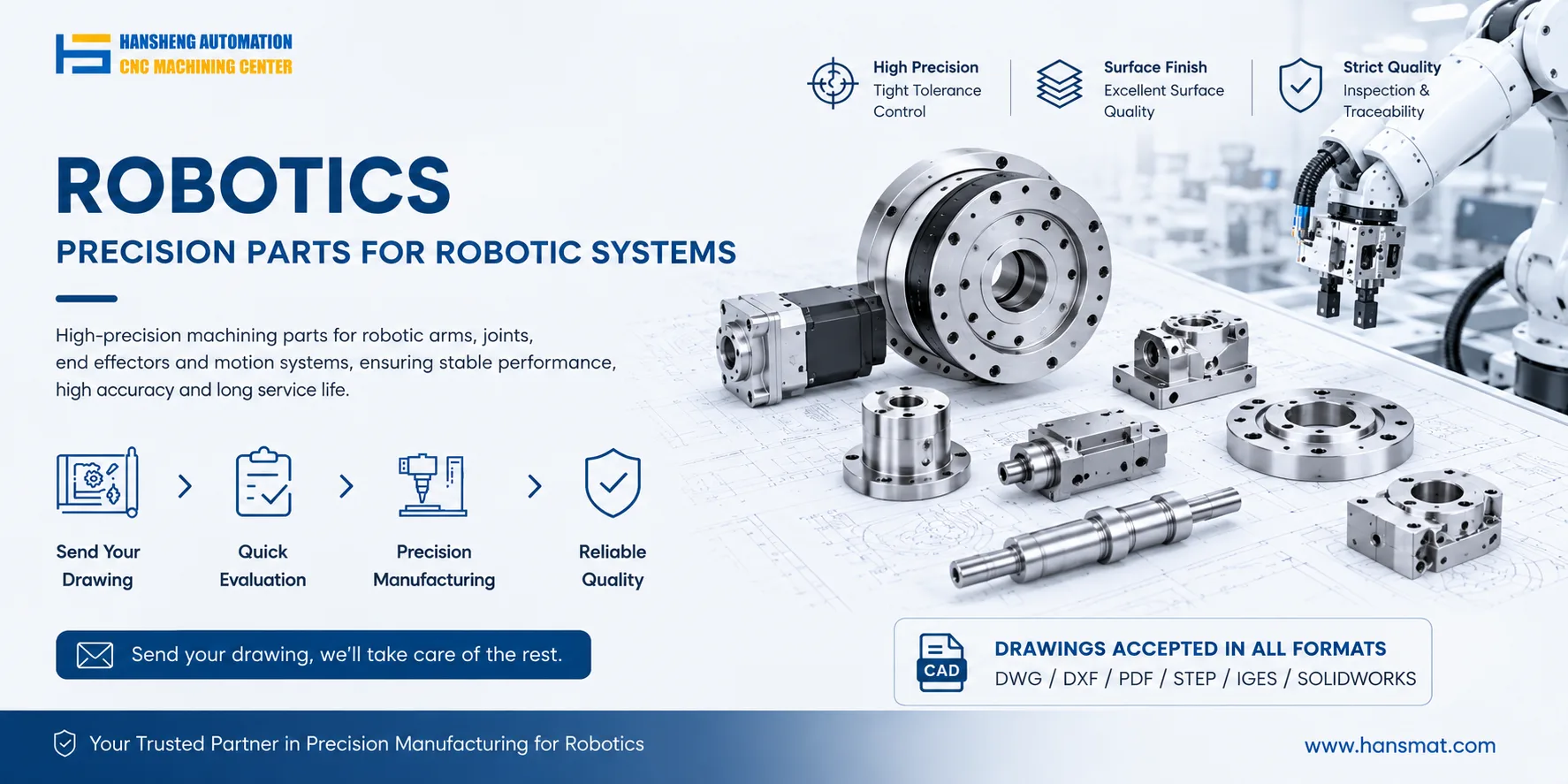
Dual-arm robots mainly serve the industrial sector and excel at highly repetitive and precision-demanding tasks, such as precision assembly, material handling, and welding on production lines. For these industrial applications, Hansheng Automation provides custom machining of non-standard fixtures, adapter plates, and replacement mechanical parts based on customer drawings. Humanoid robots have a much broader range of functions. They are designed to adapt to human living and working environments, and can not only perform operational tasks but also interact with people in areas such as service, rescue, companionship, and education.
3. Motion Capability
The difference in motion capability is significant. The working range of a dual-arm robot is basically limited to the space reachable by its robotic arms. Most are fixed in place and have very weak mobility. Humanoid robots, on the other hand, have human-like legs and are capable of walking, running, climbing stairs, and even handling complex terrain. Mobility is one of their core capabilities.
4. Technical Complexity
The technical core of a dual-arm robot lies in the motion control precision of its arms and the algorithms for coordinated operation. In comparison, humanoid robots face far more complex technical challenges. They must not only solve dual-arm coordination but also overcome higher-level difficulties such as bipedal dynamic balance, whole-body motion coordination, and complex environmental perception and interaction. Their technical integration and complexity far exceed those of dual-arm robots.