Centrifuge commissioning must follow safety rules and the equipment manual. The key details fall into four stages: preparation, no-load commissioning, load commissioning, and final verification.
Preparation stage
Safety checks: disconnect the main power supply first and attach a warning tag that says commissioning in progress, do not switch on. Check that the equipment grounding is secure to avoid electric shock. Confirm there are no unrelated people or objects nearby and leave at least 1.5 meters of operating space.
Material and parameter confirmation: for an industrial separation centrifuge, prepare the material to be processed in advance and check that rated speed, maximum load, and allowable centrifugal force match the working conditions. For a medical centrifuge, disinfect the rotor and centrifuge tubes in advance and confirm the sample fits the rotor type.
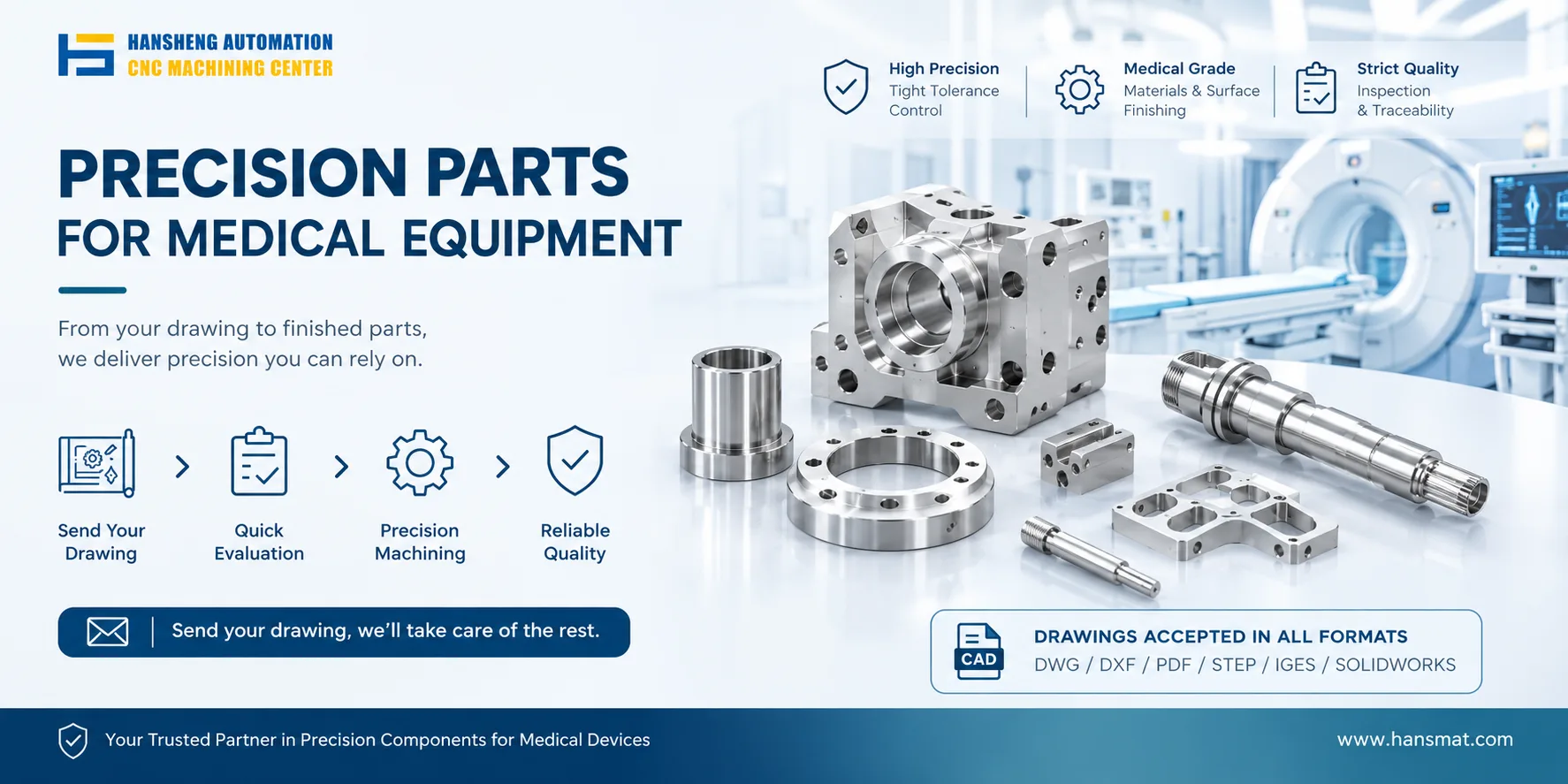
Equipment appearance inspection: check the rotor for cracks and corrosion, check that bolts are tight, check seals for aging or damage, and check belt tension. For non-standard rotors, adapters, motor mounts, and couplings, Hansheng Automation can machine custom parts to customer drawings in single units or small batches.
No-load commissioning stage
No-load test run: install the rotor without a load, start at low speed, usually 30 percent of rated speed, and watch for abnormal noise or vibration. Test the brake and the start-stop function.
Vibration inspection: raise speed step by step to 50 percent and 80 percent of rated value. Use a vibration meter to monitor vibration at the bearing housing and housing. Industrial centrifuges generally require vibration at or below 0.1 mm, and medical centrifuges at or below 0.05 mm. If vibration exceeds the limit, stop the machine and check whether the rotor is properly seated and whether the counterweight is balanced.
Parameter verification: test the temperature control system on models with temperature control, the timer, and the alarm device. Confirm that all parameters can be set and saved normally.
Load commissioning stage
Symmetrical loading: load materials in strict symmetry. The weight difference between samples or materials must not exceed the allowed range. For industrial centrifuges this is generally 50 g or less, and for high-speed medical centrifuges it is 10 g or less. Avoid unbalanced loading, which causes severe vibration.
Progressive loading: run at low speed for 10 to 15 minutes and observe equipment condition. If there is no abnormality, raise speed gradually to rated working speed. Monitor temperature, pressure, and current throughout to confirm they stay within rated ranges.
Abnormal condition handling: if abnormal noise, smoke, or severe vibration occurs during operation, press the emergency stop button immediately. Cut off power and troubleshoot. Never reach into the internal structure while the equipment is running.
Final verification stage
Shutdown inspection: after commissioning, run the centrifuge without load for 30 minutes. Confirm that all indicators are normal, then shut down. Check the rotor and chamber for wear and material residue, and clean them promptly.
Parameter records: record key data from the commissioning process, including speed, temperature, current, and vibration values. Keep the equipment operation log.
Safety closeout: switch off the main power, clean the commissioning site, and protect the equipment from dust and moisture. If the rotor is removable, store it separately to avoid impact damage.
Our precision parts machining service is not limited to centrifuge components. Hansheng Automation also produces custom parts for laboratory equipment, medical devices, compressor assemblies, filling machinery, printing equipment, tobacco packaging machinery, yacht hardware, and RC car components. We work from customer drawings and deliver single units or small batches. The service remains focused on precision parts manufacturing, not complete equipment sales.