During continuous operation, automatic high-speed cartoning machines may experience problems in carton feeding, leaflet pickup, folding, and vacuum conveying. Troubleshooting should focus on the vacuum system, pickup mechanism, conveying system, and mechanical synchronization.
1. Cartons Cannot Be Picked Up Properly
Problem
The suction mechanism fails to pick up cartons accurately, interrupting the cartoning process.
Solutions
Check the suction cups
Inspect the suction cups for aging, deformation, or damage. Replace them if their suction performance has deteriorated.
Check the vacuum lines
Inspect the vacuum lines for blockage, damage, or air leakage. Clean blocked sections and repair leakage points to maintain stable vacuum pressure.
Adjust the carton pickup mechanism
Check the timing and position between the pickup mechanism and carton conveyor. Adjust the mechanism so that pickup occurs when the carton reaches the correct position.
Check carton quality
Carton adhesion, deformation, or dimensional variation can also affect pickup. Replace cartons that do not meet the required specifications.
2. Leaflets Cannot Be Picked Up Properly
Problem
The pickup mechanism fails to remove leaflets accurately, resulting in interrupted leaflet feeding.
Solutions
Adjust the suction nozzle position
Check the height, position, and angle of the suction nozzle relative to the leaflet tray so that it can make stable contact with the leaflet.
Adjust vacuum timing
Set the vacuum generation time according to the machine cycle to ensure sufficient suction when the nozzle contacts the leaflet.
Check the vacuum lines
Make sure the vacuum system is free from blockages and air leakage and can maintain stable suction pressure.
Check the leaflet conveying mechanism
Inspect the conveying position and timing to prevent misalignment or synchronization problems.
Adjust the separating and air-blowing mechanisms
If the paper-separation or air-blowing action is inaccurate, readjust the position, airflow, and timing so that individual leaflets can be separated properly.
3. The Suction Nozzle Picks Up Multiple Leaflets
Problem
The suction nozzle picks up two or more leaflets at the same time, affecting subsequent folding and cartoning.
Solutions
Adjust the tray and nozzle position
Adjust the tray height, angle, and suction nozzle position so that only one leaflet is picked up during each cycle.
Check the separating mechanism
Adjust the synchronization between the separator and suction nozzle to ensure that adjacent leaflets are properly separated.
Check leaflet condition
Static electricity, moisture, or adhesion between sheets can make separation difficult. Improve storage conditions and replace unsuitable leaflets when necessary.
4. Leaflets Become Stuck Inside the Folding Unit
Problem
A leaflet cannot pass smoothly through the folding unit, resulting in paper jams or failed folding.
Solutions
Adjust the folding-roll gap
Set the gap between the folding rollers according to the leaflet thickness and material so that the sheet can pass through smoothly.
Check the roller coordination
If the winding or conveying roller squeezes or damages the leaflet, inspect its synchronization with the separating, suction, and air-blowing mechanisms and readjust the related settings.
Check the conveying path
Make sure the leaflet is not displaced or wrinkled before entering the folding unit, and inspect guide components for excessive wear.
5. Precision Machining and Replacement of Cartoning Machine Components
After prolonged operation, mechanical components such as suction mechanisms, guide parts, folding rollers, transmission shafts, bushings, and mounting brackets may experience wear or dimensional changes, affecting machine stability.
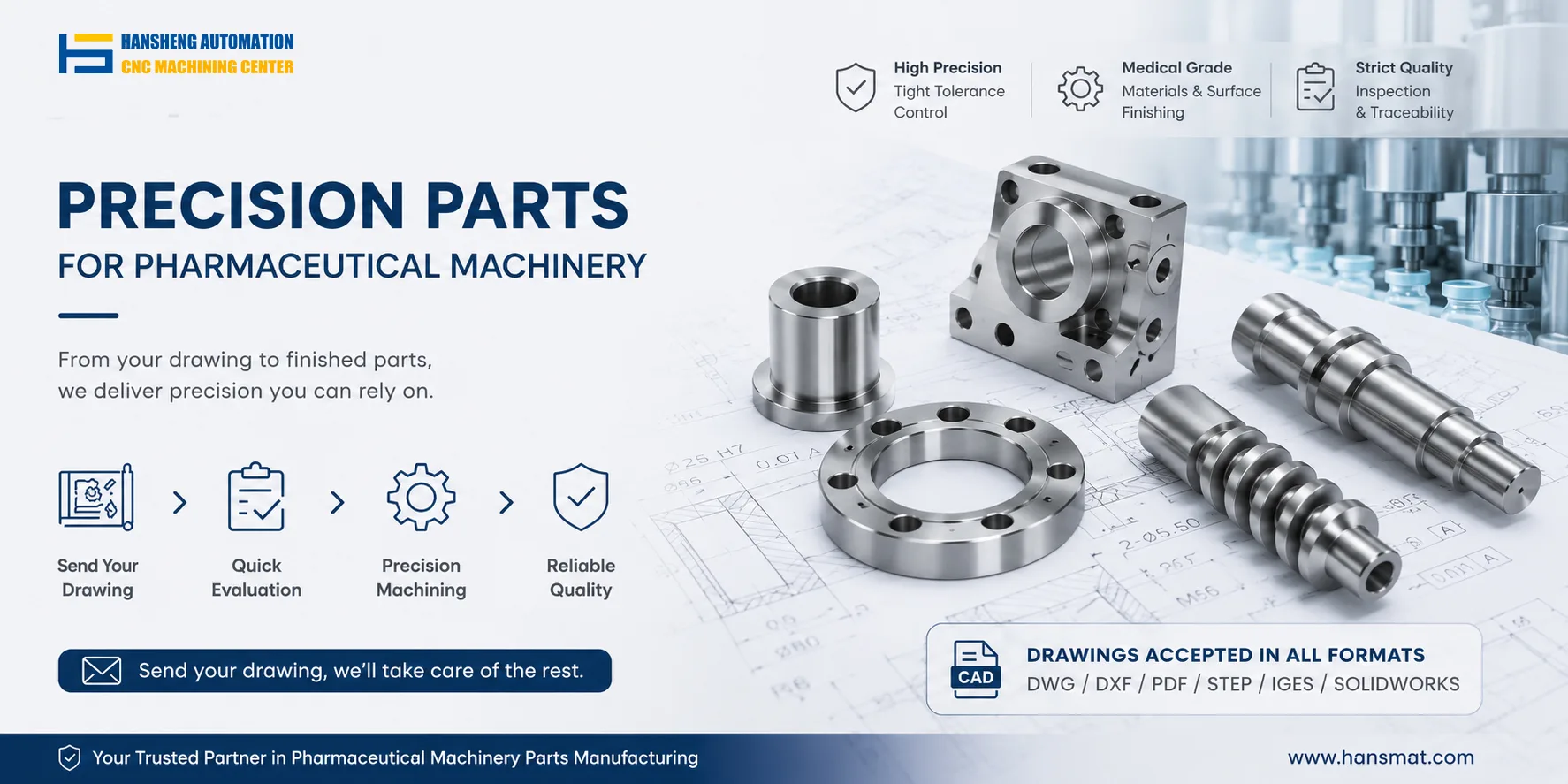
Hansheng Automation provides precision custom machining based on customer 2D or 3D drawings, including pickup mechanism components, guide parts, shafts, bushings, rollers, and mounting supports. Depending on the component structure and operating requirements, we can use CNC turning, CNC milling, precision grinding, and other suitable processes to support equipment maintenance, replacement parts, and mechanical improvements.