During prolonged operation, a plate-and-frame filter press may develop hydraulic pressure problems, plate movement difficulties, worn sealing surfaces, uneven filter cake formation, and leakage between plates. These problems can reduce filtration efficiency, increase maintenance costs, and, in severe cases, damage the filter plates or frame.
Common faults generally involve the hydraulic closing system, plate-shifting mechanism, filter plate sealing surfaces, filtration process, and structural components. Maintenance personnel should identify the cause based on the actual symptoms before carrying out repairs.
Hydraulic Pressure Loss, Plate Pack Loosening, and Oil Leakage
Symptoms
After the filter plate pack has been closed, the hydraulic system may fail to maintain the specified pressure. The plates may gradually loosen, resulting in slurry or filtrate leakage during filtration.
Other symptoms include oil leakage from the hydraulic cylinder, a continuous drop in the pressure gauge reading, and frequent activation of the hydraulic pump to restore pressure.
Possible causes
The hydraulic closing system uses pressurized oil to move the piston and closing plate, providing the clamping force required to hold the filter plates together. Leakage or control problems can prevent the system from maintaining the required pressure.
Common causes include:
Worn hydraulic seals: Piston seals and O-rings may deteriorate or become damaged during prolonged operation, causing external oil leakage or internal leakage within the cylinder.
Loose hydraulic connections: Loose fittings, damaged seals, or defective hoses can cause oil leakage and reduce pressure-holding capability.
Hydraulic pump malfunction: Internal pump wear, insufficient oil level, or a blocked suction line can reduce oil supply and system pressure.
Hydraulic valve faults: A stuck or leaking relief valve, directional control valve, or check valve can interfere with pressure buildup and retention.
Hydraulic oil or piping problems: Incorrect oil viscosity, contamination, or air trapped in the hydraulic circuit can affect system stability.
Solutions
First, check the hydraulic oil level and condition. Confirm that the pump can draw in and supply oil normally.
Inspect the hydraulic cylinder, pipe fittings, and valve assemblies for external leakage. Replace aged or damaged seals with components that meet the original equipment specifications.
If the hydraulic pump starts frequently to compensate for pressure loss, further inspect the check valve, relief valve, and cylinder for internal leakage. Clean or replace valves with stuck or damaged spools according to the maintenance procedure.
If cylinder movement is unstable or jerky, check for air in the hydraulic circuit and bleed the system according to the manufacturer's instructions.
Seal replacement intervals should be based on actual operating conditions and the equipment maintenance manual. An annual replacement schedule should not be applied universally.
Slow or Misaligned Filter Plate Movement
Symptoms
During press opening or cake discharge, the plates move more slowly than normal, become misaligned, or, in severe cases, move out of their intended guide positions.
Possible causes
Filter plates are moved by guide rods, rails, rollers, or an automatic plate-shifting mechanism. Contamination, wear, or installation errors in these components can interfere with normal plate movement.
Common causes include:
Contaminated guide rods or rails: Sludge, dust, and other deposits can accumulate on the guide surfaces and increase movement resistance.
Incorrect lubrication condition: Insufficient or unsuitable lubrication on the rails or rollers can increase friction.
Worn rollers or bearings: Deformed rollers, damaged bearings, or restricted rotation can cause uneven plate movement.
Plate-shifting mechanism failure: Problems with the chains, sprockets, drive motor, or connecting components can cause an automatic plate shifter to move plates unevenly.
Deformed rails or frame: Misaligned guide rails or frame deformation can cause the plates to move off their intended path.
Solutions
Clean sludge, dust, and other deposits from the guide rods and rails regularly.
Lubricate the guide rails, roller bearings, and associated drive components as specified by the equipment manufacturer. For equipment with self-lubricating or specialized guide systems, follow the corresponding maintenance requirements rather than applying grease indiscriminately.
Inspect rollers, bearings, chains, and sprockets for wear. Repair or replace damaged components as necessary.
If the plates are visibly misaligned, check guide rail parallelism, frame level, and connecting components. Make the necessary adjustments before resuming operation.
Keep the floor clean during maintenance and remove spilled oil or grease promptly to reduce the risk of slips and falls.
Grooves and Erosion on Filter Plate Sealing Surfaces
Symptoms
After a period of operation, grooves, channels, or localized wear may develop along the edges or sealing areas of the filter plates.
As the damage progresses, sealing performance deteriorates. Slurry may leak through the worn areas, causing filtrate leakage, unstable filtration pressure, or incomplete filter cake formation.
Possible causes
Grooves on the sealing surfaces are commonly associated with prolonged slurry erosion, abrasive particles, or poor sealing.
For example, when slurry leaks through the plate edges, solid particles carried by the liquid can continuously erode the sealing surfaces and form localized grooves.
Uneven closing force, plate misalignment, or hard particles trapped between adjacent plates can also cause localized wear during repeated operation.
Solutions
First, inspect the location, depth, and extent of the damage to determine whether the sealing surface has been affected.
For minor surface grooves, provided that the plate body has no cracks, deformation, or structural damage, consult the equipment manufacturer to determine whether a repair compound compatible with the plate material is approved for localized repair.
If the grooves are deep, the sealing surface is severely worn, or the plate body has cracked, replace the plate. Surface patching should not be used as a substitute for a structurally sound pressure-bearing component.
During routine maintenance, inspect the plate sealing surfaces for residual sludge and solid particles. Remove deposits promptly to prevent continued erosion and leakage.
Also check the hydraulic closing force, plate alignment, and sealing condition to prevent repeated leakage at the same location.
Uneven or Incomplete Filter Cake Formation
Symptoms
After filtration, some chambers contain relatively thick filter cakes, while others contain thin cakes or remain partially empty.
Other symptoms may include reduced filtrate flow, extended filtration cycles, and excessive moisture in the discharged cakes.
Possible causes
Uneven cake formation is usually associated with feed quantity, sludge concentration, filtration resistance, and slurry distribution between chambers.
Common causes include:
Insufficient feed supply: Low pump flow, inadequate pump head, or pump malfunction can prevent the chambers from receiving enough sludge.
Low sludge solids content: When the feed solids concentration is too low, insufficient solids enter the chambers to form filter cakes of the required thickness.
Blocked feed channels: Blocked feed ports, frame channels, or slurry pipelines can restrict feeding to individual chambers.
Blinded filter cloths: Fine particles accumulating on the cloth surface increase filtration resistance and restrict filtrate flow.
Inadequate sludge conditioning: Incorrect flocculant dosage or insufficient mixing may produce fine particles that are difficult to filter.
Poor feed pressure control: Increasing pressure too quickly may force fine particles into the filter cloth pores and blind the media before a uniform cake has formed.
Solutions
First, check the actual feed pump flow rate and pressure to confirm that the pump meets the requirements of the filter press.
If the sludge solids content is too low, adjust the feed conditions and upstream thickening process according to the production requirements. For sludge with poor filterability, optimize the flocculant dosage and conditioning method through testing.
Inspect the feed ports, frame channels, and slurry pipelines. Remove accumulated sludge and foreign material.
Clean blinded filter cloths using a method compatible with the cloth material. Replace the cloths if normal permeability cannot be restored.
Adjust the feeding sequence according to the rated equipment pressure and sludge filtration characteristics. Gradually increasing the feed pressure helps the chambers fill more evenly.
Do not increase the feed pressure or install a higher-capacity pump before identifying the cause. Either action may increase the load on the plates and piping without correcting the underlying problem.
Damage to Filter Plates or Frames
Symptoms
Filter plates or frames may develop cracks, breakage, deformation, or damage along their edges. Severe damage can cause substantial slurry leakage and prevent normal filtration.
Possible causes
Filter plates and frames are exposed to filtration pressure and mechanical closing force during operation. Structural damage may occur when operating conditions exceed the equipment design limits.
Common causes include:
Excessive feed pressure: Pressure exceeding the rated capacity of the plates or frames can subject them to excessive loading.
Blocked feed or filtrate passages: Blocked feed ports, drainage ports, or external filtrate pipes can cause abnormal local pressure conditions.
Incorrect valve operation: Starting the feed pump while the feed or discharge valves are in the wrong position may cause abnormal pump discharge pressure.
Inadequate plate cleaning: Solid particles remaining on the sealing surfaces can cause uneven clamping and increase the risk of localized damage.
Unsuitable material temperature or chemical compatibility: Exposure to temperatures, pH conditions, or chemicals outside the plate material's operating limits can cause deterioration, corrosion, and loss of strength.
Incorrect plate arrangement: An incorrect number, model, or sequence of plates may result in uneven loading across the plate pack.
Prolonged abnormal clamping: Closing force above the specified limit or prolonged loading outside the manufacturer's requirements may reduce plate service life.
Solutions
Stop feeding and release the slurry-side and hydraulic pressure according to the equipment safety procedure. Never remove filter plates while the system remains pressurized.
Use cleaning tools that will not damage the plate surfaces to remove residual sludge and foreign material from the feed ports, drainage channels, and sealing areas.
Inspect the feed pump pressure, pipeline valves, and pressure control devices to identify blockages or abnormal pressure increases.
Replace plates with cracks, significant deformation, or structural damage using components that match the original equipment specifications. Plates with only surface deposits or minor scratches can be cleaned and inspected according to their actual condition.
If the effective chamber volume needs to be reduced, use manufacturer-approved dummy plates or other compatible components. Do not remove plates arbitrarily to change the capacity of the press.
Leakage Between Filter Plates and Frames
Symptoms
During feeding or filtration, slurry or filtrate leaks from the sealing surfaces between adjacent filter plates. In severe cases, leakage may become continuous or develop into a spray.
Possible causes
Leakage between filter plates and frames is generally associated with closing force, filter cloth installation, and sealing surface condition.
Common causes include:
Insufficient hydraulic closing force: The hydraulic system fails to reach the specified closing pressure, preventing the plates from sealing properly.
Damaged or improperly installed filter cloths: Holes, wrinkles, displacement, or poor edge sealing can allow slurry to escape from the plate joints.
Foreign material on the sealing surfaces: Sludge, solid particles, or other deposits prevent the plates from making full contact.
Deformed or damaged filter plates: Warping, deformation, or cracks may cause localized sealing failure.
Excessive feed pressure: When feed pressure exceeds the permitted operating range, it may exceed the normal sealing capacity of the plate pack and cause leakage.
Solutions
Inspect the hydraulic system and confirm that the closing pressure meets the equipment specifications. Check the pump, cylinder, and seals if the pressure is insufficient.
Open the press and remove sludge, particles, and other deposits from the plate sealing surfaces. Make sure the contact surfaces are clean and flat.
Check the filter cloths for tears, wrinkles, or incorrect positioning. Replace damaged cloths and make sure the feed openings align with the corresponding plate ports.
Repair or replace deformed or damaged filter plates as required. Adjust closing pressure only within the equipment's rated limits. Do not compensate for damaged sealing surfaces by increasing hydraulic pressure indiscriminately.
Safety Precautions During Filter Press Maintenance
Plate-and-frame filter press faults may involve hydraulic pressure, feed pressure, and moving mechanical components. The equipment must be made safe before maintenance begins.
Stop feeding and release pressure: Stop the feed pump, isolate the feed line, and confirm that no residual pressure remains in the chambers, piping, or hydraulic system.
Prevent accidental startup: Disconnect the electrical supply and apply appropriate measures to prevent unexpected operation of the hydraulic pump or plate-shifting mechanism.
Avoid overpressure operation: Do not increase feed pressure or hydraulic closing pressure arbitrarily to compensate for filtration problems.
Use suitable maintenance tools: When cleaning feed ports, sealing surfaces, and guide components, avoid tools that may scratch or damage the equipment.
Use compatible replacement parts: Replace filter plates, cloths, seals, and hydraulic components with parts that meet the original equipment specifications and operating requirements.
Regular inspection of the hydraulic system, plate-shifting mechanism, filter media, feed piping, and plate sealing surfaces helps identify problems early, reduce equipment failures, and maintain reliable filter press operation.
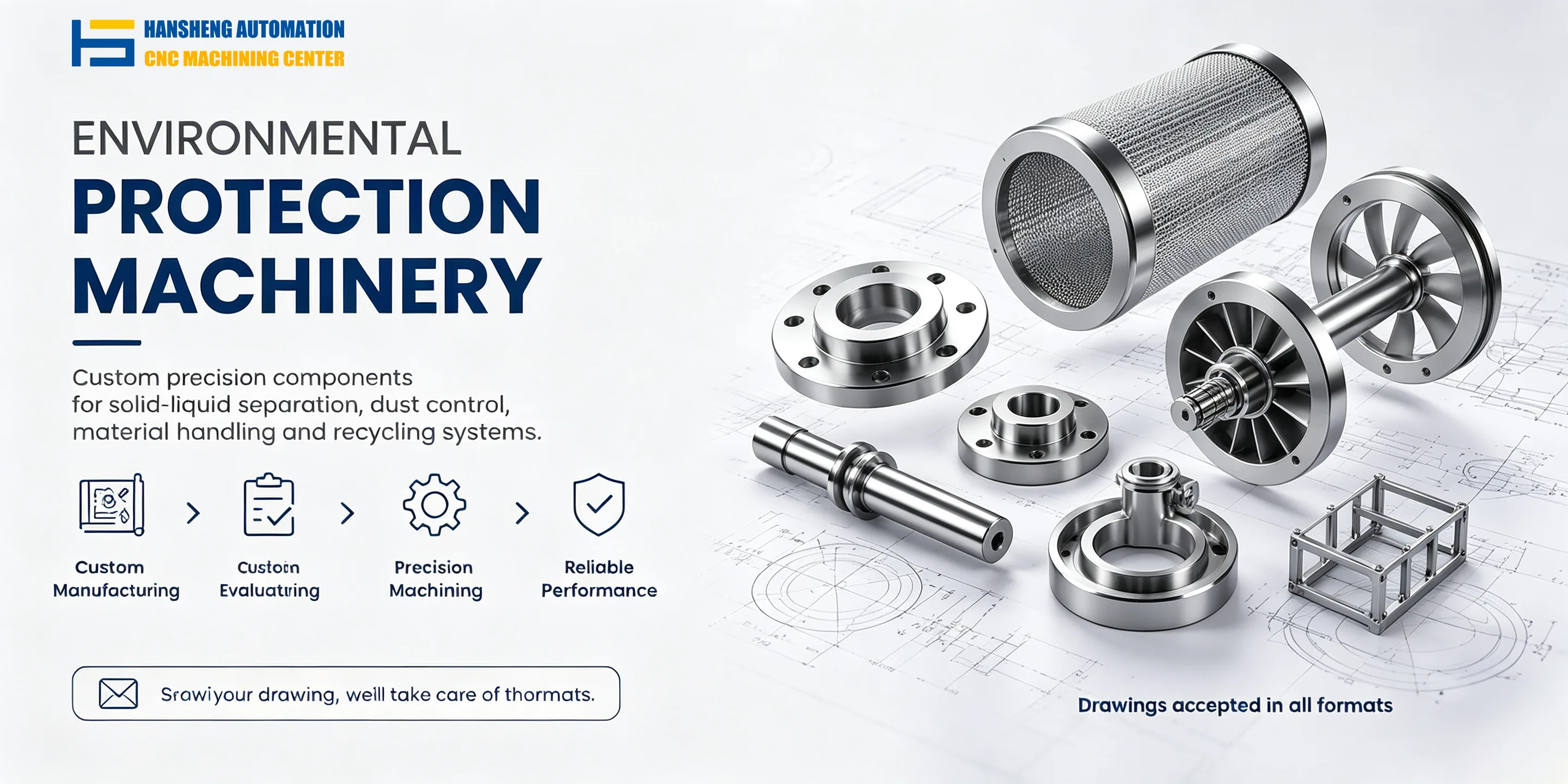
In addition to mechanical components used in filter press equipment, Hansheng Automation provides precision machining services for several manufacturing industries. We manufacture custom functional components for tobacco packaging and filling machinery, as well as precision parts for yacht equipment and structural components for remote-control racing cars, according to customer-supplied drawings. Both single-piece and small-batch precision machining are supported.