At present, humanoid robots cannot fully replace robotic arms. The two differ significantly in technical characteristics and application scenarios.
1. Technical Capability Comparison
Precision: industrial robotic arms can achieve repeatability of ±0.02 mm, based on 2023 FANUC data for its latest models, while the best humanoid robots currently reach only millimeter-level precision.
Payload: automotive welding robotic arms typically handle 210 kg, whereas the current maximum payload of humanoid robots does not exceed 50 kg, as seen in models such as UBTECH Walker X.
Speed: robotic arms used for injection molding part removal can move at up to 8 m/s, while humanoid robot walking speed is usually below 3 km/h.
2. Application Scenario Differences
Robotic arms are advantageous in the following areas:
High-intensity repetitive work at fixed stations, such as automotive welding lines.
Operation in hazardous environments, such as foundries with temperatures up to 800°C.
Assembly processes requiring millimeter-level precision.
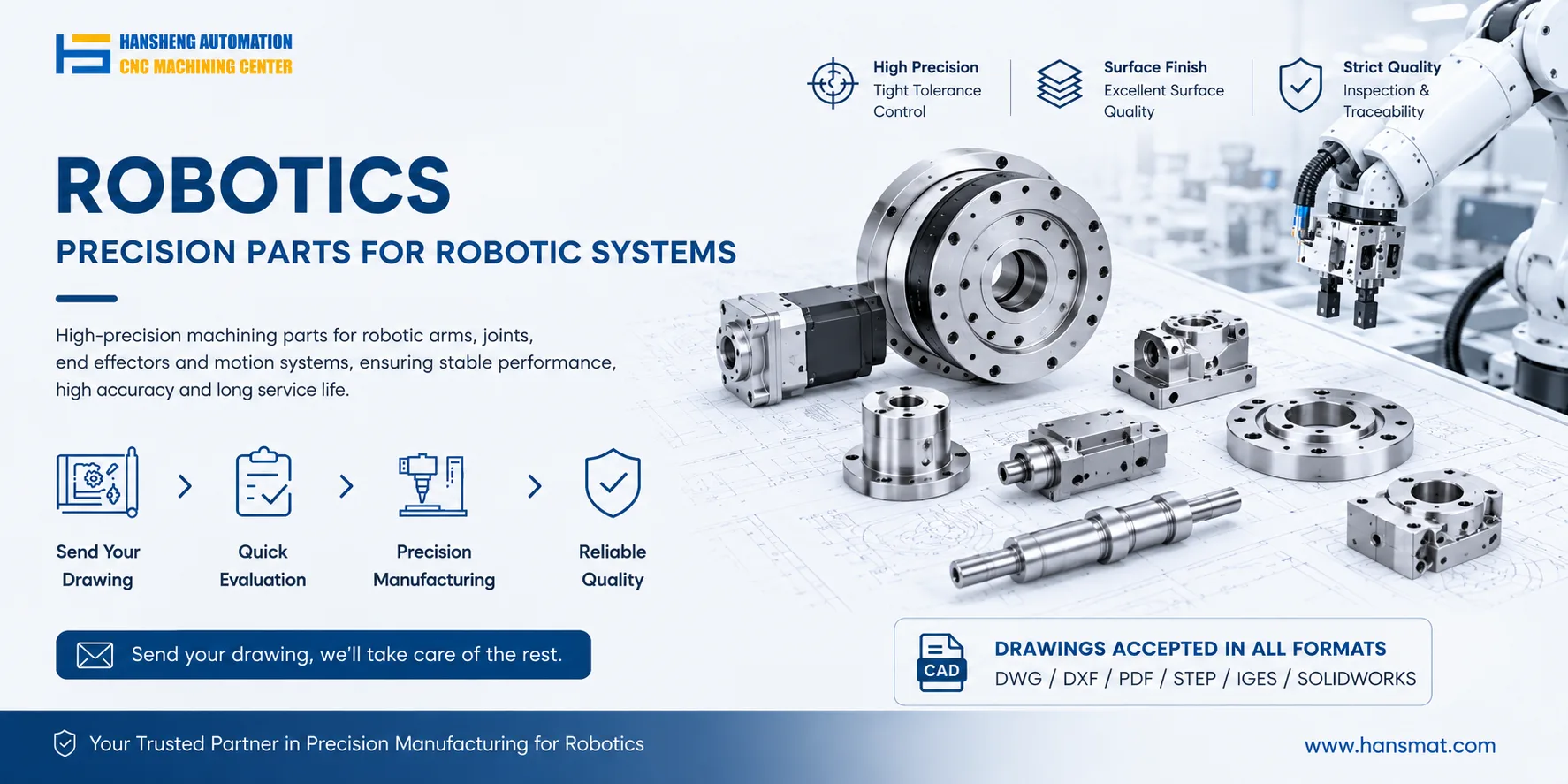
For these precision assembly and fixed-station applications, Hansheng Automation can provide custom machining of non-standard fixtures, adapter plates, and replacement mechanical parts based on customer drawings.
Humanoid robots are more suitable for:
Mobile operation in unstructured environments, such as home services.
Flexible tasks that require cross-platform operation.
Interactive scenarios that need imitation of human movements.
3. Cost-Benefit Analysis
A robotic arm on an automotive production line costs approximately RMB 150,000–300,000 per unit, with a service life of 8–10 years.
A humanoid robot costs over RMB 500,000 per unit, based on the estimated mass production price of Tesla Optimus in 2023, and its maintenance cost is 3–5 times higher.
4. Technical Bottlenecks
The energy consumption of humanoid robot bipedal balance is 12–15 times that of a robotic arm.
The coordinated control response speed of multiple degrees of freedom in humanoid robots is 40–60 ms slower than that of robotic arms.
Existing hydraulic and motor drive systems cannot yet achieve both high strength and high flexibility at the same time.
Under current technical conditions, robotic arms remain irreplaceable in industrial mass production, but humanoid robots have development potential in special fields such as service and disaster relief. The two will maintain a complementary relationship for a long time.