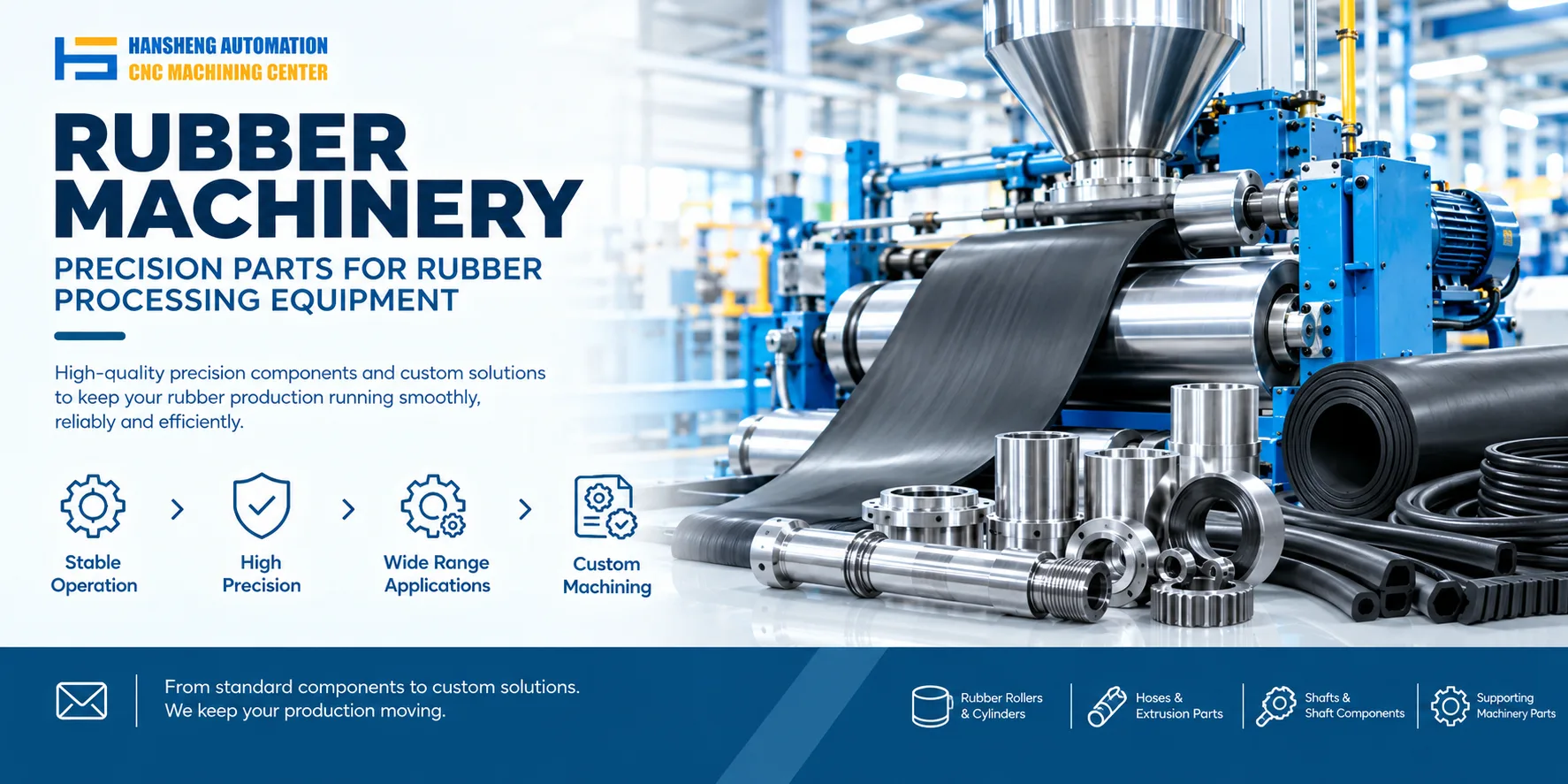
Calendering is a material processing method widely used for rubber, plastics, and certain metal materials. It uses pressure and shear between rotating rolls to bring materials to the required thickness, width, and surface condition. Product quality depends on the equipment structure, roll operation, temperature control, and process settings. Understanding how calendering equipment works helps manufacturers identify problems such as thickness variations, surface defects, and material shrinkage.
Main components of calendering equipment
Rubber calenders are commonly used in calendering processes. A typical machine consists of a frame, rolls, a drive system, a roll gap adjustment mechanism, and heating and cooling systems. These components work together to feed the material, apply pressure, form the product, and control temperature.
Frame
The frame supports the rolls, drive system, and adjustment mechanisms. During calendering, the material exerts substantial reaction forces on the rolls. The frame therefore needs sufficient strength and rigidity to maintain structural stability during operation and limit the effect of deformation on processing accuracy.
Rolls
The rolls come into direct contact with the material and are responsible for forming it. Their condition and accuracy affect product thickness and surface quality. Rolls are commonly manufactured from high quality alloy steel and undergo precision grinding, polishing, and other finishing processes.
Depending on the product requirements and processing method, a calender may use a three roll, four roll, or five roll configuration. The roll arrangement also affects the material path and forming process.
Drive system
The drive system typically consists of a motor, gearbox, and drive shafts. It rotates the rolls and controls their speed and direction.
Adjusting roll speed and direction helps regulate material transport and the operating conditions during calendering. The drive system must maintain appropriate coordination between the material feed rate and roll speed to support stable processing.
Roll gap adjustment mechanism
The roll gap adjustment mechanism changes the clearance between adjacent rolls and allows operators to adjust relevant calendering conditions. The roll gap directly affects material thickness and the degree of compression.
Adjustment may be manual or automatic, depending on the machine design and control system.
Heating and cooling systems
Heating and cooling systems regulate roll temperature to meet the processing requirements of different materials. Common heating methods include electric heating and steam heating, while cooling methods include water cooling and air cooling.
Unstable temperature control can change the plasticization state of the material, affecting product thickness, surface gloss, and forming quality.
How the calendering process works
Calendering uses rotating rolls to apply pressure to a material as it passes through the gap between them. The material gradually reaches the required dimensions and shape through a combination of compression, shear, and stretching.
Compression and shear
When material enters the gap between the rolls, it experiences pressure and shear forces. It deforms as it passes through the gap, reducing in thickness while its internal structure may also change depending on the material and processing conditions.
For polymers such as rubber and plastics, calendering can cause the molecular chains to become oriented to some extent along the processing direction. This orientation can affect the mechanical properties of the finished product.
Stretching and continuous forming
After passing through the roll gap, the material is drawn forward by the rolls and continues through the production line as a sheet or film. Roll speed, gap settings, and feed conditions jointly influence material thickness and elongation.
If these parameters are poorly matched, the finished product may develop thickness variations, uneven edges, or surface defects.
Calendering parameters must therefore be selected according to the material characteristics and product dimensions. Adjusting the roll gap alone may not be sufficient to control the final product quality.
Roll deflection and compensation methods
During calendering, reaction forces from the material can cause the rolls to bend. This deformation is known as roll deflection. Deflection changes the actual gap along the roll length, which can produce thickness differences between the center and the edges of the material.
Equipment designers commonly use roll crowning or roll crossing to compensate for these effects.
Roll crown compensation
This method adjusts the geometric profile of the roll surface to compensate for elastic deformation under load. The profile is designed to help maintain a more uniform effective roll gap when the machine is operating.
The required crown depends on factors such as roll dimensions, applied load, and machine structure. The profile should be determined through engineering analysis rather than by simply grinding the center or ends of the roll to a smaller diameter.
Roll crossing compensation
Roll crossing compensation adjusts the relative angle between the roll axes. This changes the gap distribution along the roll length and can reduce the effect of roll deflection on thickness uniformity.
The available adjustment range depends on the machine structure and processing conditions. Structural and load analyses are required before implementing this method.
The two methods use different approaches to compensate for roll deflection. The appropriate solution depends on the equipment design, processing requirements, and loading conditions during operation.
Effects of calendering on material properties
Calendering changes the material's shape and may also alter its internal structure and physical properties. The extent of these changes depends on the material, temperature, pressure, and calendering speed.
For polymers such as rubber and plastics, calendering can change molecular chain orientation. Some materials may also experience changes in crystallinity, density, or hardness. These changes can affect tensile strength, wear resistance, and other physical properties. However, different materials respond differently, so the results for one material should not be assumed to apply to all materials.
If temperature or calendering conditions are poorly controlled, the material may develop uneven plasticization, inconsistent surface gloss, or dimensional deviations. Roll temperature, speed, and gap settings should therefore be selected according to the material characteristics and finished product requirements.
Shrinkage and dimensional changes after calendering
After leaving the rolls, the material may shrink because of temperature changes, elastic recovery, or changes in its internal structure. As a result, its final dimensions may differ from those measured during calendering.
For products with tight dimensional requirements, this change must be considered during process planning and control.
Composite materials made from rubber and a reinforcing framework also require attention to the bond between the two materials. If the rubber shrinks while the framework undergoes little dimensional change, the difference can create stress between the layers. In severe cases, this may lead to delamination or loss of adhesion.
To reduce these problems, manufacturers need to evaluate shrinkage in relation to the material properties, calendering conditions, and subsequent processing requirements. Appropriate process control helps maintain dimensional accuracy and bonding quality.
Precision component machining for calendering equipment
The operating accuracy of calendering equipment depends not only on process parameters but also on the dimensional accuracy, fit, and manufacturing quality of its components. For equipment maintenance, structural modifications, and nonstandard component requirements, we provide custom machining of precision parts for calenders and rubber machinery based on customer supplied drawings. The machining process is determined by the component structure and drawing specifications.
Hansheng Automation also provides custom precision machining for components used in packaging machinery, tobacco machinery, and food processing equipment, as well as precision structural parts for yachts and remote control racing cars. We manufacture nonstandard parts according to customer drawings to support equipment assembly, replacement, maintenance, and custom manufacturing requirements.