An automated loading and unloading system for a CNC turret punch press combines robotic handling, material transfer equipment, and digital controls to automate sheet metal production. By coordinating material feeding, sheet positioning, punching, and finished part handling, the system can reduce manual intervention and support more consistent production.
The actual improvement in output, labor requirements, and operating costs depends on the punch press, automation configuration, part geometry, and production schedule.
Production efficiency and cost reduction
Continuous operation
An automated loading and unloading system can support extended production runs, including unattended operation when the machine, material supply, and safety controls are configured for it.
The reference figures for the system described in the original material include a loading and unloading cycle of up to 35 seconds, a 30% to 50% increase in punching throughput, daily output of 1,000 to 2,000 parts depending on part complexity, and equipment utilization exceeding 90%.
These figures should be treated as project-specific estimates rather than guaranteed performance. Actual output depends on punching time, tool changes, workpiece handling, material availability, and downtime.
Some systems can also replenish material while the machine continues processing, provided the equipment is designed to support this operating mode. Reducing unnecessary waiting between operations helps improve equipment utilization.
Reduced dependence on manual handling
Automation replaces much of the manual work involved in loading sheets, positioning material, unloading finished parts, and sorting components.
The reference estimate indicates that an automated system can reduce staffing requirements by two to three operators per machine and lower long-term labor costs by more than 50%. It also estimates a maintenance cost reduction of approximately 20%.
These savings depend on the existing production process, shift pattern, labor costs, maintenance requirements, and the amount of manual handling eliminated by the new system.
Positioning accuracy and quality control
Automated sheet positioning
Vision systems from suppliers such as KEYENCE and Cognex, or laser sensors, can be used to detect sheet position and correct alignment errors.
The reference positioning accuracy is ±0.1 mm, with a stated sheet thickness range of 0.5 mm to 6 mm. These values depend on the sensor, robot or handling mechanism, clamping method, sheet condition, and machine configuration.
Vacuum suction cups combined with magnetic sheet separators can help prevent multiple sheets from being picked up together. This is particularly useful when handling thin sheet metal, where stacked sheets can cause feeding errors or machine damage.
Consistent punching quality
The CNC system monitors and controls punching parameters such as force, speed, and stroke, where supported by the machine configuration. Automated handling also reduces dimensional variation caused by inconsistent manual positioning.
Some integrated systems can monitor punch wear and apply compensation when suitable sensing and control functions are available. The original reference specifies a target burr height of no more than 0.05 mm. This value must be validated through tooling specifications and actual process tests because burr formation also depends on punch and die clearance, material properties, and tool condition.
Flexible production and intelligent scheduling
Faster changeovers
Modular fixtures and preset programs can simplify changes between sheet sizes and part configurations.
The reference changeover time is 5 to 10 minutes when switching between sheet sizes such as 1 m × 2 m and 2.5 m × 5 m. Actual changeover time depends on the loading system, tooling arrangement, material storage, and program preparation.
This flexibility is useful for mixed production runs and small-batch customized orders involving electrical enclosures, distribution cabinets, and other nonstandard sheet metal components.
Integration with production management systems
The automation system can connect with manufacturing execution systems (MES) and enterprise resource planning (ERP) software to receive work orders and coordinate production schedules.
When integrated with an automated storage and retrieval system, such as a sheet metal storage tower, the line can supply raw sheets automatically and transfer finished parts for sorting and stacking. These functions reduce manual material handling and help coordinate production across multiple orders.
Safety and operational reliability
Guarding and personnel protection
Automated loading and unloading systems can use enclosed guarding, interlocked access points, safety light curtains, and other protective devices according to the machine layout and risk assessment.
Safety design must meet the requirements applicable to the installation and destination market. EU CE conformity requirements and US Occupational Safety and Health Administration (OSHA) workplace safety requirements are separate regulatory frameworks and should not be treated as interchangeable certifications.
Fault monitoring and diagnostics
The control system can monitor key operating conditions, including pneumatic pressure, vacuum level, and servo motor status. If a monitored parameter falls outside the permitted range, the system can issue an alarm and stop the affected operation where the safety and control design requires it.
This helps operators identify faults before they cause further equipment damage or disrupt production.
Environmental controls
Scrap collection systems, including automatic scrap bins and conveyor belts, can reduce the need for manual scrap removal and help keep the production area organized.
Equipment designed for sheet metal environments may also incorporate protection against oil contamination and other shop-floor conditions. Appropriate inspection and maintenance are still necessary to preserve equipment reliability.
Automation system configuration
Robots and material handling equipment
The loading and unloading mechanism may use a six-axis articulated robot or a gantry manipulator. The appropriate system depends on sheet dimensions, payload, reach, positioning requirements, and the available floor space.
The original reference gives a general handling capacity range of 50 kg to 300 kg. This should be treated as a system selection range rather than a specification for every robot model. For example, ABB IRB 4600 robots have model-dependent payload ratings ranging from 20 kg to 60 kg, so heavier loads require an appropriately rated robot or gantry handling system.
The material handling line may include roller conveyors, belt conveyors, automated guided vehicles (AGVs), sheet leveling machines, and loading tables.
Control system integration
A programmable logic controller (PLC), such as a Siemens or Mitsubishi unit, can coordinate the loading and unloading equipment with the CNC turret punch press.
Communication interfaces and program exchange depend on the controller and machine manufacturer. G-code interaction may be available on supported configurations, but it should not be assumed for every punch press.
Sheet positioning and scrap removal
Vision-based correction combined with mechanical locating features can help establish a consistent sheet reference before punching.
Scrap can be removed through automatic bins or conveyor systems, reducing the need for manual clearing. Depending on the production line, finished parts can be sorted into separate containers or transferred to downstream processes using barcode identification or dimensional inspection.
Typical applications and return on investment
Applications
Automated turret punching is used in sheet metal fabrication, automotive manufacturing, home appliance production, and architectural metal processing.
Typical applications include elevator door panels, electrical cabinet panels, automotive reinforcement parts, battery trays, air conditioner housings, washing machine panels, aluminum curtain wall panels, and stainless steel decorative components.
The suitable automation configuration depends on the workpiece dimensions, material thickness, part complexity, and production volume.
Investment and payback period
The original reference estimates an initial investment of approximately RMB 800,000 to RMB 3 million, depending on the automation level and punch press specifications. This estimate includes robots, conveyors, sensors, and system integration.
The same reference gives estimated annual labor savings of RMB 150,000 to RMB 300,000 per machine and a 2% to 5% reduction in scrap. Under the assumed production conditions, the estimated payback period is 1.5 to 3 years.
For a machine with an annual output value of RMB 5 million, the reference estimates that automation could increase annual output value by 20% to 30%.
These figures are planning estimates, not guaranteed results. A project assessment should include equipment and integration costs, material utilization, actual production hours, maintenance expenses, staffing changes, and the value of additional production capacity. The payback period should be calculated using the expected net operating savings and additional contribution generated by the system.
Custom precision machining for industrial applications
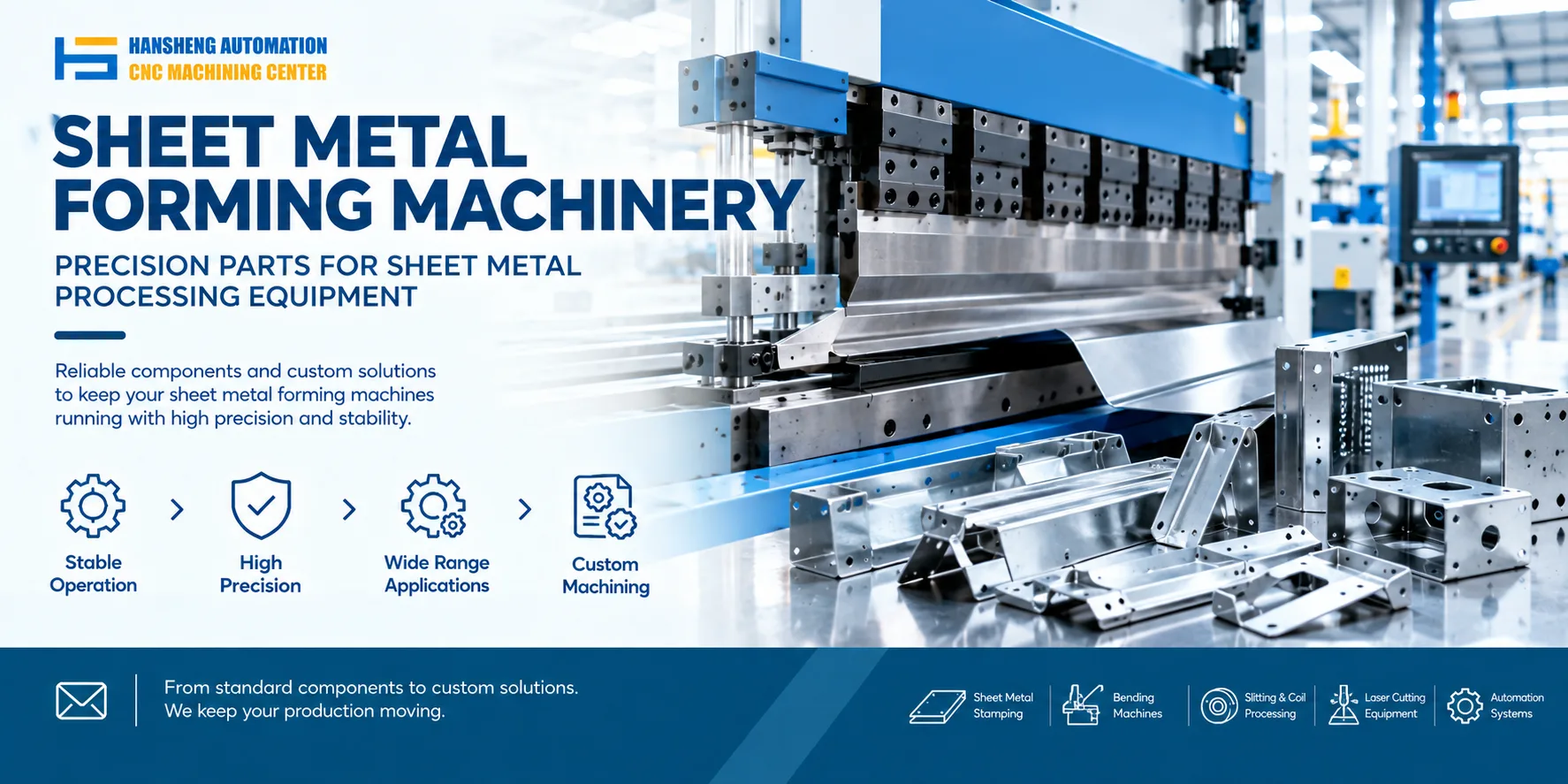
Hansheng Automation provides custom precision machining based on customer drawings for a range of industrial applications. Our work includes precision components for yacht equipment and RC racing cars, as well as nonstandard parts for tobacco packaging machinery and filling machinery. Each component is manufactured according to the supplied drawings and the specific dimensional and structural requirements.