

With the emergence of more and more engineering plastics, corresponding alternatives have emerged in various industries. For example, plastic gears are becoming a low-cost alternative to metal gears. So, can plastic gears really replace metal gears? Hansheng Automation will provide an in-depth understanding of plastic gears from different perspectives in this article.
Plastic Gears vs. Metal Gears
As the two materials have different characteristics, we cannot simply talk about the advantages and disadvantages of plastic gears and metal gears. Instead, we need to make in-depth comparisons at different levels. The ultimate goal is to make the right choice for your application scenario.
| Characteristic / Performance Indicator | Precision Plastic Gears | Metal Gears |
|---|---|---|
| Noise and Vibration | Extremely Low The material itself has high damping characteristics, which can effectively absorb impact and vibration to achieve silent operation. | Relatively High Rigid materials tend to generate noise and vibration during meshing, requiring high-precision machining and lubrication for improvement. |
| Lubrication Requirement | None Most engineering plastics have self-lubricating properties, enabling long-term maintenance-free dry operation. | Necessary Must rely on lubricating oil/grease to reduce wear and heat, with the risk of oil pollution. |
| Weight / Inertia | Extremely Light Density is much lower than that of metal (about 1/7 of steel), which can significantly reduce system weight and rotational inertia. | Heavy High density, resulting in large weight and inertia, increasing energy consumption and structural load. |
| Corrosion Resistance | Excellent Does not rust and can resist corrosion from various chemicals, acids, and alkalis. | Poor Ordinary steel is prone to rust, and although stainless steel can resist corrosion, its cost is high. |
| Impact Load Absorption | Good The material is tough, and the gear teeth can undergo slight elastic deformation to absorb impact energy. | Fair The material is rigid and sensitive to impact loads, prone to gear tooth damage. |
| Load Capacity | Medium to Good Unit strength is lower than that of metal, suitable for medium and low torque transmission applications. | Extremely High Can withstand very high torque and loads, making it the first choice for heavy-duty applications. |
| Operating Temperature Range | Limited Ordinary engineering plastics are usually within -40°C to 120°C. Special plastics like PEEK can reach up to 250°C. | Wide Most metals can maintain stable performance in extreme temperature ranges. |
| Manufacturing Cost (Large Batch) | Low Injection molding efficiency is extremely high, with almost no secondary processing, and the cost advantage in large-scale production is obvious. | High Involves multiple cutting, heat treatment, and grinding processes, resulting in relatively high unit costs. |
In summary: Choose plastic gears for quietness, self-lubrication, lightweight, corrosion resistance, and cost-effectiveness (for large volumes). Choose metal gears for high load capacity, extreme temperature environments, and ultimate transmission precision. There's no true alternative between the two; they're just the right choice for different scenarios.

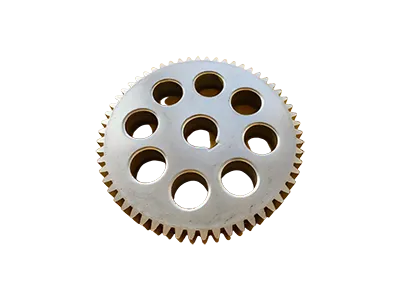
What are the raw materials used for plastic gears?
Plastic, as a general term, encompasses a wide range of materials that can be used to make gears. The properties of the material itself determine the performance of plastic gears. The following are mainstream engineering plastics.
| Material | Key Characteristics | Application Scenarios | Precautions |
|---|---|---|---|
| POM (Polyoxymethylene) | High strength, high rigidity, low friction coefficient and water absorption, dimensionally stable. | Automotive, consumer electronics, etc. | Poor acid resistance, performance degrades under long-term high temperature. |
| Nylon (PA6, PA66) | High toughness, wear resistance and fatigue resistance. Strength and heat resistance can be improved by adding glass fiber (GF). | Used in occasions requiring high impact load and wear resistance, such as power tool transmission. | Strong hygroscopicity, which may lead to changes in dimensions and strength, requiring special consideration in design. |
| PBT (Polybutylene Terephthalate) | Similar to POM, but with better heat resistance and chemical resistance. | Used in fields with heat resistance requirements. | Molding shrinkage rate needs precise control. |
| PEEK (Polyether Ether Ketone) | Extremely high strength, rigidity and heat resistance (continuous use temperature can reach 250°C). | Designed for extreme harsh environments such as aerospace, medical, and semiconductor. | High cost and difficult to process. |
Manufacturing process
The two processes are injection molding and CNC cutting, which are introduced in detail below.
| Comparison Dimension | Precision Injection Molding | CNC Machining |
|---|---|---|
| Basic Principle | Inject molten plastic into a high-precision metal mold cavity under high pressure, and obtain the finished product after cooling and solidification. | Start with a solid plastic rod or sheet, and use computer-programmed cutters to remove material by milling, turning, drilling, etc., until the final gear shape is formed. |
| Application Scenario | Mass production (thousands to millions of pieces) | Product prototype production, functional testing, small-batch production (1 to hundreds of pieces) |
| Cost Structure | High mold cost and large upfront investment, but the higher the production volume, the lower the unit cost. | The unit cost is relatively high. The cost is directly related to the processing time and does not decrease significantly with the increase in production volume. |
| Production Speed and Cycle | The mold manufacturing cycle in the early stage is long (several weeks). Once the mold is completed, the production speed is very fast, and the cycle for a single part is only tens of seconds. | Fast early preparation and delivery. No mold opening is required, and programming and processing can be performed immediately. However, the processing time for a single part is long. |
| Precision Level | Depends on the precision of the mold. A high-precision mold can stably produce parts with good precision (usually up to ISO 7-9 grades). | Can achieve extremely high precision. Controlled directly by precision machine tools, it is easier to achieve higher tolerance grades than injection molding (easily reaching ISO 7 grade or higher). |
| Material Selection | Suitable for most thermoplastic plastics (such as POM, PA, PC). | Suitable for almost all engineering plastics. |
Finally, plastic gears aren't simply a replacement for metal gears; rather, they're becoming an attractive option for a growing number of applications thanks to their inherent properties. Both have their advantages and disadvantages. If you have product requirements or design ideas, please contact us to discuss your needs directly with our engineers.