The dry granulation tableting process offers significant advantages in pharmaceutical and industrial production. Under normal circumstances, dry granulation does not require the addition of binders to directly transform dry powders into granules. This process not only significantly increases the bulk density of the materials and improves their appearance and flowability, but also allows precise control over the disintegration profile of the finished product, thereby facilitating subsequent storage and transportation. Compared to traditional wet granulation, dry granulation eliminates multiple complex steps, offering obvious benefits in energy conservation and pollution reduction. Furthermore, the extrusion process provides a certain sterilizing effect, and its granulating and protective benefits are particularly pronounced for drugs or sensitive materials that are unstable under hot and humid conditions.
In terms of application scope, dry granulation is highly suitable for processing materials containing crystalline water, traditional Chinese medicine (TCM) extracts, and raw materials with a certain moisture content (typically around 3% to 8%). However, some special materials such as flour, carbon black, graphite, or untreated pure TCM powders are difficult to granulate directly without adding appropriate excipients. Additionally, the fineness of the raw powder significantly affects the granulation results: a powder fineness of around 80 to 300 mesh is optimal; excessively coarse powder leads to poor granule uniformity, while excessively fine powder increases the difficulty of feeding and compacting, which directly impacts the final granule yield.
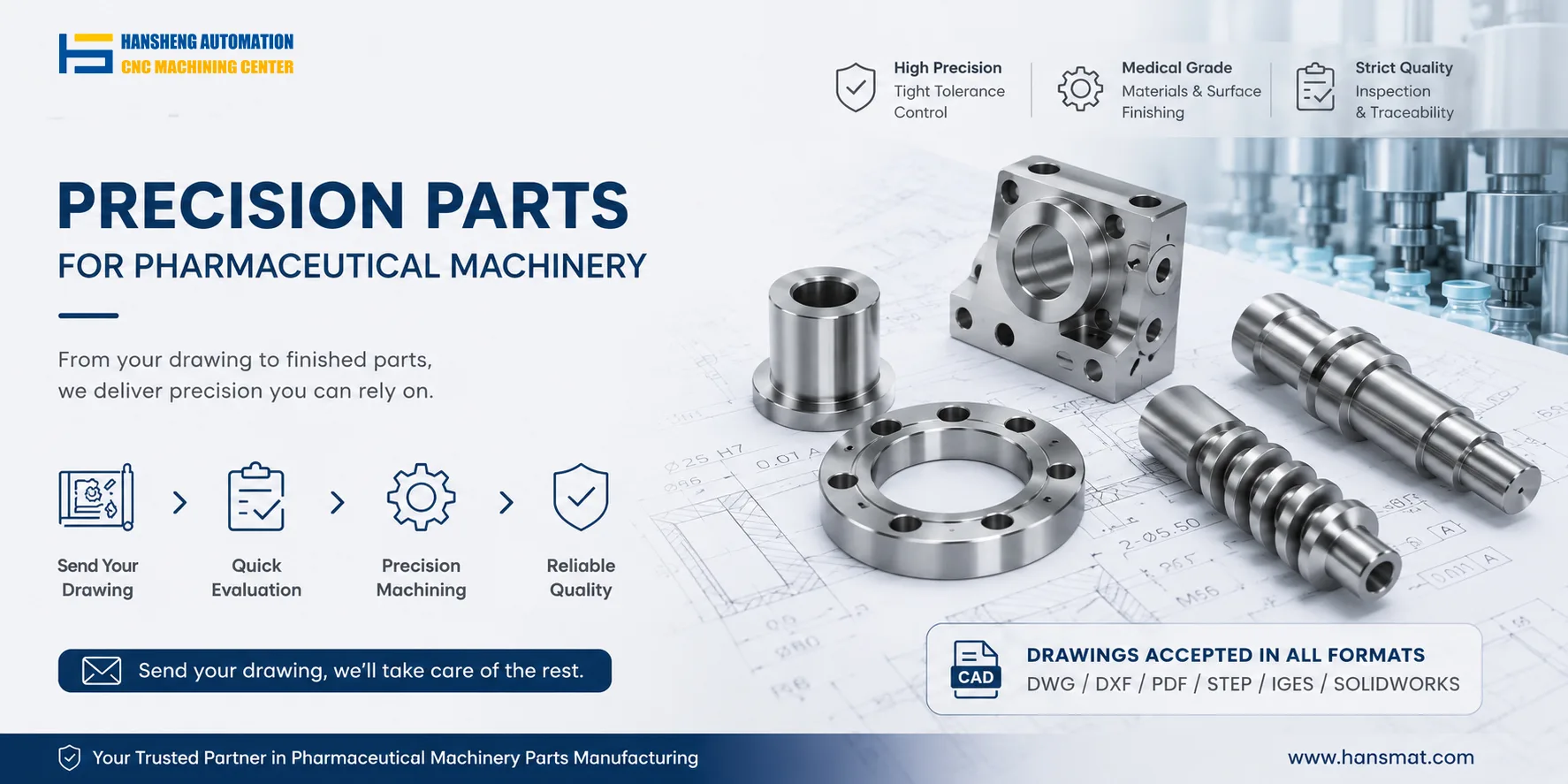
Hansheng Automation supports the precise manufacturing of non-standard components based on client drawings. We provide high-standard custom precision machining services for core components that are highly susceptible to wear in the dry granulation process, such as rollers, feeding screws, and sizing blades. Since processing raw materials of different mesh sizes (such as 80 to 300 mesh) demands extremely tight fit tolerances for feeding screws and high slip resistance for roller surfaces, we strictly control the machining tolerances and surface treatment quality of our components. This effectively helps clients address processing bottlenecks such as feeding difficulties and uneven granules, thereby improving the yield of difficult-to-granulate materials.