

On April 27th, the Beijing Humanoid Robot Innovation Center released the world's first fully sized humanoid robot, "Tiangong," which is purely electric driven and can run steadily at a speed of 6 kilometers per hour in the Beijing Economic and Technological Development Zone. This is also its independently developed universal humanoid robot mother platform, which can be open to the industry for use.
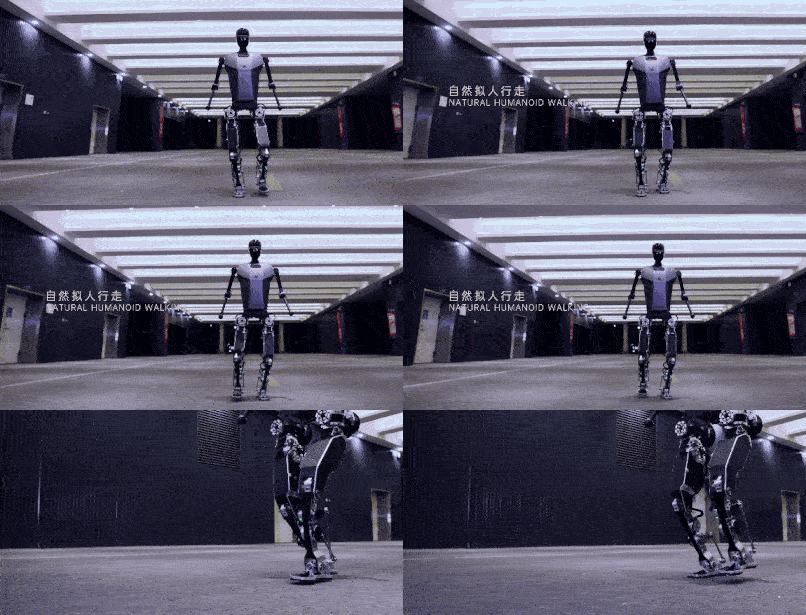
"Tiangong" stands at 163cm tall and weighs a lightweight weight of 43kg; The robot is equipped with multiple visual perception sensors, with a computing power of 550 trillion operations per second, and is equipped with high-precision inertial measurement units (IMUs) and 3D vision sensors. And it has solved basic motion control problems, making it the best platform for the application and research of embodied intelligence scenarios. In addition, Tiangong is equipped with high-precision six dimensional force sensors to provide precise force feedback.

According to the Beijing Humanoid Robot Innovation Center, "Tiangong" has open source openness and compatibility scalability, which can achieve open call communication interfaces, flexibly expand software, hardware and other functional modules, and fully meet the needs of different application scenarios; At the same time, "Tiangong" adopted its independently developed new humanoid robot motion skill learning method - "predictive reinforcement imitation learning based on state memory", achieving the world's first fully electric driven humanoid robot to simulate humanoid running. Prove the compatibility and good adaptability of the ontology hardware mother platform to existing motion control algorithms. This method not only solves the problem of poor positioning accuracy caused by reinforcement learning, but also solves the problem of poor adaptability to unstructured environments in model predictive control methods, achieving more robust, anthropomorphic, and generalized effects, which can further promote large-scale commercial applications.

At the press conference, "Tiangong" also brought a wonderful "performance" to the on-site audience, demonstrating its stronger adaptability to complex environments, faster and more anthropomorphic walking and running, and achieving a stable running speed of 6km/h. At the same time, under blind vision, "Tiangong" can smoothly pass through slopes and stairs, and can also achieve agile adjustment of gait in situations such as stumbling and missing steps. This fully demonstrates the strong adaptability of motion control methods to various terrains, and the subsequent development of perception based gait will bring stronger passability.
The Future Innovation Center will continue to iterate the "Tiangong" humanoid robot universal platform and explore the "universal embodied intelligence platform". The primary goal of the Innovation Center in the future is to build the largest scale, most information dense, and most universal high-quality embodied intelligence dataset for humanoid robots based on various configurations of robots, including the "Tiangong" mother platform. And based on this dataset, continuously train and iterate the humanoid robot embodied large model. By combining the "Tiangong" platform with large models, the planning ability for long-range tasks and the generalization ability for multi scenario and complex tasks can be achieved. The hardware and software mother platforms complement each other, ultimately converging into the best platform for embodied intelligence. And with humanoid robots as the highest and most complex robot platform technology, it is backward compatible with various configurations of robots, achieving universal embodied intelligence.