

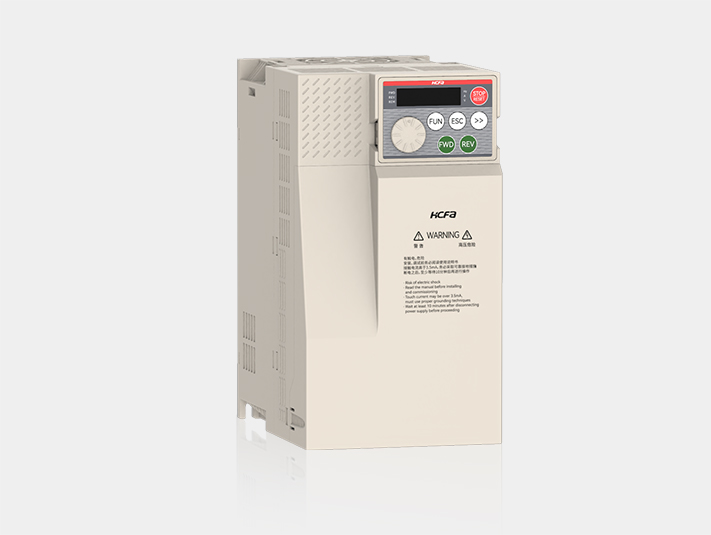
A frequency converter is a power control device that uses frequency conversion technology and microelectronics technology to control AC motors by changing the operating power frequency of the motor. The frequency converter relies on internal IGBT to adjust the voltage and frequency of the output power supply, providing the required power supply voltage according to the actual needs of the motor, achieving the goal of energy-saving speed regulation.
In addition, the frequency converter also has various protection functions such as overcurrent, overvoltage, and overload protection. With the continuous improvement of industrial automation, frequency converters have also been widely used.
The frequency converter is mainly composed of rectification (AC/DC), filtering, inverter (DC/AC), braking unit, driving unit, detection unit, microprocessor unit, etc.
1. Rectifier
The rectification circuit of a universal frequency converter consists of a three-phase bridge rectifier bridge. Its function is to rectify the power frequency and provide the required DC power for the inverter circuit and control circuit. Recently, the widely used converter is the diode converter, which converts the power frequency power supply into a DC power supply. Two sets of transistor inverters can also be used to form a reversible inverter, which can perform regenerative operation due to its reversible power direction.
2. Flat wave circuit
In the DC voltage rectified by the rectifier, there is a pulsating voltage with a frequency six times that of the power supply. In addition, the pulsating current generated by the inverter also causes fluctuations in the DC voltage. To suppress voltage fluctuations, inductors and capacitors are used to absorb pulsating voltage (current). When the device capacity is small, if there is excess capacity in the components of the power supply and main circuit, a simple smoothing circuit can be used instead of an inductor.
3. Inverter
Unlike rectifiers, inverters convert DC power into AC power of the required frequency, and by turning on and off six switching devices at a determined time, three-phase AC output can be obtained. The function of the inverter circuit is to convert the DC power output from the DC circuit into an adjustable AC power under the control of the control circuit. The output of the inverter circuit is the output of the frequency converter, so the inverter circuit is one of the core circuits of the frequency converter and plays a very important role.
4. Main circuit and control circuit
The main circuit is the power conversion part that provides voltage and frequency regulation power to asynchronous motors. The main circuit of a frequency converter can be roughly divided into two categories: voltage type is a frequency converter that converts the DC voltage source into AC, and the filtering of the DC circuit is a capacitor. Current type is a frequency converter that converts the DC of a current source into AC, and its DC circuit filter is an inductor.
The control circuit is a circuit that provides control signals to the main circuit that supplies power (adjustable voltage and frequency) to asynchronous motors. It consists of a frequency and voltage "calculation circuit", a main circuit "voltage and current detection circuit", a motor "speed detection circuit", a "drive circuit" that amplifies the control signals of the calculation circuit, and an inverter and motor "protection circuit".